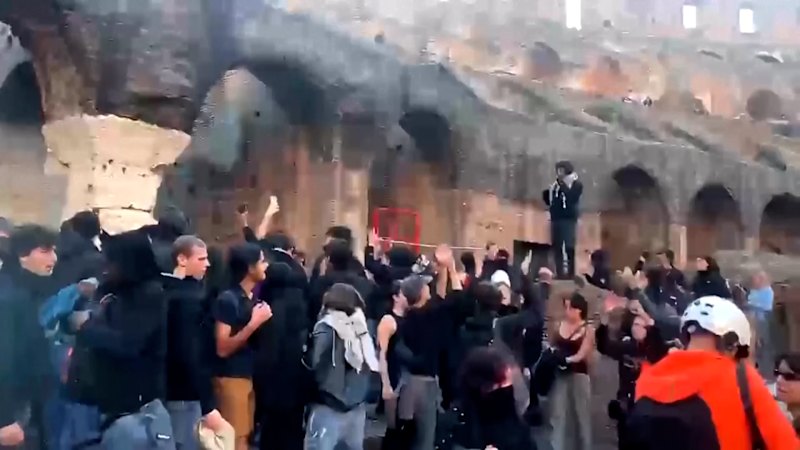
When protesters breach the perimeter of Rome’s Colosseum, the headlines treat it as a sudden, shocking anomaly. It isn't. The breach of Italy’s most famous ancient amphitheater is the inevitable symptom of a structural collision between open-access cultural tourism and modern asymmetric protest tactics. While authorities scramble to issue fines and repair superficial damage, the underlying vulnerabilities that allow activists to scale two-thousand-year-old travertine walls or dye historic fountains remain largely unaddressed, leaving global heritage sites trapped between preserving public access and militarizing human history.
To understand how an activist with a backpack, a banner, or a bottle of vegetable-based dye can bypass security at one of the most heavily policed monuments in Europe, you have to look at the physical reality of the site. The Colosseum was not built to keep people out. Emperor Vespasian designed the Flavian Amphitheatre to funnel fifty thousand spectators inside through eighty numbered entrances in under fifteen minutes. Modern crowd management relies on that exact same ancient architecture to process millions of tourists every year.
The Architecture of Vulnerability
Security at a living archaeological site operates under constraints that would make a corporate security director quit on the first day. You cannot bolt steel turnstiles into first-century stone. You cannot string razor wire across arches that appear on millions of postcards. Every physical barrier introduced to stop a bad actor degrades the visual and historical integrity that brings paying visitors through the gates in the first place.
The current security apparatus relies on a patchwork of private contractors, municipal police, and military personnel stationed under Italy's Strade Sicure (Safe Streets) initiative. On paper, the presence looks formidable. Armed soldiers stand near the Arch of Constantine. Bag scanners hum at the main tourist entrances.
Yet these measures are calibrated for a specific, twentieth-century threat profile: concealed weapons, explosive devices, and standard crowd control. They are fundamentally ill-equipped to stop a coordinated group of non-violent activists who buy regular admission tickets, wait until they are inside the labyrinthine corridors, and then deploy banners or stage sit-ins. When protesters breach the Colosseum, they rarely storm the gates like an invading army. They walk in through the front door just like everyone else.
The Ticketed Trojan Horse
Once inside the perimeter, the sheer scale of the monument works against the guards. The Colosseum covers roughly six acres, rising four stories high with a complex network of vaulted passages, staircases, and exterior ledges. A guard stationed on the second tier cannot see what is happening ten yards away around a curved ambulatory.
Protesters exploit these blind spots with precision. By the time a security officer spots someone climbing over a waist-high brass railing to reach an exterior ledge, the activist has already secured a climbing harness or unfurled a banner. At that point, the dynamic shifts entirely. Security personnel can no longer simply grab the individual; doing so risks a fatal fall onto the cobblestones below. The guard becomes a hostage to safety protocols, forced to wait for specialized fire brigade rope teams while cameras roll.
Why Monuments Became the Ultimate Stage
For decades, political demonstrators marched down avenues, gathered in piazzas, or blockaded government ministries. Those tactics eventually hit a wall of diminishing returns. A march of ten thousand people in central Rome might earn a thirty-second segment on the evening news, easily ignored by commuters and politicians alike.
Environmental groups like Ultima Generazione (Last Generation) and Extinction Rebellion realized that disrupting daily traffic alienated the public without guaranteeing international media coverage. Targeting irreplaceable cultural heritage changed the math overnight.
When activists scale the Colosseum, glue themselves to a Botticelli painting in Florence, or pour charcoal liquid into the Trevi Fountain, they hijack a global brand. The monument itself does the heavy lifting for their media strategy. News outlets from Tokyo to New York will run the photograph not because they care deeply about the specific policy demand on the banner, but because the visual contrast between ancient permanence and modern disruption is irresistible to editors.
Asymmetric attention warfare relies on minimal resources to generate maximum global visibility. Three people with a train ticket and a banner can dominate the European news cycle for forty-eight hours. Compared to the cost of buying traditional advertising or organizing a massive logistical rally, breaching a landmark offers an unmatched return on investment.
The Economics of Open Access
Critics inevitably ask why the Italian Ministry of Culture does not simply lock down the site more aggressively. The answer lies in the brutal economics of heritage management.
The Archaeological Park of the Colosseum is the financial engine of Italy’s cultural sector. Generating tens of millions of euros annually in ticket sales, it subsidizes dozens of lesser-known, unprofitable museums and excavation sites across the country. Anything that slows down the throughput of visitors threatens that revenue stream.
Consider the math of a typical peak-season day:
- Daily Footfall: Up to 20,000 visitors pass through the gates during summer months.
- Screening Bottlenecks: Adding just fifteen seconds per person for secondary bag inspections creates hours of backlog in the Roman heat.
- Refund Liabilities: Tour operators demand compensation when timed-entry slots collapse due to security lockdowns.
If authorities implement airport-style screening—requiring visitors to empty pockets, remove belts, and undergo full-body pat-downs—the line would stretch past the Roman Forum and paralyze the city center. Worse, it would turn a transcendent cultural experience into an administrative ordeal. Administrators know that tourists tolerate a certain level of friction, but pushing it too far drives visitors away and invites fierce backlash from Rome’s powerful hospitality lobby.
The Legal Counterattack and Its Limits
Facing relentless pressure from the public and the press, the Italian government responded with legislative force. In early 2024, Parliament passed sweeping legislation dramatically increasing penalties for anyone who defaces, damages, or disrupts cultural monuments. Under the new rules, fines for eco-vandals and protesters can reach up to 60,000 euros, accompanied by potential prison sentences and immediate asset seizures to pay for restoration work.
Lawmakers framed the bill as a decisive deterrent. In practice, punitive fines rarely stop ideologically driven activists.
Many individuals participating in high-profile monument breaches are students, retirees, or full-time organizers with few seizable assets. Receiving a 40,000-euro administrative fine becomes a badge of honor rather than a financial death sentence—a rallying cry used to raise legal defense funds online. Furthermore, Italian courts move notoriously slowly. Years pass between the arrest at the Colosseum and a final appellate ruling, stripping the punishment of the immediate psychological impact needed to deter the next wave of demonstrators.
There is also a crucial legal distinction that complicates prosecution. Protesters have grown increasingly savvy about avoiding permanent physical damage. Instead of spray paint, they use water-soluble charcoal, washable chalk, or non-toxic vegetable dyes. When a monument is merely occupied or temporarily stained without structural harm, prosecutors struggle to apply the harshest felony statutes meant for actual vandalism. Defense attorneys argue their clients are exercising constitutionally protected rights to peaceful assembly and free expression, forcing judges into a delicate balancing act.
The Copycat Contagion
The danger of a Colosseum breach extends far beyond the stones of Rome. Cultural institutions across Europe operate as an interconnected ecosystem, sharing intelligence and watching how peers handle crises. When a breach succeeds in Italy, security directors at the Louvre in Paris, the Prado in Madrid, and the British Museum in London immediately go on high alert.
The tactics migrate rapidly. A banner drop at the Colosseum inspires a similar stunt at the Brandenburg Gate. A sit-in inside the Vatican Museums prompts tighter restrictions at the Acropolis in Athens. Each incident forces institutions to divert scarce conservation funds toward surveillance cameras, additional guards, and protective glass barriers.
The Hidden Cost to Conservation
Every euro spent on reactive security is a euro stolen from preservation. Ancient monuments are constantly losing a slow-motion war against gravity, pollution, and foot traffic. The travertine stone of the Colosseum is porous and fragile, requiring continuous micro-injections of mortar, laser cleaning, and structural monitoring.
When protesters climb onto restricted cornices or anchor ropes around ancient columns, they apply lateral forces those stones were never meant to bear. Even if no visible chunk of rock breaks off during the incident, micro-fractures can form, allowing rainwater to penetrate deeper into the masonry. Come winter, freeze-thaw cycles expand that water, accelerating decay years after the news cameras have packed up and left.
What Real Security Would Actually Require
Fixing the vulnerability of iconic monuments requires abandoning the fantasy that minor tweaks to guard schedules will solve the problem. True protection demands structural changes to how the public interacts with ancient spaces, and every viable option carries a heavy political or experiential cost.
- Eliminating Unescorted Roaming: Shifting from open-access wandering to mandatory, small-group guided corridors would allow staff to maintain visual contact with every visitor at all times. However, this would slash daily capacity by more than half, gutting ticket revenues and sparking outrage among independent travelers.
- Pre-Perimeter Buffer Zones: Pushing security screening hundreds of yards away from the monument itself—similar to the perimeter established around the White House or major Olympic venues—would prevent activists from reaching the structure easily. In a dense, historic city like Rome, closing off surrounding avenues permanently would trigger traffic gridlock and bankrupt nearby businesses.
- Behavioral AI Surveillance: Deploying advanced computer vision software capable of flagging anomalous movements—such as someone crouching near a barrier, reaching into a bag for an extended period, or separating from the normal flow of foot traffic—could give guards a critical thirty-second head start. Yet widespread biometric and behavioral tracking in public spaces collides directly with strict European Union privacy regulations under the GDPR.
None of these solutions is clean. Each forces society to choose which value matters more: frictionless public access to shared human heritage, strict privacy rights, or the absolute physical security of irreplaceable artifacts.
The Uncomfortable Reality of Living History
For two millennia, the Colosseum has survived earthquakes, fires, medieval stone-quarrying, and Allied bombing runs during World War II. It endures precisely because it remains central to public life rather than sealed inside a climate-controlled vault.
That vitality is also its greatest weakness. As long as the amphitheater stands open to the world as a symbol of human achievement and civic gathering, people with grievances will try to claim its spotlight. Authorities can raise the fines, hire more guards, and install higher railings, yet the fundamental vulnerability remains built into the stone itself. Until governments decide whether monuments are sacred vaults to be guarded like nuclear facilities or public squares to be shared with all the risks that entails, the breaches will keep happening.