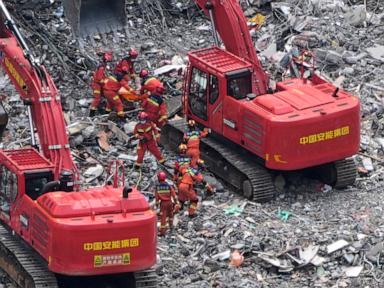
Forty-one lives vanished under a mountain of mud and stone in Chongqing, southwestern China, during a catastrophic landslide that exposed deep vulnerabilities in regional disaster management. Weeks of relentless summer downpours triggered the slope failure, burying residential structures and trapping dozens before emergency crews could reach the isolated terrain. Yet, reducing this tragedy solely to an act of nature ignores decades of rapid urbanization, altered hydrology, and systemic oversight. When mountainsides give way under seasonal monsoons, reporters often point to the heavens. They blame the rain. They rarely blame the blueprints.
Weather events are merely the trigger. The loaded gun is constructed long before the first drops fall. Across the mountainous topography of southwestern China, economic expansion demands land. Steeper slopes are cleared, natural drainage channels are altered, and weight is added to unstable geologies through heavy construction. When the regional soil reaches its saturation threshold, gravity finishes the math.
The Anatomy of a Slope Failure
Geotechnical engineering teaches a straightforward lesson. Water adds weight to soil while simultaneously reducing the frictional forces holding particles together. Add excessive groundwater pressure from blocked natural springs, and a hillside transforms from a stable foundation into a liquid conveyor belt.
Chongqing features a notoriously complex geography. Built across steep hills and river gorges, the municipality faces perpetual challenges regarding space. Planners face immense pressure to carve out flat plots for housing complexes, roads, and industrial zones. This process, known locally as slope cutting, involves slicing into the base of a hill to create a level bench for building.
When you remove the toe of a slope, you remove its primary support. Engineers attempt to compensate through concrete retaining walls, drainage pipes, and anchor bolts. However, standard municipal infrastructure struggles to keep pace with hyper-accelerated construction cycles. Maintenance schedules slip. Inspection reports sit in municipal filing cabinets while seasonal rainfall totals break historical records.
When Mitigation Fails the Reality Test
Official disaster response protocols sound impressive on paper. Early warning systems, sensor networks, and evacuation triggers are standard components of modern municipal planning. But sensors only work if they are placed in the right spots, maintained properly, and connected to decision-makers who possess the authority to order immediate evacuations before disaster strikes.
Residents often hesitate to leave their homes based on probabilistic warnings. Moving thousands of people carries economic costs and social disruption. Local officials face intense career pressure to avoid false alarms that halt commerce and displace communities unnecessarily. This administrative hesitation creates a dangerous window of delay. By the time a slope begins to shift visibly, the velocity of the earth leaves seconds for reaction, rendering early warning systems completely useless.
Insurance markets and municipal risk models frequently underestimate cumulative vulnerabilities. They calculate risk based on historical rainfall averages from decades past. Those averages no longer exist. Shifting climate patterns deliver extreme precipitation events in compressed timeframes, overwhelming drainage systems designed for slower, steadier storms.
The Human Cost of Rapid Growth
Statistics flatten human tragedy into tidy rows on a spreadsheet. Forty-one fatalities mean forty-one empty chairs, shattered families, and communities left searching for accountability. The neighborhoods affected by the Chongqing disaster were not wealthy enclaves with state-of-the-art geo-protection. They were working-class communities situated where land was available and affordable.
Infrastructure disparity remains a defining characteristic of disaster vulnerability worldwide. Wealthy districts invest heavily in deep soil anchoring, micro-pile reinforcement, and real-time subsurface monitoring. Marginalized zones rely on passive defense mechanisms and hope. When the mountain moves, that hope evaporates instantly.
Transparency during rescue and recovery operations has improved compared to previous decades, but structural accountability remains difficult to secure. Investigations into municipal oversight often stall out in bureaucratic reviews. Blame gets assigned to extreme weather anomalies, insulating municipal planners and developers from civil or criminal liability.
Shifting From Reaction to Prevention
Engineering solutions exist. They are expensive, politically unpopular, and slow. True slope stabilization requires large-scale reforestation of vulnerable hillsides, strict enforcement of building moratoria in high-hazard zones, and the relocation of communities residing in active landslide paths.
Instead, municipal authorities often default to post-disaster remediation. They clear the debris, repair the road, reinforce the immediate failure site, and wait for the next heavy rain season. This cycle repeats across mountainous regions globally. Until governments prioritize long-term ecological preservation over short-term real estate expansion, the death toll will continue to climb.
The mountain does not negotiate. It does not care about economic five-year plans or municipal budget constraints. It simply obeys the laws of physics, waiting quietly for the next heavy downpour to remind human settlements of their temporary standing upon the earth.


