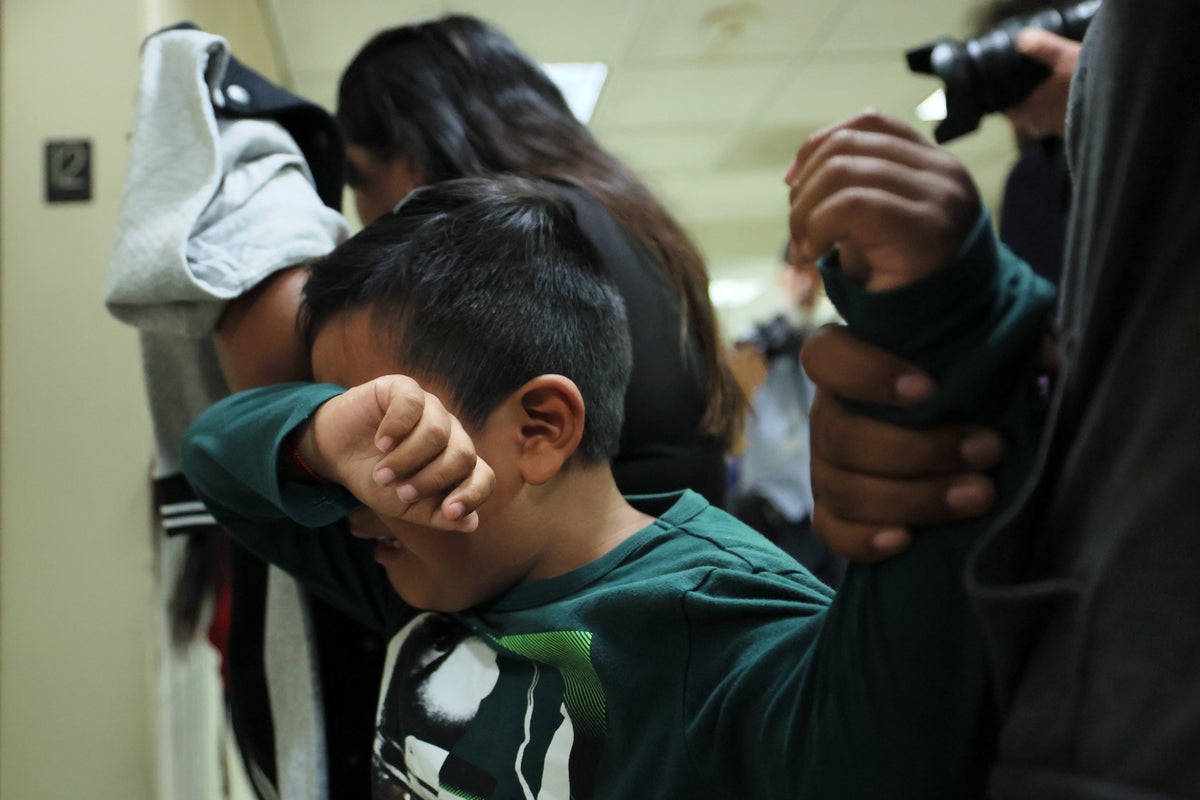
More than half of the children currently facing deportation in U.S. immigration courts are forced to navigate the dizzying legal maze entirely alone, according to Department of Justice data. Unlike the criminal justice system, the federal government is under no obligation to provide public defenders to minors in civil immigration proceedings. The result is a system where children, some barely old enough to read, must argue their own cases against seasoned government prosecutors. This administrative crisis stems from a deliberate statutory distinction between civil and criminal law, paired with a chronic shortage of pro bono counsel capable of absorbing the massive influx of juvenile cases.
The Fiction of the Civil Criminal Divide
The American legal framework operates on a foundational premise that treats immigration violations as civil infractions rather than criminal offenses. Under the Sixth Amendment, anyone accused of a crime who cannot afford an attorney is entitled to a court-appointed public defender.
Immigration court, however, falls under the jurisdiction of the Executive Office for Immigration Review, an agency of the Department of Justice. Because these are civil removal proceedings, the statutory right to counsel at government expense does not apply.
Section 292 of the Immigration and Nationality Act explicitly states that individuals in removal proceedings shall have the privilege of being represented by counsel of their choice, but at no expense to the government. This single clause creates a massive disparity.
[Criminal Court] ------------> Sixth Amendment Right ------------> Government-Funded Attorney
[Immigration Court] ---------> Civil Statute (Section 292) -----> Privately Retained or Pro Bono Only
When applied to adults, this framework is heavily criticized. When applied to children, it creates absurd court scenarios.
Federal immigration judges are routinely forced by the constraints of the law to conduct hearings with unrepresented minors. In these hearings, the judge must ask the child if they understand the charges against them, which usually involve complex statutory violations like entering the country without inspection under Section 212 of the Immigration and Nationality Act.
A six-year-old child cannot comprehend what it means to concede removability. Yet, without an attorney to interject, the child’s confused responses are entered into the official record, frequently sealing their deportation order before they even have a chance to explain why they fled their home country.
The Reality of the Courtroom Assembly Line
The physical reality of an unrepresented child in immigration court exposes the deep flaws in the administrative state. The courtroom is not modified for children.
The chairs are often too high for their feet to touch the floor. On the other side of the room sits a Department of Homeland Security trial attorney whose sole directive is to uphold the immigration laws of the United States, which means securing a removal order.
The burden of proof in these proceedings is heavily stacked against the migrant. Once the government establishes that the individual is not a citizen and lacks immediate legal status, the burden shifts entirely to the respondent to prove they qualify for a form of relief, such as asylum, Special Immigrant Juvenile Status, or a T visa for trafficking victims.
Navigating any of these relief pathways requires meticulous documentation. An asylum applicant must prove a well-founded fear of persecution based on race, religion, nationality, membership in a particular social group, or political opinion. They must submit a formal Form I-589, written entirely in English, accompanied by supporting country condition reports and corroborating evidence.
Consider a hypothetical example of a ten-year-old boy who fled gang violence in Central America. Without an attorney, he does not know that he needs to gather police reports from a municipality that may not keep them, or secure medical records detailing past physical assaults. He does not know how to articulate that the gang targeted him because of his familial ties, a nuance that could establish his membership in a "particular social group" under immigration law. When the judge asks him why he came to the United States, he might simply say he wanted to be with his mother or that he was scared. Under current jurisprudence, generalized fear of violence is rarely enough to secure asylum. Without a lawyer to frame the facts within the rigid parameters of federal immigration law, his narrative is legally insufficient, and the judge has little statutory choice but to order him deported.
Why Pro Bono Networks Are Collapsing
For decades, the federal government has relied on a patchwork network of non-profit organizations, legal aid clinics, and pro bono corporate attorneys to fill the representation gap. This reliance has reached its absolute breaking point.
The sheer volume of arriving minors has completely overwhelmed the capacity of these organizations. Legal aid groups are chronically underfunded, relying on fluctuating federal grants and private donations that fail to keep pace with the growing docket.
Furthermore, immigration law is notoriously complex, often compared by federal judges to the Internal Revenue Code in its density and lack of clarity. A corporate attorney or a family lawyer cannot simply step into an immigration courtroom and effectively defend a child without hundreds of hours of specialized training.
The stakes are incredibly high. A mistake in a tax filing results in a fine; a mistake in an asylum case can result in a child being sent back to a environment where they face immediate physical danger.
The geographic distribution of legal resources exacerbates the crisis. While major metropolitan areas like New York or Los Angeles have robust non-profit legal networks, many immigration courts are located near the southern border or in rural areas where detention facilities are placed. In these jurisdictions, the ratio of available immigration attorneys to unrepresented children is staggeringly low. A child placed in a shelter in a rural town may never see a lawyer before their first master calendar hearing, effectively guaranteeing they will proceed through the initial, critical stages of their case entirely alone.
The Backlog Stifling Due Process
The Executive Office for Immigration Review is currently drowning in millions of pending cases. This massive backlog puts immense pressure on immigration judges to clear their dockets quickly.
Judges are evaluated on performance metrics that track how efficiently they close cases. This bureaucratic pressure creates an environment where requests for continuances—which attorneys use to gather evidence or wait for U.S. Citizenship and Immigration Services to process underlying visa petitions—are increasingly denied.
When an unrepresented child appears in court, a sympathetic judge may grant one or two continuances to allow the child to find a lawyer. But as the months tick by and the pro bono queues remain jammed, the judge’s patience runs out under the weight of administrative quotas. The case is pushed forward. The child is forced to speak for themselves, and the assembly line of deportation continues to move.
The Cost of Publicly Funded Counsel
The most obvious solution to this systemic failure is to mandate government-funded legal counsel for all indigent minors in immigration court. Proponents argue this would not only protect the constitutional principles of due process but would also streamline the court system itself.
An attorney can quickly identify whether a child qualifies for relief, file the correct paperwork without errors, and prevent the endless delays caused by judges having to explain basic legal concepts to a confused child.
However, the political and financial arguments against universal representation are deeply entrenched. Implementing a federal public defender system for immigration courts would require significant taxpayer funding and a massive expansion of the Department of Justice’s budget. Critics argue that providing free lawyers to minors would create a powerful pull factor, encouraging more families to send unaccompanied children across the border under the assumption that they will receive government-funded legal assistance to secure status.
There is also the logistical nightmare of scaling such a system. The United States is already facing a severe shortage of public defenders in the criminal justice system. Finding, training, and retaining thousands of specialized immigration attorneys willing to work for government wages in high-stress environments is an immense hurdle.
Even if the political will existed to pass such legislation through a fractured Congress, the infrastructure required to support it would take years to build, leaving hundreds of thousands of children in legal limbo in the interim.
The Failed Reforms and Temporary Band-Aids
Over the years, various administrations have attempted to address the unrepresented minor crisis through piecemeal programs rather than systemic overhauls. The Department of Justice has previously launched initiatives like the Justice AmeriCorps program, which funded a small number of lawyers and paralegals to represent unaccompanied minors. While these programs provided vital assistance to a few thousand children, they were ultimately drop-in-the-bucket solutions that failed to alter the broader statistical reality.
Other attempts have focused on changing court procedures rather than providing actual lawyers. The Executive Office for Immigration Review has issued guidelines encouraging judges to use "child-friendly" courtroom techniques, such as allowing children to bring a toy to the stand or permitting a guardian to sit near them.
While these measures may lower the emotional trauma of the experience, they do absolutely nothing to solve the underlying legal deficit. A child comforted by a stuffed animal is still an eight-year-old child trying to cross-examine a federal prosecutor on the nuances of international human rights law.
The problem is further complicated by the jurisdictional split between agencies. The Department of Health and Human Services’ Office of Refugee Resettlement holds custody of unaccompanied children when they first arrive, while the Department of Homeland Security handles their enforcement and processing, and the Department of Justice runs the courts. This fractured bureaucracy ensures that tracking a child's legal needs as they move from federal custody to sponsors across the country is an administrative nightmare, with thousands of minors falling through the cracks every year.
The Inevitable Verdict of the Current System
The current setup ensures that the outcome of a child’s immigration case is largely determined by their ability to afford a private lawyer or their luck in securing a spot on a non-profit’s waitlist. It creates a system where justice is a function of geography and resources rather than the merits of a claim.
Until the fundamental statutory distinction between civil and criminal representation is rewritten for children, the federal government will continue to run a system that expects minors to be their own advocates in a process designed for adults. The data showing more than half of these children standing alone in front of a judge is not an anomaly; it is the logical, predictable output of a machine operating exactly how it was built.