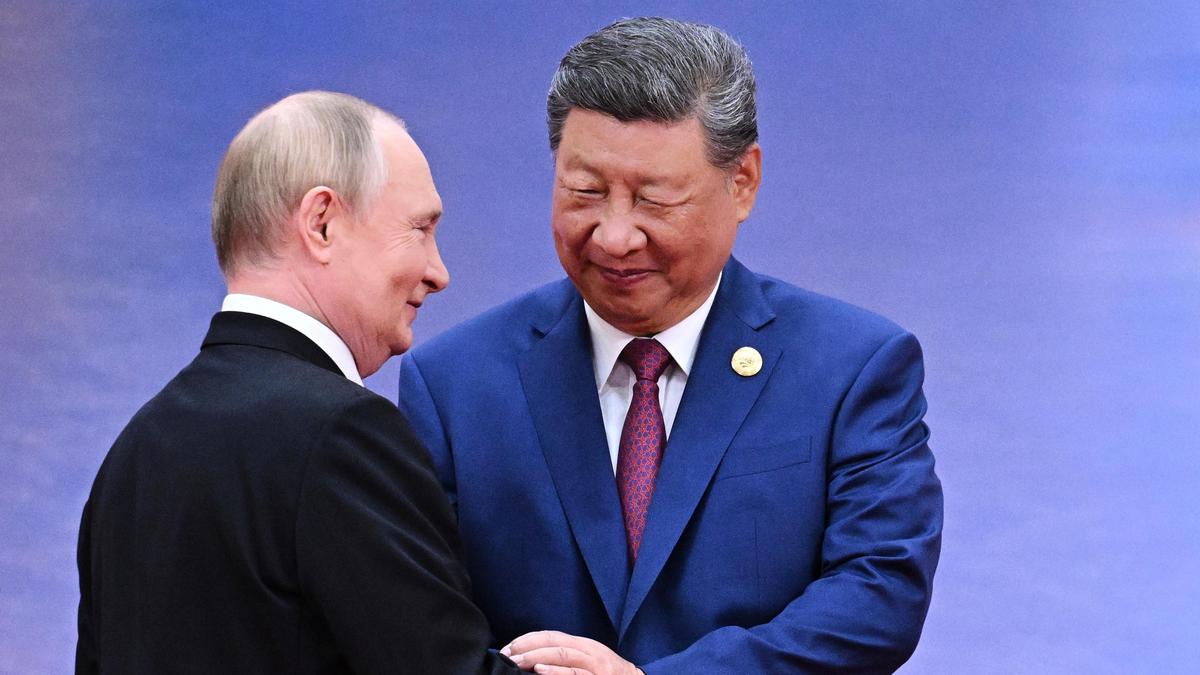
Chinese President Xi Jinping is hosting Russian President Vladimir Putin in Beijing to solidify an economic and security pact that undercuts Western sanctions, happening just four days after US President Donald Trump departed the Chinese capital. This tightly sequenced choreography positions China as the primary broker of global diplomacy, managing relationships with the world's most powerful rivals simultaneously. While Washington sought to stabilize trade during its summit, Moscow arrives to secure critical energy agreements, including the Power of Siberia 2 gas pipeline, and to ensure its primary economic lifeline remains intact amid the ongoing war in Ukraine.
By staging these summits back-to-back, Beijing signals that it refuses to choose between Western market access and its strategic alignment with Moscow. The arrangement reveals a deliberate effort by China to project stability while forcing both the United States and Russia to compete for its favor. For another view, see: this related article.
The Asymmetry of the Sino Russian Pact
Behind the grand declarations of an ironclad partnership lies a stark economic reality. Russia needs China far more than China needs Russia. Since the 2022 invasion of Ukraine, Western sanctions have severed Moscow from traditional European markets, forcing a radical redirection of Russian crude oil and natural gas toward Asia.
China now purchases more than one-quarter of all Russian fossil fuel exports. This dependency gives Beijing immense leverage over pricing, contract terms, and currency mechanics. Most transactions between the two nations are now settled in yuan and rubles, intentionally bypassing the SWIFT banking system and the US dollar. Similar insight on this matter has been provided by The Guardian.
Yet, this financial shielding is not without risk for Beijing. Chinese state banks remain deeply cautious about triggering secondary US sanctions, which could freeze them out of the global financial system. Consequently, while trade volume has surged past 200 billion dollars, Chinese institutions frequently stall transactions involving dual-use technologies that could be utilized by the Russian military. Xi must constantly calibrate this boundaries, offering Putin enough economic support to prevent a Russian collapse, but not enough to provoke an outright economic war with the West.
The Ghost at the Negotiating Table
Donald Trump left Beijing with positive optics but few binding commercial agreements, presenting Xi with a distinct tactical window. The Trump administration's foreign policy framework treats global relations as a series of bilateral trade negotiations rather than permanent ideological alliances. Xi understands this transactional nature and uses it to reassure Washington of China's role as a stabilizing force, particularly as conflicts in Ukraine and the Middle East disrupt global shipping and energy supply chains.
Putin’s arrival on Tuesday evening serves as an immediate counterweight. Kremlin spokesman Dmitry Peskov confirmed that Putin expects a direct debrief from Chinese officials regarding the substance of the Trump-Xi talks. Moscow is watching closely for any sign that Beijing might use its leverage to pressure Russia toward a negotiated settlement in Ukraine in exchange for US tariff concessions.
The Kremlin's anxiety is real. To mitigate the risk of a Chinese pivot toward Washington, Putin is pushing for the finalization of major infrastructure projects that would permanently lock Chinese demand into the Russian grid. The center of this effort is the Power of Siberia 2 pipeline, a massive project designed to redirect gas from the Yamal peninsula—which previously served Europe—directly into northern China. Negotiations have dragged on for years due to disagreements over pricing, with Beijing demanding near-domestic Russian rates. Putin’s willingness to finalize these terms during this visit underscores his urgent need for guaranteed long-term revenue.
A System of Selective De-escalation
The timing of these visits marks a departure from Cold War-era bloc politics. Rather than forming a rigid military alliance against the West, Beijing is pioneering a model of selective engagement.
This strategy allows China to cooperate with Washington on specific macroeconomic issues while simultaneously expanding security cooperation with Moscow. In September, Putin attended a massive military parade in Beijing, and joint naval drills in the Pacific have become routine. These exercises are not a prelude to a joint military campaign; rather, they are designed to signal to the US and its regional allies, including Japan and Australia, that any attempt to contain China in the Indo-Pacific will face a multi-front challenge.
The strategic friction for the West is that China’s economic support directly sustains Russia’s wartime economy. By purchasing discounted Russian oil, China provides the Kremlin with the hard currency needed to fund domestic military production. Furthermore, the steady flow of Chinese consumer goods, automobiles, and industrial machinery prevents the shortages that sanctions were intended to cause.
The Institutional Lifeline
This week's summit marks the 25th anniversary of the 2001 Sino-Russian Treaty of Friendship, an anniversary both leaders are using to project institutional permanence. The treaty established a framework based on non-interference and the mutual resolution of border disputes, allowing the two nations to cooperate without the binding commitments of a traditional defense pact.
This lack of formal obligation suits Beijing perfectly. It leaves China free to position itself as a neutral peace mediator on the international stage while avoiding any legal requirement to defend Russia if the war escalates. For Putin, the imagery of standing alongside Xi in the Great Hall of the People serves as vital domestic propaganda, demonstrating to the Russian public and elites that the country is far from isolated.
The global financial architecture is shifting as a direct result of this coordination. Platforms like BRICS and the Shanghai Cooperation Organisation are being transformed from discussion forums into functional alternatives to Western-led institutions. By developing alternative payment corridors, cross-border clearance systems, and independent supply chains, Beijing and Moscow are constructing an insulation layer designed to withstand future Western economic pressure.
The ultimate goal of Chinese diplomacy is not to defeat the United States or to fully underwrite Russia's geopolitical ambitions. Instead, Beijing is exploiting the friction between Washington and Moscow to establish itself as the indispensable hub of a fragmented international order. By keeping both rivals at the negotiating table on its own terms, China ensures that no major global security or economic issue can be resolved without its explicit consent.