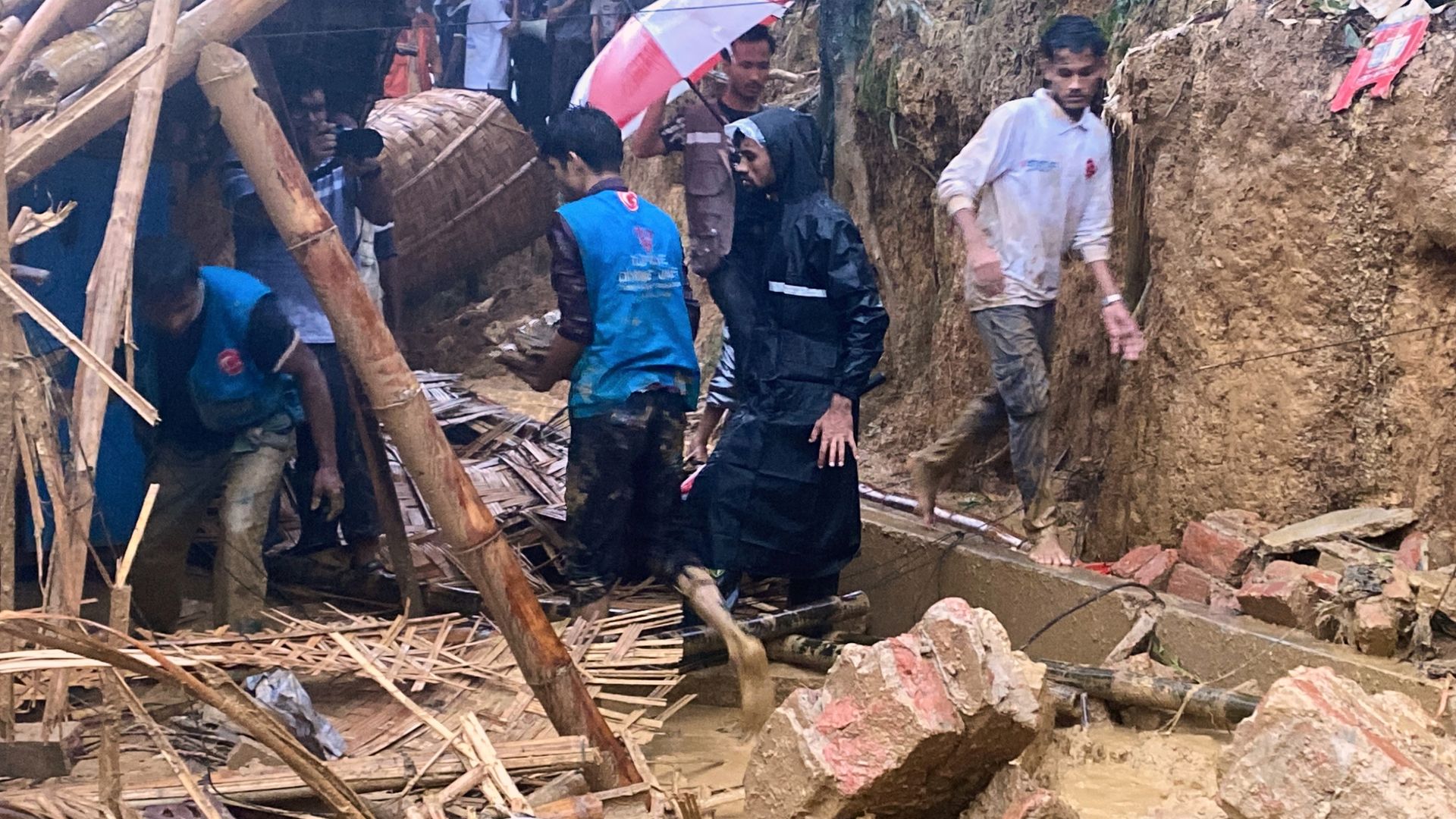
The rain came fast, erasing the fragile hills of southeastern Bangladesh and burying a temporary schoolroom under tons of liquid mud. Within hours, rescuers in the Cox's Bazar district were clawing through the earth with their bare hands to pull out the bodies of seven children and their teacher. This tragedy followed closely on the heels of another series of hill collapses that claimed eight lives as refugees slept in their makeshift shelters. The official death toll has climbed, yet the media narrative remains stubbornly fixed on the weather, treating these fatalities as an unavoidable natural disaster.
That narrative is dangerously incomplete.
The catastrophic loss of young lives in the Rohingya refugee camps and surrounding areas is not merely an act of nature. It is the predictable outcome of an agonizing intersection between systemic geopolitical inertia, intense localized environmental destruction, and a glaring failure of international coordination. For years, more than one million displaced individuals have been packed tightly into the world’s largest refugee settlement, left to survive on unstable, deforested slopes that turn into death traps every monsoon season.
The Engineered Vulnerability of Cox's Bazar
To understand why these hills are failing, one must look at how they were stripped of their natural defenses. When hundreds of thousands of Rohingya fled military persecution in Myanmar, the sudden influx required immediate, massive shelter construction. Forests were rapidly cleared to make room for bamboo and tarpaulin huts.
Trees hold the earth together. Their extensive root networks act as a natural mesh, stabilizing the loose, sandy soil common to the Chattogram region. When the vegetation was hacked away, the structural integrity of these hills evaporated.
Now, when torrential monsoon rains hit the region—with recent downpours breaking a 43-year record by dumping over 400 millimeters of water in a single 24-hour window—the unprotected earth liquefies. The water cannot absorb gradually. Instead, it pools on the surface, creates deep fissures, and sends entire hillsides crashing down onto the densely packed settlements below. The structures offer zero resistance against a wall of moving mud.
The Failure of the Relocation Strategy
Government officials frequently point to their evacuation efforts as proof of proactive management. They note that around 1,000 refugees have been moved from high-risk slopes in recent days. Yet, this represents a tiny fraction of the population living in immediate danger.
The truth about the relocation program is muddy. Many families are deeply reluctant to leave their established shelters, despite explicit warnings from camp authorities. This resistance is not born out of stubbornness; it is driven by a deep-seated fear of the unknown and a lack of clear communication from the agencies managing the camps.
Refugees are often asked to move without knowing where they will end up, whether they will retain access to basic rations, or if their families will be split apart. The alternative sites provided are often equally crowded or lack fundamental resources. When the state offers a choice between a familiar risk and an uncertain, potentially worse relocation, many choose to stay put and gamble with the weather.
A Disjointed Humanitarian Response
The coordination among the various agencies tasked with managing the camps is fracturing under pressure. Local refugee representatives point out that while emergency aid flows after a disaster, long-term preventative planning remains stagnant.
The United Nations has described this as one of the world's most protracted refugee situations. Yet, the funding and political will required to secure flat, stable land for safer long-term housing have dried up. Bangladesh has repeatedly urged the international community to facilitate a safe repatriation process back to Myanmar, but ongoing civil conflict inside Myanmar makes that option impossible for the foreseeable future.
This political gridlock means that short-term, emergency measures are being used to manage a permanent crisis. Stabilizing hillsides requires heavy engineering, proper drainage networks, and extensive replanting programs. None of these can be executed effectively when the official policy treats the camps as temporary settlements that could dissolve at any moment.
Beyond the Camps
The crisis is expanding beyond the boundaries of the refugee settlements. In nearby Chattogram city, separate landslides recently claimed the lives of local Bangladeshi children, including an infant in the Jungle Salimpur area.
This indicates a broader regional failure. Rapid, unregulated urbanization and illegal hill-cutting by local developers have destabilized the terrain far outside the humanitarian zones. The local government has struggled to enforce zoning laws or halt illegal construction on dangerous slopes. The result is a shared vulnerability where both the displaced global population and impoverished locals pay the ultimate price for administrative neglect.
The focus must shift from reactive rescue operations to aggressive terrain management and transparent relocation policies. Until international donors and local authorities coordinate to provide genuinely safe, flat land and permanent infrastructural support, the monsoon season will continue to be a period of mourning rather than a seasonal routine. The mud will slide again, and the blame will once more be falsely laid entirely on the rain.