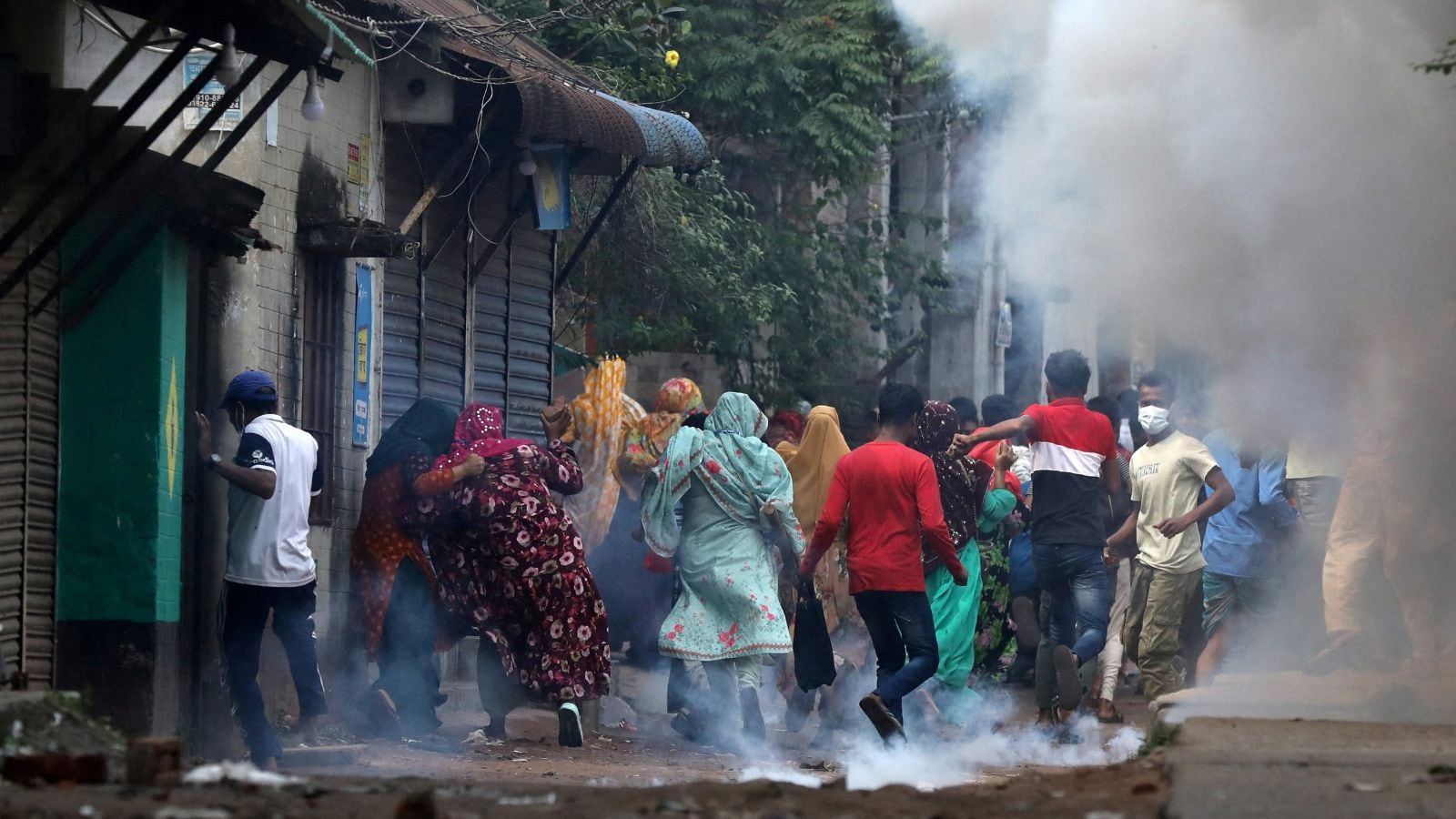
Bangladesh garment workers are demanding a massive overhaul to their monthly minimum wage because rapid inflation, currency devaluation, and soaring food prices have made survival on existing salaries impossible. When thousands of factory employees walked off the job and took to the streets in major industrial hubs like Gazipur and Ashulia, the demonstrations quickly escalated into violent clashes with security forces, factory closures, and a fierce standoff between labor unions, factory owners, and the Bangladeshi government.
To understand why streets burn every five years in Dhaka's industrial belts, you have to look past the tear gas and look at the arithmetic of global retail. Fast fashion operates on razor-thin margins at the bottom of the supply chain and massive markups at the top.
The Arithmetic of Survival in Dhaka
For years, the baseline entry-level wage for a garment worker in Bangladesh sat at 8,000 taka per month. Depending on exchange rate fluctuations, that hovered around $75 to $95 USD.
It was never enough.
Workers survived on that figure only through grueling overtime, often clocking 60 to 70 hours a week in noisy, stifling concrete buildings. When global inflation surged following supply chain disruptions and geopolitical conflicts, the Bangladeshi taka lost significant value against the US dollar. The cost of essentials—rice, lentils, cooking oil, eggs, and rent in crowded urban slums—spiked dramatically.
Labor unions and worker rights federations put forward a clear demand: a minimum monthly wage of 23,000 taka (roughly $208 at the time of the major wage board negotiations). Their math was simple and grounded in basic human survival. A family of four living in an industrial suburb cannot pay rent, buy basic groceries, cover medical emergencies, and pay school fees on anything less.
Factory owners, represented primarily by the Bangladesh Garment Manufacturers and Exporters Association (BGMEA), countered with an initial offer of 10,400 taka. The gap between the two numbers was not just a negotiating tactic. It was a chasm reflecting two entirely different views of economic reality.
After weeks of street protests, burned vehicles, ransacked factories, and fatal clashes between workers and police, the government-appointed wage board settled on 12,500 taka (about $113 per month). For the workers who had risked arrest and physical injury on the picket lines, the 56% increase felt like a betrayal. Real wages, when adjusted for brutal food inflation, barely moved.
How the Wage Board Mechanism Actually Works
Unlike countries where collective bargaining happens directly between individual unions and corporate employers, Bangladesh sets garment wages through a tripartite Minimum Wage Board. On paper, the structure looks balanced. It includes representatives from the government, factory owners, and workers.
In practice, the deck is heavily stacked.
The Bangladeshi economy relies on the Ready-Made Garment (RMG) sector for over 80% of its total export earnings. This single industry employs roughly four million people, the vast majority of whom are women who migrated from rural villages seeking financial independence. Because the state's foreign currency reserves depend almost entirely on keeping sewing machines humming, the government's primary instinct is to protect export competitiveness.
Many factory owners also sit in parliament or hold immense sway over political parties. Meanwhile, union organizing on the factory floor remains notoriously difficult. Workers who try to form independent unions frequently face termination, blacklisting, or intimidation. When the tripartite board meets every five years, the "worker representative" often lacks the political leverage to hold out against the combined weight of industrialists and state bureaucrats.
This structural imbalance guarantees cyclical violence. When workers have no legitimate, effective mechanism to negotiate pay raises inside the factory walls, their only remaining tool is taking over the highways.
The Hidden Role of Western Fashion Brands
Every mainstream news report on these protests focuses on local police, Bangladeshi ministers, and Dhaka factory owners. Almost all of them miss the real decision-makers sitting in corporate headquarters in Stockholm, Madrid, London, and New York.
Bangladeshi factory owners are essentially middlemen squeezed in a vice. On one side, they face rising costs for electricity, gas, imported raw materials, and labor. On the other side, they face relentless downward price pressure from Western apparel giants.
Consider a hypothetical example of how a basic cotton t-shirt moves through this pipeline. A major European fast-fashion retailer orders 500,000 units from a mid-sized supplier in Savar. The brand demands a Free on Board (FOB) price of $3.20 per shirt, down from $3.45 the previous year, citing "global retail headwinds." If the Bangladeshi owner refuses, the brand threatens to move the order to Cambodia, Vietnam, or Ethiopia. The owner takes the contract at a loss or break-even margin just to keep the factory open and service bank loans.
When labor costs rise by 56%, factory owners immediately turn to Western buyers and ask for higher unit prices to cover the new payroll. Most brands offer warm public statements supporting "living wages" and "worker rights," while their procurement departments quietly refuse to pay a single cent more per garment.
This creates a toxic disconnect. Corporate social responsibility teams in Western capitals publish glossy sustainability reports praising ethical sourcing, while their purchasing teams squeeze suppliers so hard that paying a living wage becomes mathematically impossible for the factory owner.
The Anatomy of the Crackdown
When the 12,500 taka wage was announced, the reaction in the industrial belts was immediate and visceral. Tens of thousands of workers walked out, blocking the Dhaka-Mymensingh highway—the vital artery connecting the manufacturing hubs to the capital and the port of Chittagong.
The state response followed a familiar, heavy-handed playbook. Industrial police and paramilitary border guards were deployed with tear gas, rubber bullets, and sound grenades. Factories were shuttered indefinitely under Section 13(1) of the Bangladesh Labor Act, a provision that allows owners to close plants without paying workers during periods of "illegal strikes."
Several workers were killed during the street battles, and dozens more were hospitalized with gunshot wounds and blunt-force trauma. Following the street suppression came the legal dragnet. Police filed blanket criminal cases against tens of thousands of unnamed workers for vandalism, arson, and assaulting officers.
Filing charges against "unnamed" suspects is a standard tactic in Bangladesh. It allows law enforcement to arrest virtually any labor organizer or vocal worker weeks after the protests have ended, chilling future dissent and forcing union leaders into hiding.
Why Bangladesh Cannot Easily Pivot Away from Cheap Labor
Critics often ask why Bangladesh does not simply move up the value chain. Why keep churning out cheap basic tees and denim when higher-margin technical apparel or electronics manufacturing pays better?
The answer lies in infrastructure, skill bottlenecks, and sheer scale.
Over the last three decades, Bangladesh built an unmatched ecosystem for high-volume, basic apparel. It has deep expertise in cotton spinning, dyeing, and massive-scale assembly. The country became the world's second-largest garment exporter after China precisely because it could produce huge quantities of basic clothing faster and cheaper than almost anyone else.
Moving into complex garments—like technical outerwear, high-end tailoring, or synthetic performance gear—requires expensive imported machinery, specialized technical training, and uninterrupted power supplies. Bangladesh still struggles with frequent power outages and expensive industrial gas shortages, forcing factories to run costly diesel generators.
Furthermore, the global market is shrinking its tolerance for high prices. As consumers in the United States and Europe grapple with their own cost-of-living pressures, ultra-fast-fashion platforms have trained shoppers to expect dresses for $10 and shirts for $5. That consumer expectation lands directly on the shoulders of a sewing machine operator in Gazipur.
The Automation Threat Looming Over the Sewing Floor
There is an uncomfortable truth that labor advocates rarely discuss publicly: pushing wages too high, too fast, without an accompanying rise in productivity or buyer prices, accelerates automation.
For decades, sewing remained stubbornly resistant to robotics because human hands are uniquely adept at handling limp, stretchy fabric. That technological barrier is eroding. Automated cutting machines, robotic pocket-setters, and laser-finishing systems for denim are already standard in top-tier Bangladeshi factories.
Factory owners facing sudden payroll spikes and thin margins do not just absorb the cost. They consolidate. Smaller, undercapitalized factories go bankrupt, leaving thousands jobless. Larger conglomerates invest in automated machinery to reduce their reliance on human labor. A production line that once required 60 workers can now be run by 35 with higher daily output.
This puts workers in an impossible bind. If they accept stagnant wages, they slowly starve due to inflation. If they fight successfully for dramatic wage hikes while Western brands refuse to fund the difference, they risk accelerating the very automation that will eliminate their jobs over the next decade.
What Accountability Actually Requires
Fixing the crisis in Bangladesh's garment sector requires dismantling the fiction that local factory owners alone control worker pay. The entire global supply chain is built to insulate Western corporations from legal and financial responsibility for the people who make their clothes.
Real reform depends on three structural shifts that industry insiders know are necessary, yet fiercely resist:
- Binding Purchasing Practices: Voluntary codes of conduct have failed for thirty years. Western governments and retail coalitions must enforce binding agreements that legally require brands to adjust unit prices automatically whenever a producing country raises its statutory minimum wage.
- Ring-Fenced Wage Contributions: Instead of handing higher prices to factory owners and hoping the money trickles down to workers, brands must adopt transparent, auditable costing models where the exact labor cost per garment is ring-fenced and verified via digital payroll records.
- True Freedom of Association: The Bangladeshi government must reform its labor laws to lower the threshold required to form a union—currently set at a prohibitive 20% of a factory's workforce—and end the use of blanket criminal charges against striking workers.
Until Western brands pay prices that reflect the actual human cost of production, and until Dhaka allows workers to organize without fear of blacklisting or bullets, the five-year cycle of starvation wages and burning streets will repeat itself on schedule. The clothes hanging on racks in London and New York will remain cheap only because the people sewing them are subsidizing the discount with their own survival.