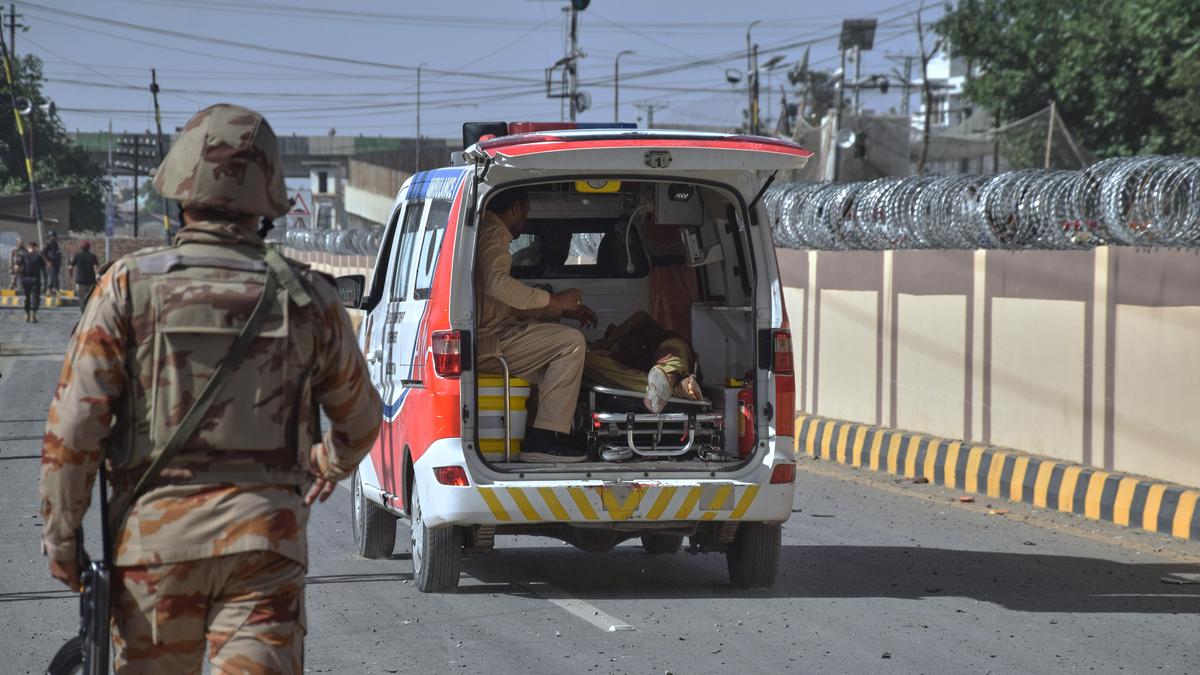
The internal security framework of Pakistan is buckling under a coordinated revival of militant violence. Data released by the Islamabad-based Pakistan Institute for Conflict and Security Studies (PICSS) reveals a 27 percent surge in terrorist attacks nationwide during May 2026. This metric represents far more than a routine statistical fluctuation. It marks the unraveling of recent tactical gains and exposes deep structural vulnerabilities along the western frontier.
Militant factions executed 128 attacks in May, up from 101 in April. The human cost of this operational escalation indicates a shifting tactical approach designed to inflict maximum institutional and psychological damage. Total civilian fatalities nearly doubled, leaping from 37 to 71, a 92 percent increase. Simultaneously, security personnel deaths skyrocketed by 143 percent, climbing from 28 to 68. These parallel spikes reveal that insurgent networks are no longer merely maintaining a low-intensity presence. They are actively seeking out high-yield engagements with state forces while intentionally exposing local populations to severe collateral risk.
The Mechanization of Mass Casualty Strikes
The defining element of the May offensive is the re-emergence of heavily orchestrated suicide operations. Six distinct suicide bombings occurred over the 31-day period, a stark departure from the solitary incidents recorded in both March and April. Four of these operations involved vehicle-borne improvised explosive devices (VBIEDs), demonstrating a sophisticated supply chain capable of acquiring high-grade military explosives, assembling large payloads, and navigating security checkpoints undetected.
These six suicide attacks alone claimed the lives of 34 security personnel and nine civilians. This high lethality ratio highlights an explicit shift in intent. Militant organizations are moving away from light infantry ambushes and sporadic hit-and-run tactics toward industrial-scale sabotage.
The strategic implications of this shift are evident. VBIEDs require significant financial backing, specialized engineering expertise, and secure urban or semi-urban safe houses. The execution of multiple vehicle-borne strikes within a single month proves that the logistics networks underpinning these groups have outpaced the state's preemptive intelligence capabilities.
Balochistan as the Ground Zero of State Fractures
While the resurgence is a nationwide challenge, the southwestern province of Balochistan bears the brunt of the crisis. The territory recorded 71 separate terrorist attacks in May compared to 34 in April, an alarming 109 percent increase.
May 2026 Security Metrics: Balochistan vs. National Scale

Metric                   National Total    Balochistan Share    Percentage
--------------------------------------------------------------------------
Total Terror Attacks     128               71                   55.4%
Reported Abductions      54                52                   96.2%
This geographic concentration shows that Baloch separatism, spearheaded primarily by the Baloch Liberation Army (BLA), has evolved structurally. The group's Majeed Brigade has refined its recruitment and radicalization pipelines, drawing increasingly from educated, middle-class Baloch youth rather than traditional tribal fighters. This shift introduces a higher degree of technical literacy and operational discipline into their ranks.
The crisis is further highlighted by a sharp increase in abductions. Out of 54 kidnappings reported across Pakistan in May, 52 took place within Balochistan. These are not random criminal enterprises for ransom. They are targeted political abductions aimed at local administrative officials, intelligence assets, and individuals suspected of cooperating with federal authorities. By systematically removing these actors, the insurgency creates localized governance vacuums, effectively cutting off the federal government's visibility in rural districts.
The Infrastructure Chokepoint
The tactical capabilities of the modern Baloch insurgency were laid bare on May 24, 2026, during the devastating Quetta train bombing. A VBIED driven by a 25-year-old operative struck a shuttle train near Chaman Phatak in the provincial capital. The blast derailed the locomotive and three carriages, killing at least 47 people—including 20 soldiers—and injuring nearly a hundred others.
The BLA claimed direct responsibility, explicitly noting that the train was carrying security personnel connecting to the Jaffar Express. This choice of target points to a broader strategy aimed at disrupting national connectivity.
By attacking the railway infrastructure, the insurgency hits a vital logistical artery used for both military troop movements and economic transport. It also sends a direct warning to external investors. The location of Balochistan makes it the geographic crown jewel of the China-Pakistan Economic Corridor (CPEC), with the deep-water port of Gwadar serving as its terminus. Continuous kinetic strikes against transit networks in Quetta signal to Beijing that Islamabad cannot guarantee the safety of the infrastructure core to these multi-billion-dollar trade routes.
Kinetic Success and the Intelligence Deficit
The federal response to this deteriorating environment relies heavily on direct military intervention. Pakistan’s security forces conducted extensive counterterrorism operations throughout May, neutralizing 270 militants and apprehending 15 others. These operations were concentrated across distinct regional lines.
- Erstwhile FATA Districts: 128 militants eliminated.
- Balochistan: 71 militants eliminated.
- Mainland Khyber Pakhtunkhwa: 62 militants eliminated.
- Punjab: 1 militant eliminated.
While a body count of 270 neutralized combatants reflects aggressive battlefield execution, it reveals a fundamental flaw in the state's counterterrorism philosophy. High elimination metrics occurring alongside a 27 percent increase in successful insurgent strikes indicate that the state is treating the symptoms of the militancy rather than its structural drivers.
The military is caught in a reactive cycle. It cleanses geographic zones through kinetic force, yet fails to prevent the immediate regeneration of those same cells. This pattern points to an intelligence deficit. The state’s security apparatus remains heavily reliant on conventional military maneuvers—such as sweeps and clearing operations—while struggling with the granular, human-intelligence work required to disrupt the initial stages of militant recruitment and logistics.
The Cross Border Diplomatic Impasse
The resurgence of violence cannot be decoupled from the geopolitical reality along Pakistan's western border. Since the political transition in Kabul in 2021, the Durand Line has transformed from a porous border into a major diplomatic flashpoint.
Islamabad maintains that the Tehreek-e-Taliban Pakistan (TTP) operates safe havens within Afghanistan, planning and launching cross-border attacks with the passive consent or active backing of the Afghan Taliban. Kabul routinely rejects these accusations, suggesting instead that Pakistan's security challenges are entirely internal.
This diplomatic deadlock has severely weakened bilateral border management. While Pakistan has attempted to restrict border movements and secure crossings, the vast, rugged terrain makes absolute interdiction nearly impossible without full cooperative intelligence-sharing from Kabul. Because that cooperation is absent, militant networks use the border as a strategic shield. They exploit the diplomatic friction to move men, funds, and material across the frontier, knowing that Pakistani forces face severe diplomatic and military limitations once a pursuit reaches the international border.
The state’s current strategy of relying on large-scale kinetic clearances is hitting its natural limit. Without addressing the underlying political alienation in Balochistan, modernizing the civilian intelligence apparatus, and resolving the border management dispute with Kabul, localized military victories will yield only temporary reprieves. The data from May indicates that the militant networks have adapted to the military's playbook. They are expanding their reach, refining their methods, and demonstrating a capacity to absorb high casualties while scaling up their offensive operations.