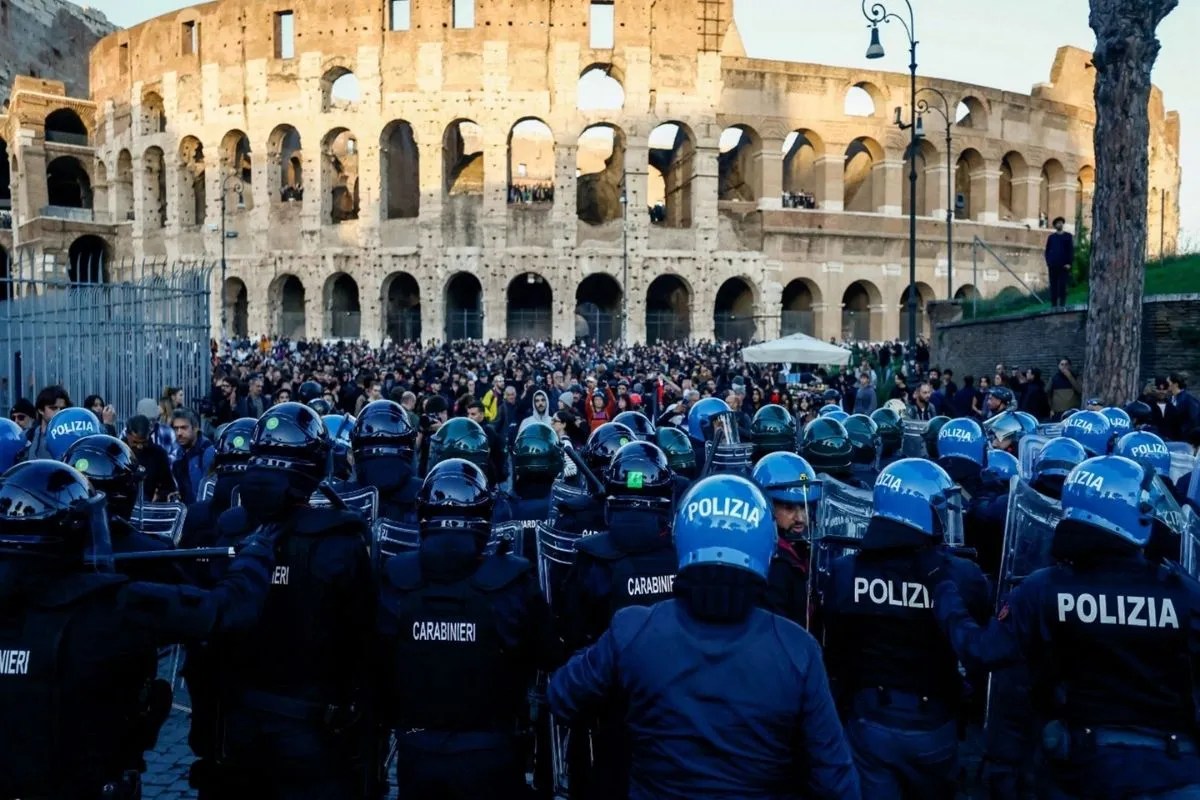
Headline-driven coverage of street protests often treats anger, landmark marches, and police arrests as isolated snapshots rather than linked parts of a broader political and economic strain. The Hindi headline "महंगाई और मेलोनी सरकार के खिलाफ गुस्सा, कोलोसियम तक पहुंचा प्रदर्शन, 9 गिरफ्तार" points to a clear chain of events in Italy: rising living costs, opposition to Prime Minister Giorgia Meloni's administration, demonstrations reaching Rome's Colosseum, and nine arrests.
When an event is summarized in a single line, the underlying mechanics stay hidden. Why does household price pressure turn into political mobilization? Why does a demonstration converge on a recognizable monument like the Colosseum? And how do a small number of arrests fit into a wider public-order response? Answering those questions requires separating immediate street incidents from structural pressures, while keeping verified facts distinct from analytical interpretation.
Deconstructing the Competitor's Framing
A typical breaking-news headline compresses a complex story into three elements: grievance, location, and enforcement. In this case, the grievance is inflation and opposition to the Meloni government; the location is the Colosseum area in Rome; and the enforcement outcome is nine arrests.
That structure works well for rapid alerting, yet it leaves three analytical gaps:
- Grievance without transmission: Stating that anger is directed at inflation and the government does not explain how macroeconomic price changes translate into street mobilization, or what policy choices protesters blame.
- Geography without function: Mentioning the Colosseum tells readers where the crowd gathered or pushed forward, but not why iconic spaces carry disproportionate visibility and risk during urban protests.
- Counts without context: Reporting nine arrests establishes a concrete enforcement figure, yet a single headcount cannot show whether those detentions reflected targeted breaches at a specific site, broader clashes across cities, or standard crowd-control policing.
To write a stronger analysis, each of those elements has to be placed inside a clear cause-and-effect framework rather than treated as self-explanatory.
Known Facts vs. Educated Hypotheses
A disciplined analysis separates confirmed reporting from interpretation. In reporting tied to this headline and surrounding coverage of Italian cost-of-living and anti-government demonstrations, the core factual anchors are that protests linked to inflation and opposition to Giorgia Meloni's government took place in Italy, reached the Colosseum in Rome, and resulted in nine arrests. Broader reporting around Italian protests in autumn 2026 also documents recurring friction over living costs, wages, housing, budget and security policies, and demonstrations spanning multiple cities.
Where exact figures or local site details are not established in the headline itself, analysts rely on educated hypotheses grounded in political economy and urban policing:
- Hypothesis on grievance concentration: Cost-of-living frustration tends to mobilize people most sharply when essential outlays—such as groceries, utilities, fuel, and rent—rise faster than real household wages, making abstract budget debates feel personal.
- Hypothesis on spatial targeting: Crowds gravitate toward central or globally recognizable landmarks because those locations amplify media reach and symbolize state or civic authority, even when the underlying grievances are economic.
- Hypothesis on arrest counts: A figure like nine arrests often reflects containment around a specific flashpoint or perimeter breach rather than the total scale of a wider demonstration, though exact charging or detention criteria depend on official police reporting.
Treating these hypotheses as working explanations rather than proven facts keeps the analysis honest when granular local data is incomplete.
The Transmission Mechanism of Cost-of-Living Anger
Inflation rarely triggers street action on its own; it moves through a household balance-sheet mechanism. When consumer prices climb on everyday essentials while nominal wages adjust slowly, real purchasing power erodes. Households face a squeeze between fixed or semi-fixed obligations—housing, energy, food, transport—and stagnant take-home pay.
Once that squeeze persists, voters and workers look for an accountable actor. In parliamentary and national politics, executive leadership and fiscal policy become focal points because governments shape taxes, subsidies, public wages, social support, and budget priorities. Even when global supply chains, energy markets, or central-bank rate paths influence inflation, domestic political anger concentrates on the incumbent government's perceived inaction or misplaced priorities.
Labor unions, student groups, and political activists often act as mobilization bridges in this phase. Cost-of-living strain supplies the broad latent frustration, while organized groups provide the timing, march routes, slogans, and strike or rally coordination that turn private financial stress into visible public protest.
Why Iconic Landmarks Become Flashpoints
Why do demonstrations over economic grievances end up at or near a place like the Colosseum? In urban protest dynamics, physical space serves three distinct functions:
- Visibility multiplier: High-profile landmarks guarantee immediate visual recognition for domestic and international audiences. A march past a famous monument communicates scale and urgency faster than a rally in a peripheral square.
- Symbolic compression: Historic and civic sites compress complex grievances into a single image. Even when protesters are focused on wages, inflation, or government policy, standing at a world-famous site frames the dispute as a clash over public life and national priorities.
- Security bottleneck: Iconic monuments combine high foot traffic, tourist presence, heritage protection rules, and tight perimeters. That combination creates friction points where crowd movement, barrier lines, and police intervention intersect quickly.
When demonstrators enter or press against a protected or high-visibility site, enforcement typically shifts from passive traffic management to perimeter defense and targeted arrests. That explains how a broader economic protest can produce a sharp, localized headline involving a specific number of people taken into custody.
Policing, Public Order, and Political Trade-Offs
Arrest numbers sit at the intersection of two competing pressures facing any government during contentious protests: preserving public order and avoiding political escalation. Rapid containment around sensitive sites protects public safety and heritage assets, while signaling that authorities will enforce legal boundaries.
At the same time, enforcement has limits as a policy instrument. Arresting individuals who cross a line or clash with officers addresses immediate disorder at the scene, but it does not lower grocery prices, ease rent pressure, or close a perceived gap between official economic messaging and everyday household budgets. If economic grievances remain unresolved, street energy can shift to other dates, cities, or flashpoints rather than disappearing after a single enforcement action.
A common analytical mistake in both directions is over-interpreting or under-interpreting arrest counts. A small number of arrests does not automatically prove a protest was peaceful or insignificant, nor does it prove widespread insurgency; it simply marks a specific point where crowd behavior crossed an enforcement threshold.
Analytical Blind Spots and Limitations
Even a structured reading of this story faces real constraints. Headline summaries omit granular operational facts—such as the exact sequence at the site, the composition of the crowd, whether arrests occurred at an entry point or along a march route, and what legal charges followed. Without primary police statements, court records, or verified on-the-ground reporting, analysts cannot assign blame for specific incidents or generalize from one arrest count to an entire movement.
There is also a risk of retrospective over-attribution: reading long-term political decline or systemic collapse into every street demonstration. Protests reflect real pressure and political friction, yet governments, labor markets, and public opinion respond to multiple forces over time, including fiscal constraints, parliamentary arithmetic, and shifting voter priorities.
Strategic Action for Analysts and Decision-Makers
To track and respond to cost-of-living protests without falling for surface-level headlines, monitor household essential-price pressure alongside organized mobilization calendars—specifically tracking food, energy, and housing costs relative to wage growth, union or student protest schedules, and flashpoint choices around major civic or tourist landmarks. Relying solely on arrest tallies or dramatic location tags misreads the durability of the underlying unrest; pairing economic transmission indicators with site-specific security and political messaging gives a far clearer read on whether street pressure will fade or expand.
Rome protests Colosseum inflation Meloni government arrested
This video directly covers the protests in Rome involving the Colosseum, inflation, and opposition to the Meloni government referenced in the prompt.


