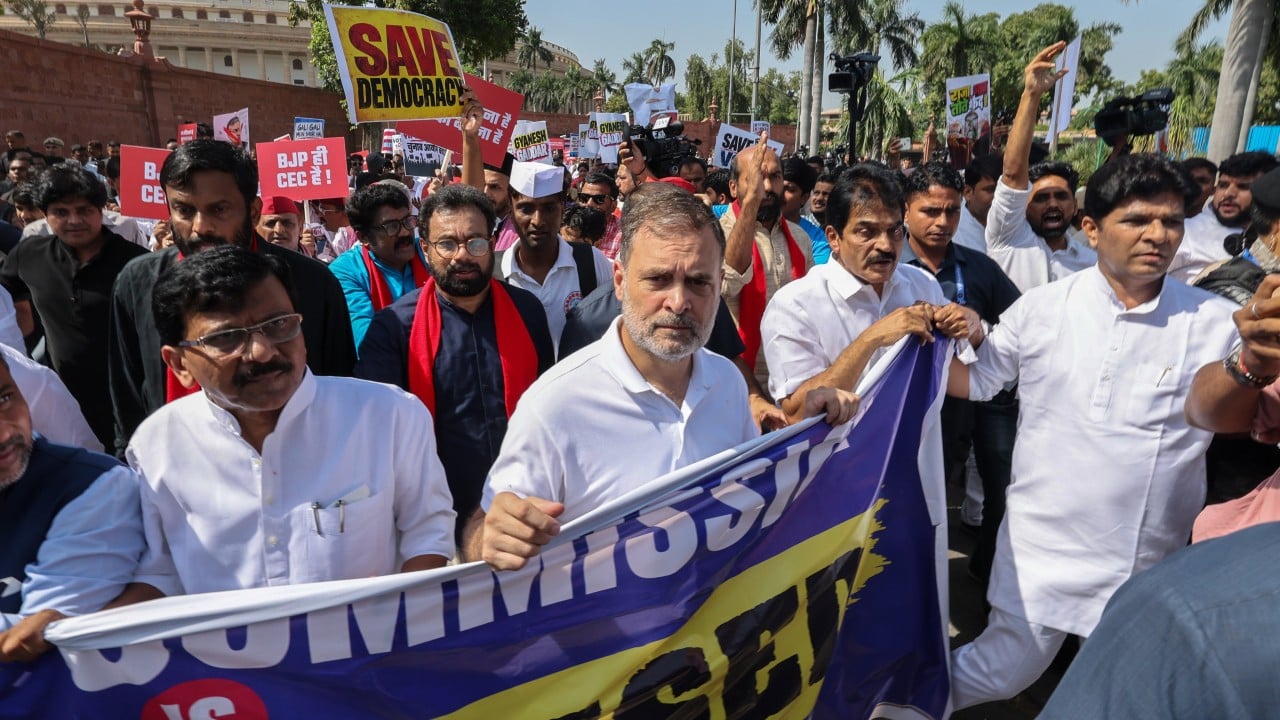
The media script writes itself every time a batch of opposition politicians gets bundled into a police van in New Delhi. Sirens wail, cameras flash, and headlines flash across global feeds lamenting the latest blow to democratic norms. The narrative centers on lawmakers staging high-profile marches to demand the resignation of Chief Election Commissioner Gyanesh Kumar, fueled by accusations that massive revisions to voter lists are systematically disenfranchising millions.
It looks like a classic David versus Goliath showdown. But look closer at the mechanics of modern political theater, and a more uncomfortable truth emerges. By making the poll body the primary villain and street theater the main weapon, the opposition is walking straight into a well-laid trap that drains their political capital while leaving the underlying structures of power entirely untouched.
The Flawed Premise of Institutional Moral Suasion
The lazy consensus among political analysts is that public street protests targeting electoral administrators will eventually shame the ruling establishment into compliance or spark a popular uprising. This assumes that institutions operate on a sense of shame and that public optics can override entrenched political machinery.
History shows the opposite. When opposition figures like Rahul Gandhi stage recurring demonstrations outside election offices, they treat the Election Commission as an independent referee that can be pressured into fairness through moral outrage. This is a strategic error. In high-stakes modern politics, administrative bodies tasked with managing massive electoral rolls do not fold because politicians sit on asphalt. Instead, these confrontations provide the ruling party with a neat counter-narrative: lawmakers are accused of creating manufactured anarchy and disrupting governance for cheap headlines.
The opposition's obsession with the person at the top of the Election Commission misses the broader systemic reality. Bureaucratic machinery obeys incentives, not optics. Shouting for a resignation on the streets of New Delhi does nothing to audit a single digital database entry or challenge local bureaucratic execution where administrative manipulation actually happens.
The Data Vacuum And The Real Battleground
Let us look at the actual mechanics of voter list revisions. Critics point to claims that millions of names have vanished from electoral rolls during recent updates. If true, this is a monumental structural crisis. Yet, staging a march toward a designated protest site like Jantar Mantar is an analogue tactic in a digital war.
A serious opposition strategy would not rely on dramatic, short-lived detentions that cycle out of the news cycle in forty-eight hours. It would deploy an army of data scientists, local booth-level agents, and legal teams to systematically cross-reference dropped names down to the exact constituency, polling booth, and demographic. Fighting administrative disenfranchisement requires granular, unsexy legal warfare, not theatrical arrests that make for good evening broadcasts.
When political parties choose the path of least resistance—high-visibility street protests instead of grueling, localized data verification—they reveal a deeper weakness. They lack the localized machinery required to counter administrative engineering at the grassroots. Marching to the commission headquarters is much easier than mobilizing thousands of volunteers to manually check electoral databases door-to-door.
Unconventional Realities No One Wants To Admit
The hard truth is that the opposition benefits from these detentions just as much as the government does. For the opposition, getting bundled into a bus provides instant media validation and keeps bruised egos relevant. For the ruling dispensation, a disorderly opposition playing to the cameras reinforces the narrative of a fractured, desperate alternative incapable of disciplined governance.
Both sides are locked in a symbiotic loop of predictable theater. The government projects strength and order; the opposition projects defiance. Meanwhile, the actual integrity of the electoral roll remains unverified by any independent, transparent audit because both factions prefer fighting over the microphone rather than doing the heavy lifting of data reconstruction.
Stop treating the Election Commission as an independent moral actor that will surrender to street pressure. Until opposition leadership replaces the megaphone with a ledger, every dramatic arrest in New Delhi will remain what it truly is: a well-rehearsed performance with a predetermined, irrelevant ending.
Rahul Gandhi, Indian opposition lawmakers detained over election chief protest for second day
This video report captures the high-profile detention of opposition leaders during their protests outside election offices, highlighting the theatrical nature of these confrontations.


