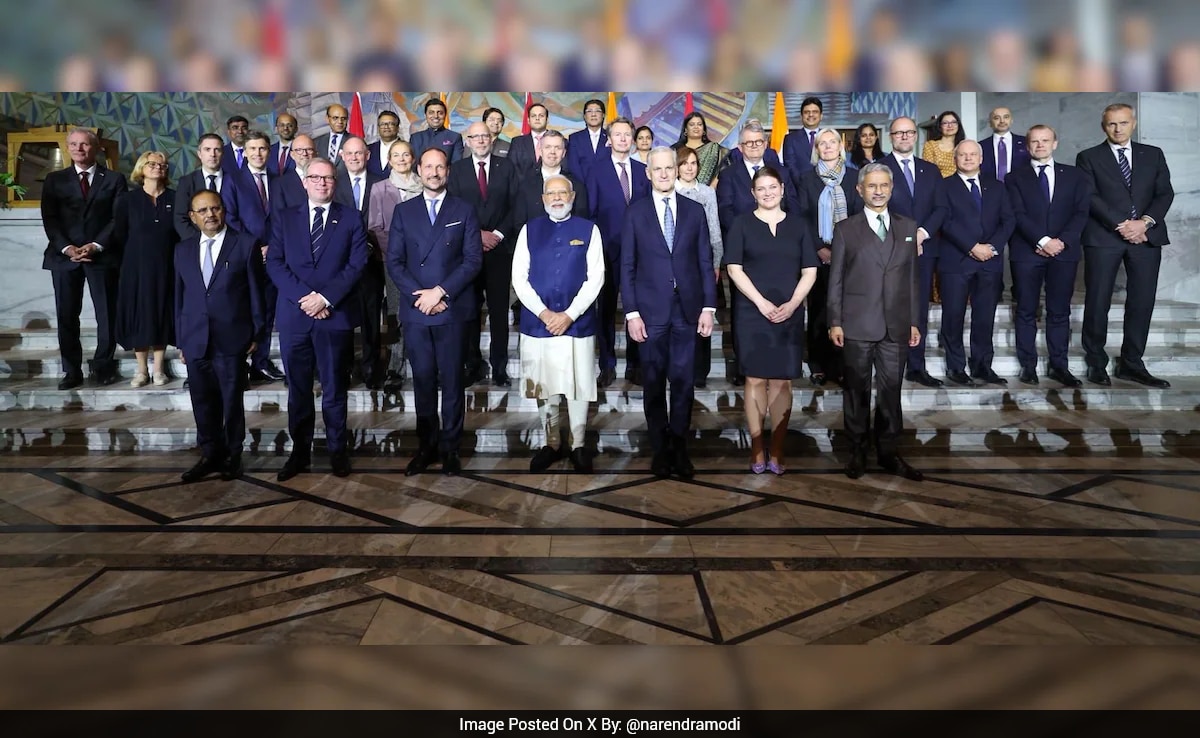
You probably missed it amidst the usual daily political noise, but something massive just happened in Oslo. For the first time in 43 years, an Indian Prime Minister made an official bilateral visit to Norway. Narendra Modi landed in the Norwegian capital, met King Harald V, and stood alongside Norwegian Prime Minister Jonas Gahr Støre at the India-Norway Business and Research Summit.
This wasn't just another diplomatic photo-op. It marks a fundamental shift in how the world’s most populous nation and Europe's energy powerhouse intend to do business.
The biggest takeaway from the summit is the formal upgrading of bilateral ties to a Green Strategic Partnership. If you've been watching global trade shifts, you know this moves far beyond simple import-export tallies. It's a calculated pairing of Norwegian capital and technological prowess with India’s unimaginable economic scale.
Let's unpack what actually went down in Oslo, why the timing matters, and what it means for businesses in both nations.
The 100 Billion Dollar Target Under TEPA
The timing of this summit isn't random. It serves as the first major high-level check-in since the India-EFTA (European Free Trade Association) Trade and Economic Partnership Agreement went into effect. This agreement, binding India with Iceland, Liechtenstein, Norway, and Switzerland, acts as the real engine behind the current diplomatic push.
Prime Minister Modi laid down a clear, heavy marker during his address. He explicitly challenged the 50-plus CEOs and 250 business leaders in the room to hit the mandated investment target. We're talking about $100 billion in investments into India over the next 15 years.
What does India offer in return? A massive demographic dividend and an aspirational, highly tech-literate youth population. According to official estimates, hitting this $100 billion investment milestone is expected to create at least one million direct jobs in India.
Norwegian Prime Minister Støre didn't hold back either. He openly called the trade agreement "unique," noting that Norway has never signed an agreement of this nature or scale with any other country before. It's a massive vote of confidence from a country that holds the world’s largest sovereign wealth fund.
Where the Money is Flowing
Vague diplomatic statements often hide the actual commercial reality. Let's look at the concrete sectors where Indian and Norwegian companies are actually signing deals right now.
Before the main summit even kicked off, four targeted roundtable sessions were held across Oslo. They didn't focus on abstract ideas; they focused on highly technical, high-stakes industries.
The Blue Economy and Shipbuilding
Norway is a global leader in maritime technology, ocean sustainability, and green shipping. India has a massive coastline and an urgent need to modernize its port infrastructure and shipping fleets. Modi highlighted shipbuilding as a sector with "unlimited possibilities" for joint ventures. The goal here is simple: maritime decarbonization. Think electric cargo vessels, automated port systems, and sustainable deep-sea fisheries.
Clean Energy and Green Hydrogen
India is targeting 500 GW of renewable energy capacity and the production of 5 million tonnes of green hydrogen by 2030. Modi boldly claimed that "no one in the world can match India's aspirations in clean energy." Norway, with its massive financial reserves from oil and gas, is looking to deploy capital into clean energy investments globally. It's a perfect match. The Norwegian Government Pension Fund Global already holds roughly $28 billion in Indian capital markets, and Indian officials are actively pushing to funnel a larger slice of that wealth into grid infrastructure, battery storage systems, and wind energy.
Critical Minerals and Deep Tech
You can't build a green future without the raw materials. The partnership explicitly covers critical minerals necessary for the global electric vehicle transition. On top of that, India is offering full regulatory and state support for Norwegian firms willing to invest in artificial intelligence, cyber technology, space exploration, and defense.
Changing the Economic DNA
During his pitch to the Oslo business elite, Modi stated that India has completely altered its "economic DNA" over the last decade. He pointed toward deep structural reforms in taxation, modernized labor laws, and a focus on competitive federalism, where Indian states actively compete against one another to attract foreign business.
For a long time, foreign investors viewed India as a bureaucratic nightmare. The bureaucratic red tape was legendary. However, the implementation of TEPA proves that the regulatory framework is shifting to favor long-term institutional investors. Norway’s sovereign wealth fund doesn't chase short-term hype. They look for decade-long stability, and India is working hard to prove it can provide exactly that.
Geopolitics Behind the Deal
We have to look at the broader picture. This summit happens against a backdrop of intense global friction. Western energy markets are fractured, supply chains are decoupling from China, and India is balancing its energy imports from various global regions.
Norway is one of the world's primary oil and gas exporters. In fact, just a week prior to this summit, a major consignment of Norwegian Liquefied Natural Gas (LNG) was delivered to India as part of a massive 15-year supply agreement. While India builds out its green infrastructure, it still requires massive amounts of transitional fossil fuels to keep its economy growing at 7% or more per year. Securing a stable, long-term energy pipeline from a stable democracy like Norway is a major strategic win for New Delhi.
Furthermore, this bilateral meet sets the stage for the 3rd Nordic-India Summit, bringing together the leaders of Sweden, Finland, Iceland, and Denmark. The Nordic region realizes that accessing the Indian domestic market is no longer optional if they want to sustain their own economic models.
What Happens Next
If you're an executive, investor, or entrepreneur in the tech, maritime, or energy space, you need to watch this space closely. The summit wasn't just talk; it concluded with the signing of multiple business-to-business MoUs and government agreements covering health innovation, space ties, and digital infrastructure.
Here's what to look out for over the coming months:
- B2B Energy Matchmaking: Watch for joint ventures between Norwegian wind developers and Indian state-backed energy corporations.
- Capital Allocation: Track the upcoming portfolio adjustments of the Norwegian Pension Fund to see how quickly they scale up their Indian equity and green bond investments toward that $100 billion goal.
- Maritime Contracts: Monitor Indian public sector shipyards for new technology transfer agreements coming out of Oslo.
The era of India and Europe viewing trade solely through the lens of traditional goods is over. The future belongs to capital-intensive, deeply integrated technology partnerships.


