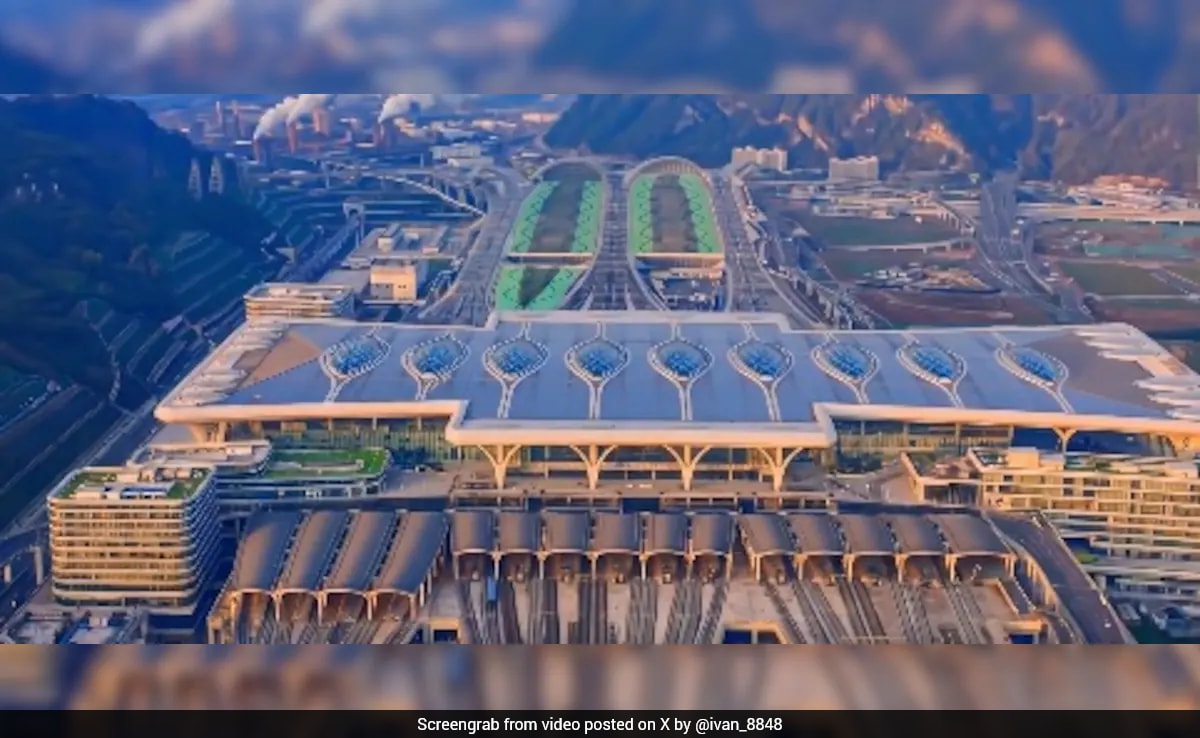
The international press is obsessed with speed. Every time China blasts through a mountain to erect a massive high-speed railway hub in less than four years, western media outlets swoon. They marvel at the 38-month timelines. They gawk at the sheer volume of concrete poured into rugged terrains. They pitch these projects as undisputed triumphs of modern engineering and logistics.
They are looking at the wrong metrics.
Speed is a terrible proxy for efficiency. When you judge a megaproject solely by how fast it was built, you fall into a classic trap: celebrating the construction phase while completely ignoring the decades of economic friction, structural vulnerability, and astronomical maintenance costs that follow. Carving a massive transit hub into a mountain in 38 months isn't a miracle. It is an aggressive, high-risk allocation of capital that often defies long-term economic logic.
The Illusion of Efficiency
Mainstream coverage loves to focus on the raw logistics. They highlight the thousands of workers operating 24/7, the prefabricated concrete modules, and the synchronized supply chains. They treat these projects like a masterclass in optimization.
As someone who has spent years analyzing heavy infrastructure investments and structural logistics, I can tell you that throwing unlimited labor, state-backed capital, and raw political will at a mountain is not "efficiency." It is brute-force engineering.
True efficiency means achieving the maximum economic output with the minimum required input. When you compress a timeline artificially to meet a political deadline, your cost curve doesn't scale linearly—it goes vertical.
The Real Cost of Compressed Timelines
- Premium Material Procurement: Sourcing millions of tons of specialized, quick-curing concrete and high-grade steel on a compressed schedule requires paying massive premiums to suppliers, disrupting local markets.
- Logistical Redundancy: To build at that velocity, you cannot wait for optimal supply chains. You run parallel, redundant shipping routes and keep massive safety stocks on-site, bloating overhead.
- Geotechnical Shortcuts: In standard mountain infrastructure engineering, engineers prefer to monitor rock stability and water table shifts across multiple seasons to see how the landscape reacts to excavation. A 38-month window compresses this observation period, forcing teams to rely on heavy, expensive over-engineering (like massive, unnecessary retaining walls and deep anchoring systems) to compensate for unknown geological variables.
Geography Always Wins
Building a major high-speed rail hub on a mountain creates an immediate, permanent operational deficit.
High-speed rail relies on a fundamental principle: maintaining straight, level tracks to ensure safety and speed. Mountains are the literal antithesis of this principle. When you force a station into a mountainous region, you aren't just building a terminal; you are committing to an endless network of complex tunnels and massive viaducts leading into and out of that station.
Consider the physics. A standard high-speed train traveling at 350 km/h cannot handle steep gradients. This means the approaches to a mountain station require miles of gradual inclines supported by towering concrete pillars.
[Level Valley Track] ----> [Miles of Mega-Viaducts] ----> [Mountain Station Hub] <---- [Deep Tunnel Network]
These aren't standard assets. They are highly complex structural liabilities.
The Maintenance Nightmare
Every tunnel bored through a mountain alters the local hydrology. Water tables shift. Internal hydrostatic pressure builds up against the concrete lining of the tunnels. Over time, this results in water ingress, which degrades track beds and corrodes electrical systems.
Outside the tunnels, the viaducts face different risks. Mountainous terrain is notorious for micro-climates, high winds, and seismic activity. The cost of monitoring, maintaining, and repairing these elevated structures over a 50-year lifecycle can easily dwarf the original construction cost. By celebrating the 38-month build time, commentators are cheering at the starting line of a grueling, ultra-expensive marathon.
The Ghost Station Phenomenon
Let’s address the most glaring flaw in the mountain-megaproject obsession: the demand mismatch.
Why are these stations built on mountains or in remote, rugged regions in the first place? Often, it is because the high-speed rail network is being pushed into less dense, interior provinces to spur economic development.
But infrastructure alone does not create economic gravity.
In classic urban planning, transit hubs succeed because they sit at the center of existing, high-density economic activity. You build a station where people already are. When you build a massive, multi-level station on a mountain miles away from a primary urban center, you create a logistical disconnect.
Passengers arriving at these mountain hubs frequently find themselves stranded miles away from their actual destinations, requiring further commutes via local subways, buses, or taxis. The time saved by the high-speed train is immediately erased by the friction of the final mile.
The Yield Problem
Bent Flyvbjerg, an Oxford professor and the world's leading authority on megaprojects, has documented a consistent trend: over 90% of global megaprojects suffer from cost overruns and demand shortfalls.
Mountain stations are hyper-vulnerable to this trend. They are built based on highly optimistic population growth and economic integration forecasts. When the actual passenger volume ends up being a fraction of the station's capacity, you are left with a sprawling, heated, lit, and staffed ghost hub that eats capital every single day. The revenue from ticket sales cannot even cover the utility bills, let alone pay down the debt incurred to build it.
What the Applauding Analysts Get Wrong
When western commentators look at these projects, they often view them through a lens of envy. They look at their own country's delayed subway lines or bureaucratic environmental reviews and think, “If only we could bypass the red tape and build on mountains in 38 months.”
This is a profound misunderstanding of risk management.
| Feature | The Brute-Force Approach | The Lifecycle-First Approach |
|---|---|---|
| Primary Metric | Speed of construction completion | Total cost of ownership over 50 years |
| Geotechnical Risk | Mitigated via costly over-engineering | Mitigated via multi-season observation |
| Urban Integration | Built where space allows (e.g., mountains) | Built where existing economic density resides |
| Financial Horizon | Upfront debt-fueled capital deployment | Long-term yield and operational viability |
The bureaucratic friction in western infrastructure planning is undoubtedly frustrating and often excessive. However, skipping the rigorous, multi-year economic viability and environmental impact phases isn't a shortcut to success—it's a shortcut to unmanageable debt and underutilized assets.
The real flex in modern infrastructure isn't building a station quickly in an impossible location. The real flex is building a station that pays for itself, integrates flawlessly with the surrounding city, and doesn't require a state bailout a decade later to keep the lights on.
Stop grading megaprojects on a stopwatch. Start grading them on the balance sheet.