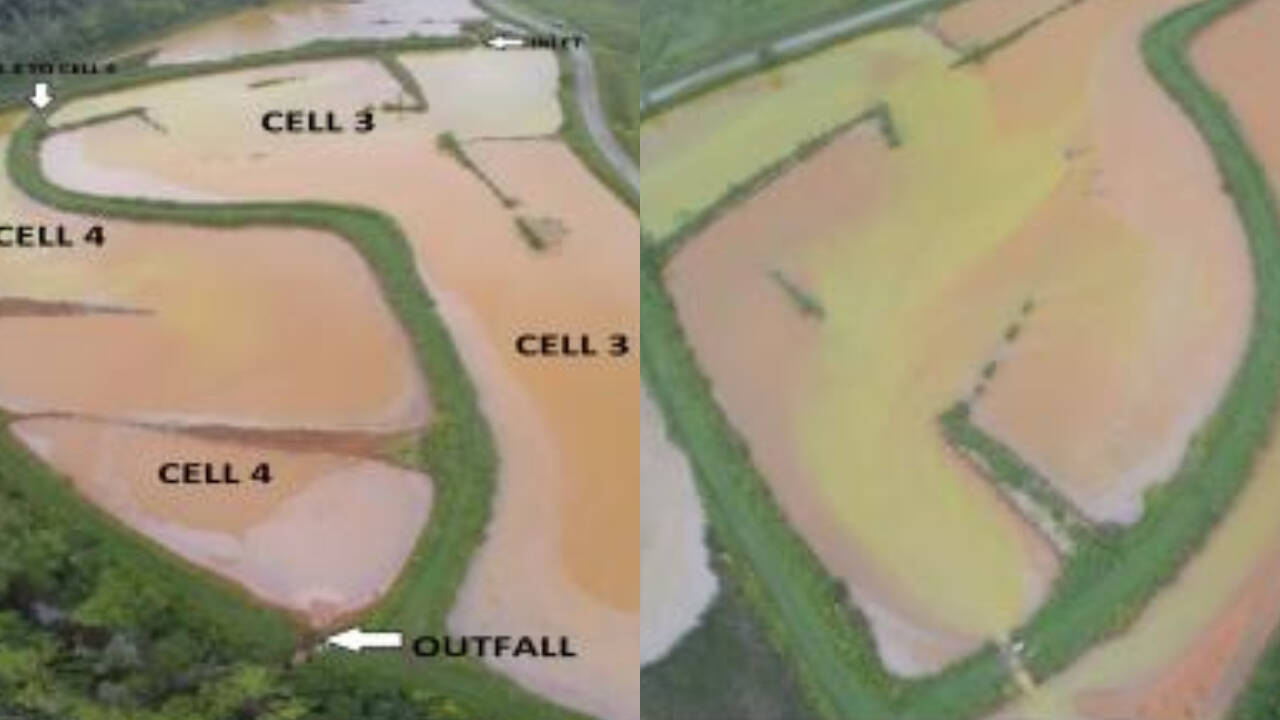
Passive treatment systems engineered to mitigate abandoned mine drainage rely on predictable hydraulic retention times to precipitate dissolved metals out of solution. When field diagnostics reveal an empirical retention time representing a fraction of theoretical design specifications, the structural integrity of the entire ecological remediation process collapses. Recent evaluation of the Monastery Run Wetland 1 installation near Latrobe, Pennsylvania, demonstrated a catastrophic deviation between mathematical modeling and physical reality. Designed to maintain water for twenty-nine hours at a flow rate of one thousand seven hundred ten gallons per minute, aerial tracking data established that the actual cumulative retention time across its four cells stalled at a mere four point six five hours.
Uncovering this disparity requires an examination of the fluid dynamics governing multi-celled passive systems. The installation, constructed in nineteen ninety-seven to treat multiple underground mine discharges, utilizes a sequence of settling ponds and shallow wetlands. Chemical precipitation of iron requires sustained contact between oxygenated water and catalytic surfaces. When fluid velocity outpaces kinetic requirements, the fundamental chemistry fails.
The hydraulic architecture of Monastery Run Wetland 1 exposes three primary operational failure points.
The Input Volume Discrepancy
Passive systems operate on fixed volumetric assumptions. Initial testing using fluorescent yellow-green xanthene dye in cell one verified baseline expectations under controlled conditions. However, the introduction of an unmeasured secondary mine-water source into cell two completely altered the mass balance equations. Unaccounted input volume shifts the hydraulic gradient, accelerating flow velocity and bypassing the designed detention curves.
The Tracer Dispersion Barrier
Traditional in-situ grab sampling fails to capture spatial velocity profiles across complex wetland geometries. To track tracer dilution through cells three and four, researchers deployed an unmanned aerial vehicle carrying an optical sensor payload, executing twelve sequential flights. Aerial tracking proved that fluorescent dye concentrations dissipated rapidly not through chemical degradation, but through preferential channelization. Water carved narrow, high-velocity pathways through the vegetative mats, leaving dead zones where fluid stagnation occurred alongside torrential trickles.
The Residence Time Deficit
Visual and aerial observations isolated the retention timeline across individual sectors. Cell three registered an average retention time of approximately sixty-one minutes, while cell four managed sixty-six minutes. Combined with the upstream cells, the total active window of four point six five hours is wholly inadequate for the biochemical oxidation and settling of ferrous iron particles.
Addressing systemic retention failures requires moving beyond superficial dredging or vegetation clearing. Remediation protocols must focus on hydrodynamic restructuring. Engineers must install internal baffling systems to force uniform plug flow across each cell, eliminating short-circuiting channels. Furthermore, hydraulic control structures must be retrofitted at inter-cell connections to dynamically manage variable discharge volumes from abandoned subterranean networks. Without structural intervention, passive remediation assets will continue to function as mere conduits rather than active chemical reactors.