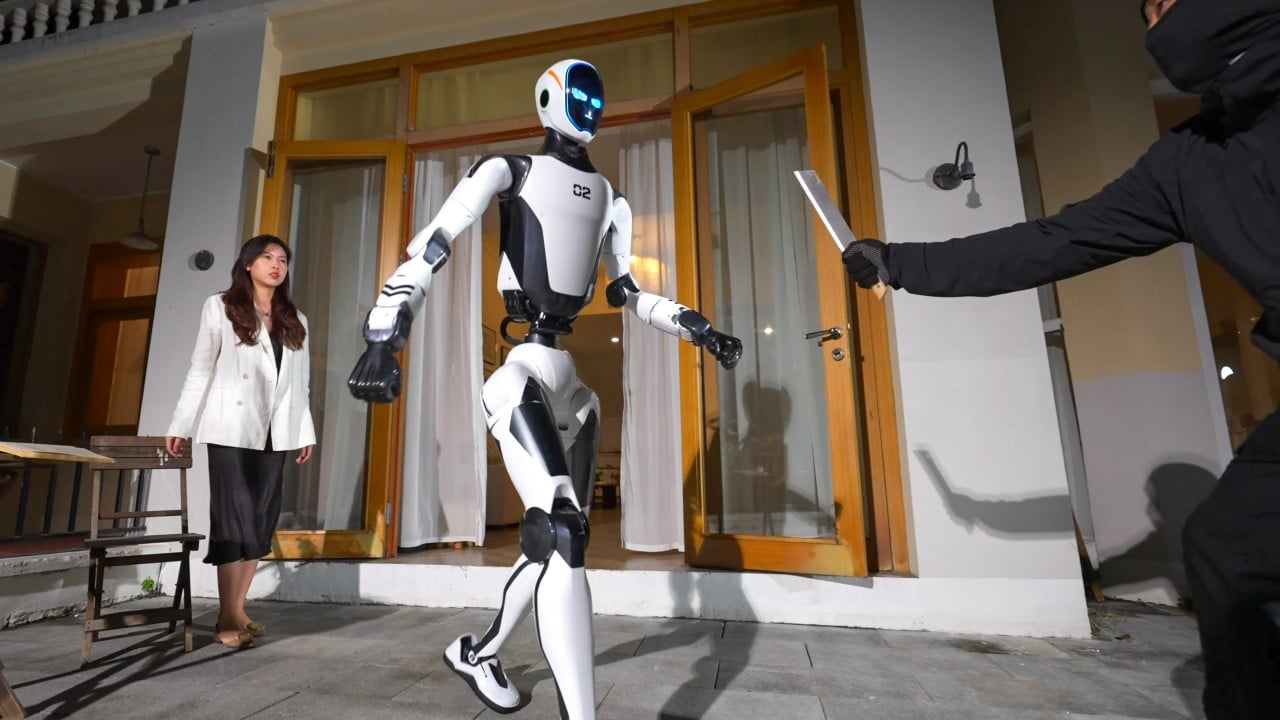
Headline claims about a humanoid "guardian" robot disarming knife attackers and lifting automobiles confuse staged choreography with verified load-bearing performance. Evaluating a platform like Unitree's H2-X requires separating open-loop demonstration footage from closed-loop torque physics, battery draw under load, and legal liability in adversarial environments.
Deconstructing the Guardian Narrative
Promotional clips of a humanoid bodyguard confronting an armed intruder or hoisting a vehicle sell an intuitive story: one versatile machine replaces both security personnel and heavy rescue gear. That framing skips the engineering gap between a choreographed sequence and an unscripted encounter. Recently making news lately: Why Earth and Mars Formed So Differently Right Next Door.
A human attacker with a blade does not move on a fixed trajectory. Disarming an adversary requires low-latency perception, contact-force estimation without crushing a wrist or losing balance, and immediate recovery when the target shifts weight or drops a weapon. Lifting a car creates a different set of constraints: high joint torque concentrated over a short moment arm, high current draw from the battery pack, and structural contact points that do not buckle under a point load.
Competitor coverage typically treats both feats as proof of operational readiness. Treating them as equivalent hides where the real bottlenecks sit. Combat agility stresses dynamic balance and sensor-to-actuator latency; heavy lifting stresses actuator thermal limits, mechanical leverage, and traction. Additional insights regarding the matter are covered by The Verge.
The Three Pillars of Physical Guardian Claims
Every claim made for a security-and-rescue humanoid rests on three distinct subsystems. Weaknesses in any one pillar limit real-world utility regardless of how fluid the video looks.
Actuation and Leverage Physics
Joint torque ratings describe rotational force at a specific axis, not raw lifting capacity at full arm extension. On full-size bipedal platforms in the H2 class, leg joints reach up to 360 N·m while arm joints peak around 120 N·m, with rated continuous arm payloads sitting far lower than peak figures.
Torque translates into force inversely with lever arm length. A joint rated for 120 N·m acting through a 0.69-meter extended arm produces roughly 174 N of vertical force at the tip before accounting for the mass of the arm itself. Lifting even a corner of a passenger vehicle—where a single wheel corner often bears 300 to 500 kg—requires favorable geometry, short moment arms, or structural leverage rather than a straight-arm deadlift.
High-torque bursts also raise winding temperatures in compact permanent-magnet motors and gear reducers. Sustained peak current heats copper windings and softens lubricants, forcing control software to throttle output or enter thermal protection.
Perception and Close-Quarters Control
Disarming an attacker is a contact-rich control problem under uncertainty. Vision systems must track a moving limb, a flexible blade, and shifting body weight simultaneously while avoiding occlusion from the robot's own torso or arms.
Even when perception detects a threat early, actuation speed and compliance determine safety. Rigid position control against a thrashing human risks either failing to hold the limb or causing severe blunt-force injury. Force-torque sensing, compliant control loops, and reliable fall recovery are mandatory when operating within arm's reach of people.
In practice, demonstration videos often rely on rehearsed timing, teleoperation, or tuned policies tailored to a single scenario. The gap between a clean take and an unscripted scuffle remains wide until autonomous closed-loop success rates are published under adversarial conditions.
Energy Budget and Duty Cycle
A humanoid robot carries its own mass plus any payload on a finite battery pack. While promotional summaries frequently cite multi-hour runtime figures, runtime depends heavily on duty cycle.
Walking briskly on flat ground draws a baseline power load. Sprinting, kicking, grappling, or holding heavy loads spikes current draw sharply. A battery rated around roughly 1 kWh can empty quickly during sustained high-torque maneuvers, turning an all-shift security post into a schedule of battery swaps or charging downtime.
The Cost Function of Deployment
Buying the hardware is only the first term in the deployment cost function. For a buyer evaluating a guardian humanoid, total cost of ownership breaks down into five operational drivers:
- Hardware and configuration tier: Base units cost far less than developer or heavy-duty configurations equipped with higher-grade compute modules, specialized end-effectors, or open control interfaces.
- Integration and custom software: Out-of-the-box motion libraries rarely cover site-specific rules of engagement, facility layouts, or edge-case emergency workflows.
- Maintenance and wear parts: High-load bearings, harmonic or planetary gearboxes, joint seals, and battery packs degrade faster when subjected to impacts, falls, and peak torque cycles.
- Support and downtime: Unscheduled faults require spare units, field technicians, or return-to-depot servicing that can sideline a robot for weeks.
- Insurance and legal exposure: Deploying an autonomous or semi-autonomous machine to physically restrain people or lift vehicles around bystanders introduces liability questions that standard commercial policies may price aggressively or exclude.
Consider a facility manager comparing a humanoid guardian against two specialized alternatives: a stationary perimeter camera-and-access system paired with trained human guards, and a dedicated tracked or wheeled rescue/utility machine. Human guards bring judgment, legal accountability, and adaptability across messy social situations; specialized machines bring proven mechanical strength or continuous coverage without bipedal balance risk. A humanoid only wins on cost when its versatility replaces multiple assets without creating new failure modes.
Cause-and-Effect Gaps in Current Coverage
Headline reporting on guardian humanoids tends to stop at the visual spectacle and miss four downstream chains of consequence.
First, higher peak force increases collateral risk. A machine strong enough to pry open a door or lift part of a vehicle can easily break bones or crush equipment if a perception glitch misclassifies a bystander or a slip occurs mid-maneuver.
Second, bipedal center-of-mass dynamics limit pushing and pulling. Applying lateral or upward force to a heavy, uneven object like a car shifts the robot's ground-reaction forces. Without high ground friction and careful foot placement, the robot is more likely to slip or tip backward than hoist the load cleanly.
Third, autonomous force intervention raises legal and regulatory hurdles. Using physical force against a human involves strict rules of proportionality, self-defense, and chain of custody. A robot cannot easily explain intent in court, and remote human teleoperation shifts responsibility to the operator and employer while introducing network latency risks.
Fourth, public visibility alters human behavior. A humanoid that looks like a martial-arts bodyguard can deter petty opportunism, yet it can also provoke aggressive testing, crowding, or panic in public spaces—turning a security asset into a crowd-control hazard.
What Is Known Versus Educated Hypothesis
Separating verified engineering realities from speculation keeps procurement decisions grounded:
- Known facts: Bipedal platforms in Unitree's lineup use multi-degree-of-freedom architectures, high-torque joint actuators, onboard compute, and battery packs capable of dynamic whole-body poses, balance recovery, and targeted commercial or research rollouts. Promotional videos show combat-style maneuvers and vehicle-related stunts.
- Educated hypotheses: Full-scale guardian models will likely see initial traction in controlled demonstrations, specialized security trials, or structured industrial/inspection roles long before they perform unassisted street disarms or routine emergency vehicle extrications. Battery endurance under heavy combat or lifting loads will likely remain a practical constraint in near-term deployments.
Step-by-Step Evaluation Protocol for Buyers
Organizations tempted by guardian-robot demos should run a structured evaluation before committing capital:
- Define the failure budget: Specify what happens if the robot drops a load, misses a moving target, or falls near a person. Eliminate use cases where a single control error causes severe harm.
- Audit autonomy versus scripting: Ask whether demonstrated actions ran autonomously onboard, via remote teleoperation, or through pre-programmed motion sequences, and request unedited multi-trial success rates.
- Measure continuous duty cycle: Test runtime under realistic task loads—including walking, turning, and peak manipulation—rather than idle standing or light walking.
- Verify interface and safety controls: Confirm hardware emergency stops, torque limits, software access needed for integration, and cybersecurity/data handling controls.
- Run a bounded pilot: Deploy in a low-risk, supervised environment with clear escalation to human staff before expanding scope.
No single hardware platform solves physical security, emergency rescue, and general labor at once. High-torque humanoids are advancing fast as mobile manipulation platforms, but treating viral stunts as field readiness leads to misallocated budgets.
The strategic play for security leaders and robotics buyers is to treat humanoid "guardian" releases as R&D and deterrence benchmarks—not turnkey replacements for trained responders—and fund controlled pilots around narrow, high-visibility tasks while keeping human judgment and specialized heavy equipment in command of high-stakes interventions.


