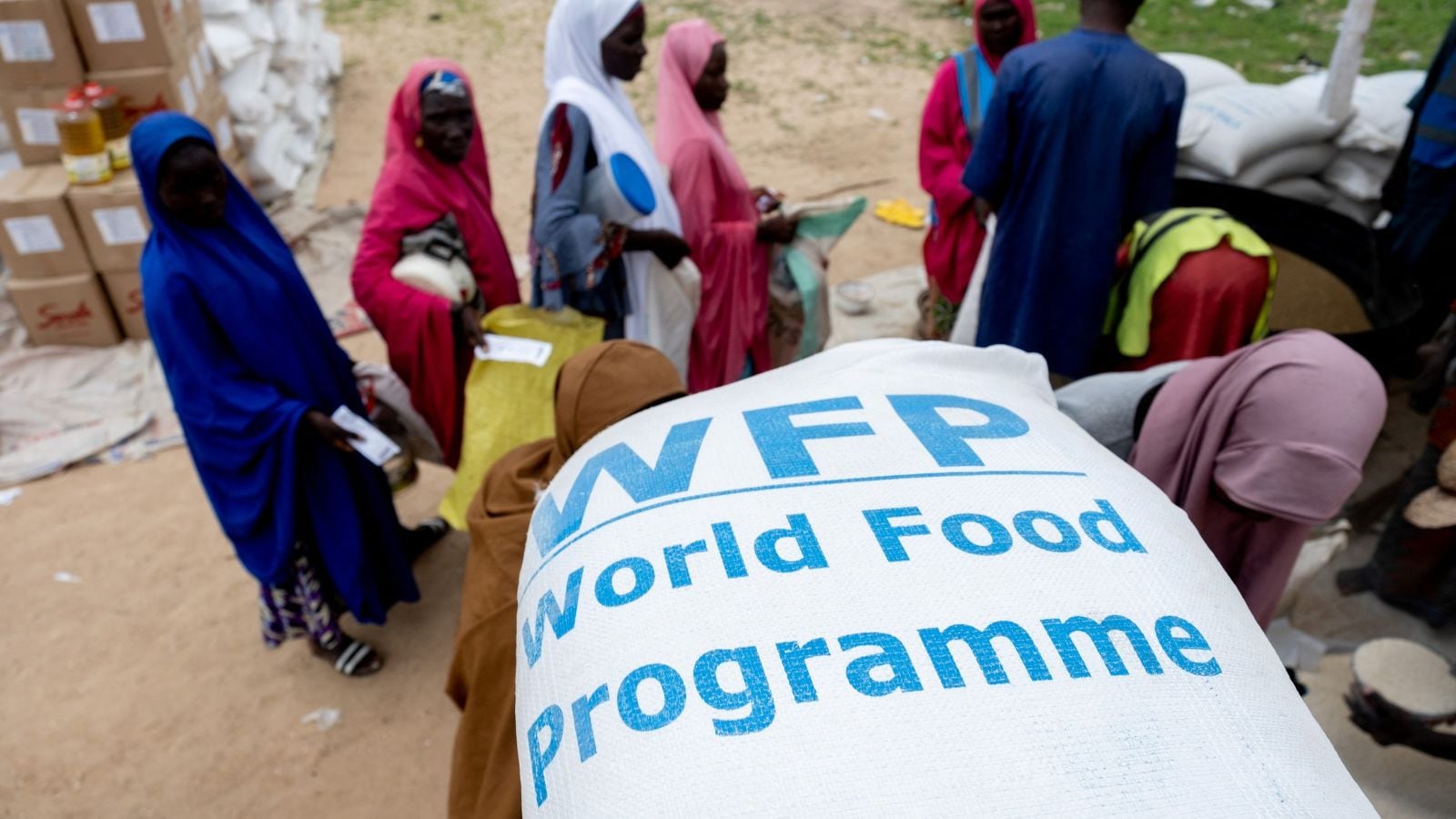
When the United Nations reduces its global food aid target during an accelerating hunger crisis, the decision does not reflect bureaucratic indifference or a miscalculation of human suffering. It represents a forced operational recalibration driven by a widening structural deficit between humanitarian demand and sovereign donor liquidity. To understand why agencies like the World Food Programme (WFP) slash beneficiary lists precisely when acute food insecurity peaks, analysts must discard moralizing commentary and examine the unit economics, supply chain constraints, and capital allocation mechanics governing international relief.
The Architecture of Humanitarian Insolvency
International food assistance operates on a voluntary, non-binding funding model rather than a predictable tax base. Agencies project annual operational requirements based on macroeconomic indicators, climate modeling, and conflict assessments, then appeal to sovereign states for capital commitments. When pledges fall short of projections, the agency faces a hard liquidity wall. Unlike private corporations, humanitarian organizations cannot issue debt to bridge cash flow gaps, nor can they print currency.
This structural reality forces managers to execute triage across three competing variables:
- Breadth of Coverage: The total headcount of recipients receiving some level of caloric or cash support.
- Depth of Ration: The percentage of daily minimum kilocalorie requirements provided per beneficiary.
- Operational Overhead: The fixed and variable costs required to procure, transport, store, and secure commodities in high-risk environments.
When funding contracts while operational overhead rises, an agency cannot maintain both breadth and depth. Cutting the headline target is an accounting acknowledgment that the agency has exhausted its capacity to dilute rations without rendering the intervention biologically ineffective.
The Cost Function of Last-Mile Delivery
A standard error in mainstream coverage of aid reductions is treating a dollar pledged as equivalent to a dollar of food delivered. In practice, the conversion efficiency of humanitarian capital has degraded severely due to compounding friction across the global supply chain.
The unit cost of delivering one metric ton of food assistance is governed by three primary cost drivers:
- Commodity Acquisition Inflation: Global grain, oilseed, and fertilizer markets remain sensitive to geopolitical shocks and extreme weather events. Even when spot prices stabilize from historic highs, forward contracting costs and local market premiums in deficit regions remain elevated above pre-2020 baselines.
- Logistics and Maritime Friction: Transporting bulk commodities from surplus producers to deficit ports requires maritime freight, port handling, and inland trucking. Security disruptions along critical maritime chokepoints force vessel rerouting, driving up fuel surcharges, war-risk insurance premiums, and transit times.
- Access Denial and Security Taxes: Contemporary hunger crises are overwhelmingly concentrated in active conflict zones. Operating in fragmented territories requires negotiated access, armored logistics, airlifts where road corridors are mined or blockaded, and losses from diversion or looting. Air drops can cost up to ten times more per metric ton than overland transport, rapidly draining budget allocations meant for direct food procurement.
Because these variable costs absorb a larger fraction of every donated dollar, a flat budget produces a real-terms contraction in delivered calories. A nominal 20 percent drop in donor contributions frequently translates into a 35 to 40 percent reduction in actual food reaching distribution points.
The Triage Matrix and Ration Dilution Mechanics
Before officially lowering a target population, field commanders attempt to absorb budget shortfalls through incremental ration dilution. If a standard food basket is designed to provide 2,100 kilocalories per person per day—the baseline threshold for maintaining basic physiological function—an agency facing a 25 percent funding gap might reduce the basket to 1,575 kilocalories.
This tactic carries a sharp diminishing return. Below a specific caloric floor, distributed aid ceases to prevent malnutrition and merely slows the rate of physiological deterioration. In households experiencing acute stress, diluted rations are almost always pooled and redistributed among extended family members, further reducing the per-capita intake for vulnerable subgroups such as pregnant women and children under five.
Once ration dilution crosses the threshold of nutritional futility, operational managers must switch from a universal stabilization model to a targeted survival model. This transition requires reclassifying populations using the Integrated Food Security Phase Classification (IPC) scale:
- IPC Phase 3 (Crisis): Households have food consumption gaps reflected by high or above-usual acute malnutrition, or are marginally able to meet minimum food needs only by depleting essential livelihood assets.
- IPC Phase 4 (Emergency): Households have large food consumption gaps resulting in very high acute malnutrition and excess mortality, or face extreme loss of livelihood assets.
- IPC Phase 5 (Catastrophe/Famine): Households have an extreme lack of food and basic needs even after full employment of coping strategies. Starvation, death, and destitution are evident.
Cutting the target number means removing millions of Phase 3 beneficiaries from assistance rolls to preserve full rations for Phase 4 and Phase 5 populations. This is a calculated decision to accept higher rates of asset depletion and chronic stunting among the moderately food-insecure in order to prevent immediate, mass mortality among the starving.
Second-Order Feedback Loops of Aid Withdrawal
The decision to sever support for Phase 3 populations triggers predictable, destructive feedback loops that increase the total cost of the crisis over a 12-to-24-month horizon. These second-order effects rarely appear in initial news reports, yet they dictate the trajectory of regional stability.
Liquidation of Productive Assets
When external food transfers stop, Phase 3 households survive by selling productive assets—breeding livestock, agricultural tools, seeds, and land rights. Because entire communities execute this strategy simultaneously, local markets flood with assets, collapsing their prices while staple food prices surge. Once a farming or pastoralist household liquidates its capital base, it loses the capacity to recover during subsequent favorable weather cycles. The household transitions permanently from temporary crisis into structural destitution, eventually entering Phase 4 and requiring far more expensive emergency intervention the following year.
Forced Displacement and Urban Congestion
Rural populations deprived of localized food assistance migrate toward urban centers or cross international borders in search of functioning labor markets and aid hubs. This sudden demographic shift overwhelms municipal water, sanitation, and healthcare infrastructure. Concentrated populations in makeshift camps experience rapid outbreaks of cholera, measles, and acute respiratory infections. Disease interacts synergistically with malnutrition: a malnourished child is vastly more likely to die from a routine enteric infection, while an infected child cannot absorb nutrients even when food is eventually provided.
Recruitment Elasticity for Non-State Armed Groups
In conflict-affected regions, the withdrawal of international food distribution alters the local political economy. Non-state armed groups, cartels, and local militias often control the remaining illicit trade routes and informal taxation networks. For young men facing household starvation, joining an armed faction becomes a rational economic survival strategy to secure regular food and cash stipends. Aid cuts inadvertently lower the recruitment costs for armed actors, prolonging the very conflicts that caused the food crisis and further restricting humanitarian access.
The Donor Fatigue Fallacy vs. Fiscal Crowding Out
Analysts frequently attribute declining humanitarian budgets to "donor fatigue," a vague psychological term that obscures concrete fiscal mechanics. Sovereign donor behavior is governed by domestic budgetary constraints, interest rate environments, and competing geopolitical priorities rather than emotional exhaustion.
Three macroeconomic forces explain the contraction in humanitarian capital:
- Debt Service Crowding Out: Major OECD donor nations face elevated sovereign debt-to-GDP ratios combined with higher debt-servicing costs. As mandatory interest payments consume larger portions of national budgets, discretionary spending—which includes foreign aid—becomes the primary target for legislative cuts.
- Competing Geopolitical Appropriations: Sovereign foreign assistance budgets are largely zero-sum. Massive capital allocations toward kinetic conflicts in Eastern Europe and the Middle East, alongside domestic refugee hosting costs within donor countries themselves, directly cannibalize funds previously available for chronic crises in the Sahel, the Horn of Africa, and South Asia.
- Bilateralization of Aid: Major donors increasingly favor bilateral aid agreements tied to specific foreign policy objectives, migration control, or strategic resource access, rather than unearmarked multilateral contributions to UN agencies. Un-earmarked funding gives the UN operational agility to shift resources to emerging emergencies; earmarked funding locks capital into donor-preferred geographies, leaving politically unfashionable crises entirely unfunded.
Methodological Limitations of Humanitarian Forecasting
Evaluating the severity of UN target cuts requires understanding the limitations of the data models used to generate those targets. Humanitarian needs assessments rely heavily on remote sensing, satellite imagery, market price monitoring, and periodic household surveys.
In active war zones or regions governed by authoritarian regimes, ground-truth data collection is frequently blocked or manipulated. Agencies must extrapolate food insecurity levels from incomplete datasets. Two distinct analytical risks emerge from this environment:
- Underestimation Bias: When enumerators cannot access besieged cities or remote rural districts, acute starvation goes unrecorded until mortality rates spike visibly. Official target cuts may therefore understate the true scale of human exclusion.
- Baseline Distortion: Agencies calculate funding appeals based on ideal intervention standards rather than realistic absorptive capacity. When an appeal is slashed by 40 percent, it is critical to distinguish between cuts to actual, ongoing food deliveries versus cuts to aspirational expansion plans that faced severe logistical bottlenecks regardless of funding.
Strategic Restructuring for Humanitarian Operators
Relying on traditional emergency food distribution models in an era of structural fiscal contraction guarantees recurring operational failure. To maximize caloric and nutritional outcomes per dollar spent, humanitarian leadership and institutional funders must execute four structural shifts:
- Transition from In-Kind Commodities to Digital Cash Transfers: Where local markets remain functional, shipping physical grain across oceans is economically obsolete. Mobile money and biometric voucher systems eliminate maritime freight, warehousing, and spoilage costs, directing up to 85 percent of every dollar directly to beneficiary purchasing power while stimulating local agricultural supply chains. Limitation: Cash transfers fail in hyperinflationary environments or areas under total blockade where physical food supply is absent; injecting cash into a supply-constrained market merely inflates local food prices.
- Deploy Parametric Insurance and Anticipatory Action: Waiting until a population reaches IPC Phase 4 to mobilize funds guarantees paying peak logistical prices to treat severe acute malnutrition. Agencies must shift capital into pre-arranged financing triggers tied to satellite drought indices and flood forecasts. Releasing drought-resistant seeds, livestock feed, and micro-grants before crops fail prevents asset liquidation at a fraction of emergency response costs. Limitation: Parametric models carry basis risk—the danger that satellite indicators fail to capture localized micro-climatic failures, leaving affected communities without triggered payouts.
- Consolidate Overlapping Agency Mandates: The current UN architecture features significant administrative redundancy across food, agricultural, refugee, and children's agencies. Merging procurement desks, logistics fleets, and biometric registration databases across agencies can strip out hundreds of millions of dollars in duplicated overhead, redirecting fixed administrative costs into front-line rations.
- Enforce Strict Conditionality on Earmarked Capital: UN executives must establish a minimum overhead and flexibility fee on heavily earmarked bilateral grants, using those surcharges to capitalize an un-earmarked rapid-response reserve for underfunded IPC Phase 4 emergencies. Without cross-subsidization mechanisms, the global relief system will remain structurally incapable of responding to acute crises that lack geopolitical sponsorship.


