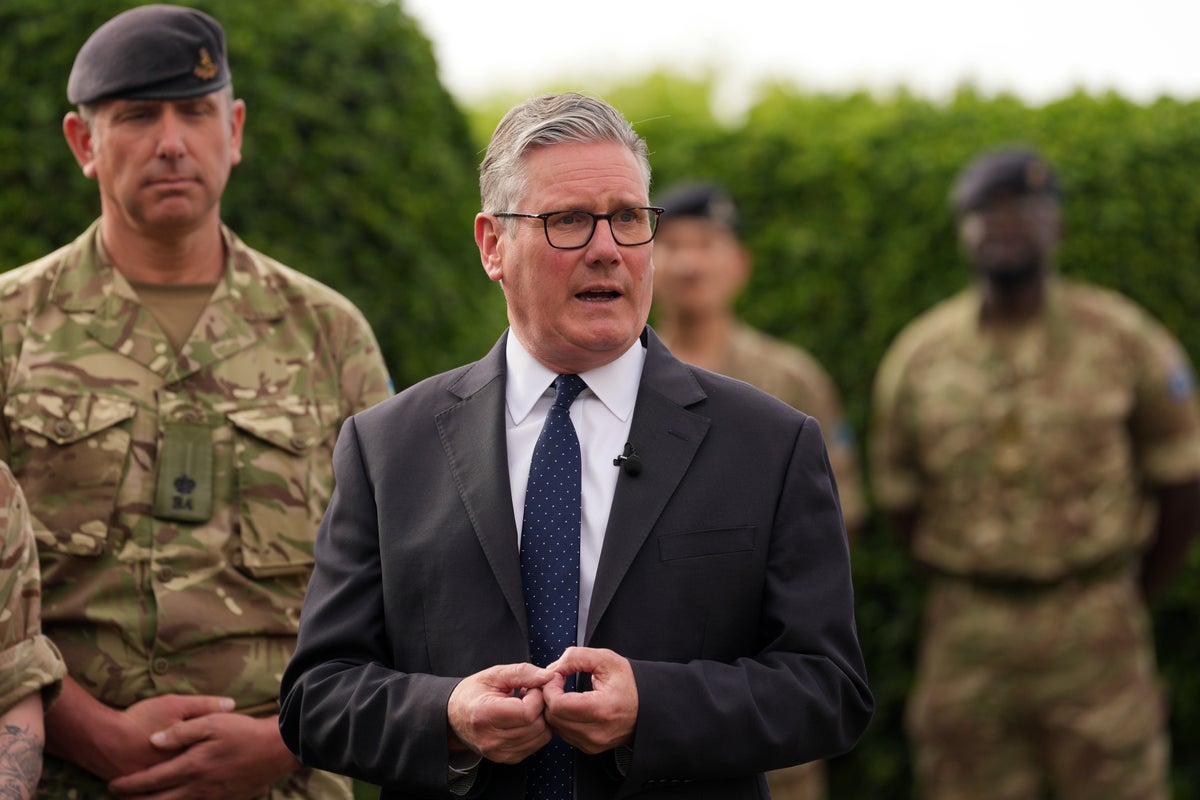
The refusal by Prime Minister Keir Starmer to commit Royal Navy assets to the proposed U.S. blockade of the Strait of Hormuz is not merely a diplomatic disagreement; it is a calculated divergence based on the incompatible operational goals of London and Washington. While the White House under Donald Trump has pivoted toward a "Maximalist Blockade" designed to choke Iranian oil exports and force nuclear concessions, 10 Downing Street has adopted a "Defensive Multilateralism" strategy. This framework prioritizes the restoration of global shipping lanes over the pursuit of regime-altering economic pressure.
This strategic split can be analyzed through three distinct pillars of risk: the Legality of Engagement, the Escalation Ladder of Maritime Interdiction, and the Domestic Economic Cost Function. Don't miss our previous article on this related article.
The Three Pillars of the UK-US Strategic Split
1. The Legality of Engagement
The United Kingdom’s maritime policy is anchored in the United Nations Convention on the Law of the Sea (UNCLOS). Under UNCLOS, a blockade is typically classified as an act of war. Starmer’s government has identified a legal bottleneck: participating in a "blockade" as defined by the White House—which includes interdicting vessels that have paid Iranian tolls—lacks a clear mandate under existing UN Security Council resolutions.
Conversely, the UK-France coalition is framing its involvement as a "Freedom of Navigation" (FON) operation. The objective is protection, not prohibition. By distancing the UK from the "blockade" terminology, Starmer preserves the legal standing to engage in mine countermeasure (MCM) operations without being categorized as an active belligerent in the wider U.S.-Iran conflict. If you want more about the background here, Reuters offers an informative summary.
2. The Escalation Ladder of Maritime Interdiction
The Trump administration’s plan involves "seeking and interdicting every vessel in international waters that has paid a toll to Iran." This introduces a high-frequency friction point. Each interdiction is a potential kinetic trigger.
- The U.S. Mechanism: Offensive interdiction. Force is used to stop, board, and potentially seize non-Iranian vessels to enforce a financial boycott.
- The UK Mechanism: Defensive clearance. The Royal Navy’s contribution is restricted to mine-hunting systems and air defense (Type 45 destroyers) intended to shield tankers from asymmetrical threats.
Starmer's refusal to merge these mechanisms stems from the "Escalation Trap." If a British vessel were to seize a tanker on behalf of the U.S. blockade, the UK becomes a primary target for Iranian IRGC fast-attack craft and "loitering munitions." By maintaining a defensive posture, the UK attempts to keep the conflict localized to U.S. and Iranian interests, avoiding a broader regional conflagration that would permanently shutter the Strait.
3. The Domestic Economic Cost Function
Chancellor Rachel Reeves has explicitly linked the Iran conflict to the "cost of living" crisis. The economic logic driving Starmer’s caution is the Supply-Chain Volatility Index.
A full blockade, even if successful in the long term, causes an immediate supply shock. The Strait of Hormuz carries approximately 20% of the world’s liquid petroleum. A U.S.-led blockade that stops all traffic to and from Iranian ports—as initially suggested by President Trump—risks a "Price Floor Spike" where oil markets price in a total loss of Persian Gulf throughput.
The UK’s strategy is to minimize this spike by focusing on reopening the channel via a broad coalition including France, Italy, and the UAE. This "Stabilization Coalition" aims to lower insurance premiums for commercial shipping, whereas the U.S. blockade strategy arguably increases them by turning the entire waterway into a combat zone.
Quantifying the Maritime Capability Gap
While President Trump has suggested that the UK is "sending minesweepers" to "clean out" the Strait, the operational reality is more constrained. The Royal Navy’s mine countermeasures (MCM) capability is transitionary.
Current UK assets in the region rely heavily on autonomous mine-hunting drones. These systems are highly effective for "silent" clearance but are vulnerable in an active combat environment where air superiority is not guaranteed.
The "MCM Constraint" consists of three variables:
- Detection Latency: The time required to map and neutralize "smart mines" laid by Iran.
- Asset Scarcity: The Royal Navy’s surface fleet is stretched between North Atlantic obligations and the Indo-Pacific.
- Threat Density: The presence of shore-to-ship missiles makes traditional minesweeping hazardous without a massive carrier strike group escort, which the UK is currently reluctant to commit to an offensive blockade.
The Divergence in Crisis Resolution
The breakdown of the Islamabad peace talks highlights the friction between "Maximalism" and "Incrementalism."
- U.S. Strategy (Maximalism): Leveraging the blockade to force a total cessation of Iran’s nuclear program. The blockade is the end-state tool.
- UK Strategy (Incrementalism): Separating the nuclear issue from the maritime security issue. Starmer’s team argues that the Strait must be treated as a global utility, independent of the bilateral nuclear dispute.
This creates a diplomatic bottleneck. By hosting a conference for a "defensive multinational mission," France and the UK are effectively creating a "Third Option" for neutral shipping nations. This coalition provides a platform for countries that want the Strait open but do not want to participate in the "Maximum Pressure 2.0" campaign.
Strategic Forecast: The Emergence of Two Straits
The likely outcome of this divergence is the de facto creation of a two-tiered maritime environment in the Gulf.
- The U.S. Blockade Zone: Focused on the northern routes and Iranian port approaches, characterized by high-intensity interdictions and frequent kinetic exchanges.
- The International FON Zone: A corridor protected by the UK-France led coalition, focused on the deep-water channels and Omani territorial waters, attempting to maintain the flow of non-Iranian energy to global markets.
The success of Starmer’s strategy depends on Iran’s ability to distinguish between the two. If Tehran views the UK-France coalition as a "force multiplier" for the U.S. rather than a neutral protection force, the defensive assets will be targeted regardless of their mission statement.
The immediate tactical priority for the UK is the successful deployment of the "Hormuz Coalition" this week. For the strategy to hold, the UK must secure participation from regional powers—specifically the UAE and Saudi Arabia—to provide the mission with local legitimacy. Without regional "buy-in," the UK risks being caught in the crossfire of a U.S.-Iran naval war with no clear exit ramp and an increasingly volatile domestic energy market.
The strategic play is now a race: can the UK-led coalition stabilize the shipping lanes before the U.S. blockade triggers a kinetic Iranian response that renders the entire Strait impassable? Success requires the UK to maintain a razor-thin distinction between "securing the route" and "blockading the nation."


