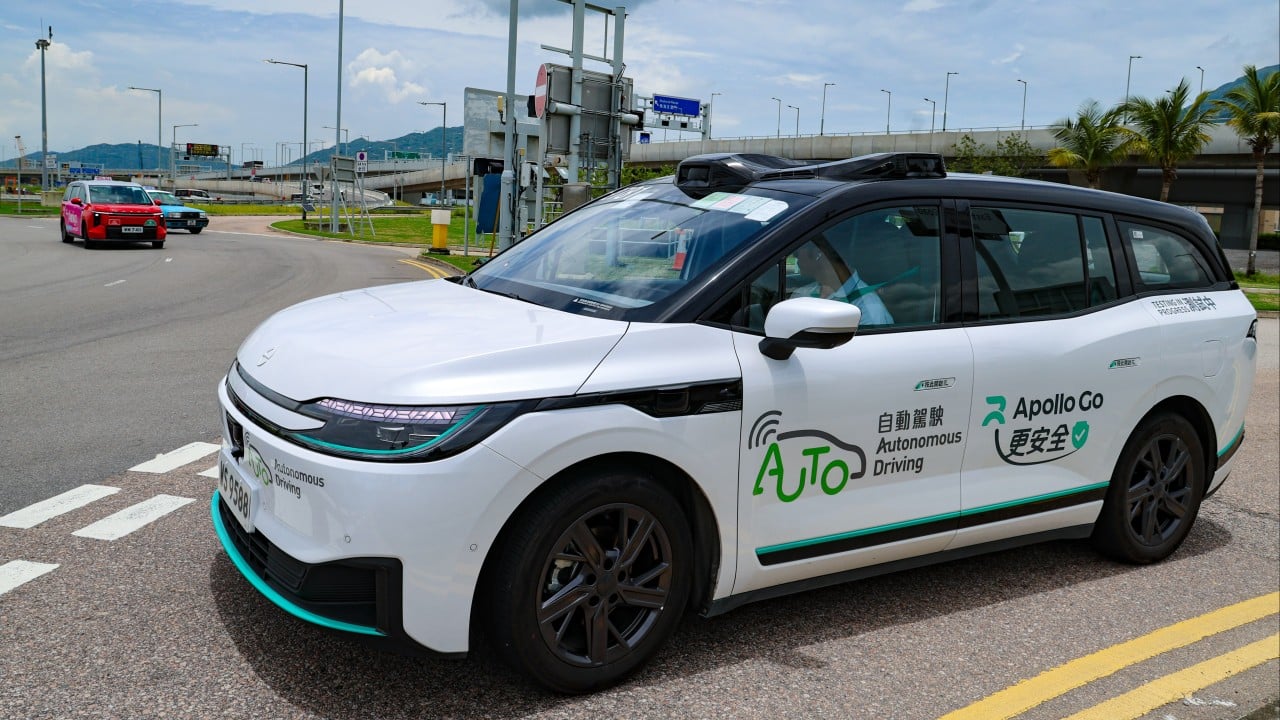
The tech press is currently swooning over Hong Kong’s decision to greenlight Baidu’s autonomous vehicle testing. The narrative is comforting, familiar, and entirely wrong. It goes like this: Hong Kong is a dense, complex urban jungle, and if an AI driver can survive there, it can survive anywhere. By opening the streets to robotaxis, the city is positioning itself as a forward-thinking hub of urban mobility.
It sounds great on a press release. In reality, it is a fundamental misunderstanding of both autonomous technology and urban geography.
Hong Kong is not the ultimate training ground for self-driving cars. It is their graveyard.
The industry is suffering from a collective delusion that sheer density equals a better machine-learning environment. I have spent years analyzing urban transport networks and the deployment of sensor architectures. The harsh truth that nobody in the room wants to admit is that Hong Kong’s unique infrastructure makes widespread autonomy a statistical and operational impossibility.
We are watching a massive misallocation of capital driven by geopolitical posturing rather than engineering reality.
The Topography Trap: Where GPS Goes to Die
The tech sector loves to talk about camera resolution and LiDAR range. They rarely talk about urban canyons.
Autonomous vehicles rely on a multi-layered localization stack. To know exactly where it is within centimeters, a vehicle needs a clear line of sight to global navigation satellite systems (GNSS), supplemented by Real-Time Kinematic (RTK) positioning.
Now look at Central or Mong Kok. You have narrow corridors flanked by skyscrapers wrapped in metallic glass. This creates a severe multipath effect, where satellite signals bounce off buildings before reaching the vehicle. The result is position degradation. A car thinks it is three meters to the left of where it actually is. In a sprawling suburb of Phoenix, Arizona, that error means riding up on a wide concrete curb. In Hong Kong, it means plowing into a dense crowd of pedestrians stepping off a narrow sidewalk.
The Sensor Saturation Crisis
To compensate for broken GPS signals, robotaxis rely heavily on simultaneous localization and mapping (SLAM) via LiDAR and cameras. But Hong Kong presents a visual and spatial chaos that fundamentally breaks standard edge-case logic.
- Double-Decker Occlusion: A standard autonomous vehicle roof pod sits roughly two meters high. In Hong Kong, you are constantly flanked by double-decker buses and trams that completely block the vehicle’s lateral line of sight, blinding its sensors to oncoming traffic or pedestrians emerging from between vehicles.
- Micro-Behaviors: Traffic in Hong Kong does not follow the sterile, rule-bound logic of Silicon Valley test tracks. It operates on aggressive micro-negotiations. Minibus drivers cut across three lanes with inches of clearance based on subtle eye contact. Pedestrians cross whenever there is a physical gap, not when a light changes.
AI models are trained on probability. When a environment becomes too chaotic, the system defaults to its safest programmed action: the hard stop.
Testing Baidu’s Apollo fleet in limited, highly controlled pockets of the New Territories or sunny, wide stretches of Sunny Bay is a parlor trick. It proves the car can drive on a road. It does not prove it can operate a commercial network in the urban core. If you deploy these vehicles at scale in Kowloon, the city will grind to a halt not from crashes, but from phantom braking events as the AI suffers from sensory overload.
The Financial Lie of the Robotaxi Unit Economics
Let’s look at the financial math that the current hype cycle completely ignores. The economic justification for autonomous fleets relies entirely on high utilization rates and low operational costs. The argument is that removing the human driver makes the ride drastically cheaper.
That calculation falls apart the moment you look at Hong Kong’s existing transport efficiency.
+------------------------+------------------------+------------------------+
| Metric                 | Traditional HK Taxi /  | Projected Robotaxi     |
|                        | Minibus Network        | Fleet                  |
+------------------------+------------------------+------------------------+
| Vehicle Capital Cost   | Low ($30,000 - $50,000 | Extreme ($150,000+ per |
|                        | USD equivalent)        | unit with sensor stack)|
+------------------------+------------------------+------------------------+
| Maintenance Overhead   | Decentralized, rapid   | Centralized, highly    |
|                        | roadside fixes         | specialized calibration|
+------------------------+------------------------+------------------------+
| Space Efficiency       | Maximized via dynamic  | High deadheading rates |
|                        | human routing          | due to rigid drop-offs |
+------------------------+------------------------+------------------------+
Hong Kong already possesses one of the most efficient, profitable, and heavily utilized public transit systems on earth. Over 90% of daily journeys happen on public transport. The mass transit railway (MTR) is a masterclass in urban movement. Red and green minibuses fill the gaps with ruthless, hyper-capitalist efficiency, operating on razor-thin margins that no heavily depreciating tech asset can match.
A robotaxi is an incredibly expensive piece of hardware. The LiDAR sensors alone require constant cleaning and recalibration in Hong Kong’s humid, polluted maritime climate. When a human driver bumps a curb in a traditional Toyota Comfort taxi, they bend a rim, swap it out in twenty minutes, and keep driving. When an autonomous vehicle clips a barrier, it misaligns a $10,000 sensor array, requiring the vehicle to be towed to a specialized facility for dynamic recalibration.
The tech companies are entering a market where the baseline competition is already optimized to the absolute limit. They aren't replacing inefficient, single-occupancy private car trips like they are in Los Angeles. They are trying to compete with a world-class subway and a hyper-aggressive minibus network. It is an economic mismatch.
Dismantling the Regulatory Illusion
People look at Hong Kong’s new regulatory framework for autonomous vehicles and assume it paves a smooth road to commercialization. It does the exact opposite.
The regulatory framework is designed to manage risk, not encourage disruption. Governments do not get fired for blocking innovation; they get fired when a driverless car pins a pedestrian underneath its chassis. Because of this structural bias, the operational constraints placed on these trials are suffocating.
The current permits require safety drivers, restricted geofenced zones, and specific operating hours. To move from these theatrical trials to true commercial viability requires the removal of the geofence and the safety driver.
But consider the legal reality of Hong Kong’s tort law system. If an autonomous vehicle causes a fatal accident in an ultra-dense area, where does the liability fall? To the software developer in Beijing? To the local fleet operator? To the safety supervisor sitting in a remote teleoperation center miles away?
While lawyers spend a decade arguing over the chain of liability, the fleet sits idle, burning venture capital.
The Wrong Solution to the Wrong Problem
The most frustrating part of this autonomous gold rush is that it addresses a problem Hong Kong does not have.
Cities like Houston, Dubai, or Atlanta are built for cars. They are vast, fractured landscapes where citizens are trapped in traffic because they have no other choice. In those environments, automation makes sense as a desperate attempt to optimize a fundamentally broken layout.
Hong Kong is a pedestrian city built on a rail spine. It does not need smarter cars; it needs fewer cars.
                                [Urban Space]
                                      |
             +------------------------+------------------------+
             |                                                 |
     [The Delusion]                                    [The Reality]
  Deploy Robotaxis to                               Remove Vehicles to
Optimize Congestion Space                         Reclaim Pedestrian Space
Every square meter of asphalt given over to a vehicle—autonomous or otherwise—is space stolen from a resident. The focus on autonomous testing is a distraction from the real work of urban planning: expanding pedestrian zones, increasing rail capacity, and using micro-mobility to solve the first-mile, last-mile problem.
Adding an AI driver to a vehicle does not change its physical footprint. A robotaxi occupies the same amount of space on Nathan Road as a regular sedan. It still creates congestion. It still prevents the city from pedestrianizing high-density commercial zones.
The Tech Is Being Optimized for the Wrong Geography
The autonomous vehicle industry is fundamentally lazy. It has spent the last decade optimizing algorithms for the grid systems of North American suburbs.
When these companies try to port those models into the hyper-dense verticality of an East Asian metropolis, they discover that the underlying architecture is wrong. The deep neural networks used for object detection are incredibly sensitive to contextual clues. A system trained to recognize a pedestrian standing cleanly on a sidewalk corner struggles when confronted with a crowd overflowing into the gutter, filtered through heavy tropical rain, under a canopy of neon signs and bamboo scaffolding.
To make an autonomous vehicle work safely in Hong Kong’s core, you would need to fundamentally redesign the city itself. You would need to install dedicated physical barriers along every sidewalk to keep pedestrians separate from the sensors. You would need to ban human-driven vehicles to eliminate the unpredictable micro-negotiations that confuse the AI. You would need to strip away the architectural texture that defines the city's character.
We are being told that autonomous vehicles will transform Hong Kong. The engineering and economic reality says otherwise: for the technology to work here, you would have to destroy the city’s efficiency just to save the asset's business model.
Stop looking at the test vehicles humming along the empty roads of the outer districts as a glimpse into tomorrow. They are expensive, heavily subsidized experiments running on borrowed time, operating in environments specifically chosen because they don't represent the actual city.
The future of urban transport in dense environments isn't a smarter car. It is the realization that the car itself is obsolete.