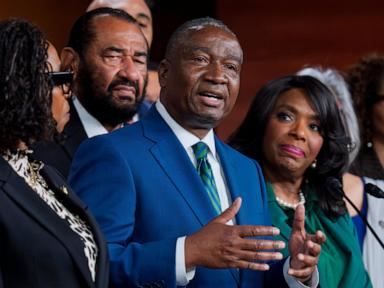
The Congressional Black Caucus (CBC) is facing an existential crisis that money alone cannot solve. While often hailed as the "conscience of Congress," the group is currently staring down a legal and judicial barrel that threatens to roll back fifty years of hard-won representation. The 2023 Supreme Court ruling in Allen v. Milligan may have offered a temporary reprieve for voting rights, but the broader conservative legal offensive against race-conscious redistricting is systematically dismantling the geographical foundations of Black political influence. This isn't just about losing seats in the House of Representatives; it is about the fundamental erosion of the mechanisms used to ensure minority voices aren't drowned out by a white majority.
The math of power is shifting. For decades, the CBC relied on the "majority-minority" district—a geographic area where Black voters make up the majority—to guarantee a seat at the table. However, a series of aggressive legal challenges, coupled with a Supreme Court that has grown increasingly skeptical of race-based remedies, has put these districts in the crosshairs. If the legal definition of "fairness" shifts toward a strictly colorblind interpretation of the Fourteenth Amendment, the CBC could see its numbers decimated in a single election cycle.
The Legal Trap Set for Minority Districts
The current threat stems from a tactical pincer movement. On one side, you have the Voting Rights Act (VRA) of 1965, specifically Section 2, which has long been the primary tool for creating districts where Black voters can elect their preferred candidates. On the other side is a conservative judiciary that increasingly views these very districts as "racial gerrymandering."
In states like Alabama, Louisiana, and Georgia, the fight has moved beyond simple turnout. It is now a war over maps. The Supreme Court's decision in Milligan was a surprise win for voting rights advocates, as the court upheld the requirement to create a second majority-Black district in Alabama. But look closer at the concurring opinions. The victory is fragile. Justice Kavanaugh, the swing vote, hinted that the authority to use race in redistricting might have an expiration date.
This creates a paradox for the CBC. To maintain their numbers, they must argue that race is a defining factor in voting behavior. Yet, the more they emphasize race to justify their districts, the more they feed the argument that these districts violate the Equal Protection Clause by sorting citizens into buckets based on skin color. It is a high-stakes game of legal chicken.
Beyond the Voting Rights Act
The problem goes deeper than a few court cases in the Deep South. The very demographic makeup of the United States is changing, and the CBC’s traditional strategy of geographic concentration is becoming harder to sustain.
The Urban Exodus and Its Political Cost
Black Americans are moving. The Great Migration of the 20th century, which saw millions move from the rural South to Northern and Midwestern cities, has reversed. People are moving back to the South, but they aren't necessarily moving back into concentrated urban centers. They are moving to the suburbs.
When Black voters disperse into suburban tracts, their collective voting power is diluted. In a majority-minority district, 60% of the population might be Black. In a suburban "coalition district," that number might drop to 25% or 30%. In these settings, Black candidates must rely on building alliances with white progressives, Latinos, and Asian Americans.
This shift changes the nature of the "conscience." A representative from a 60% Black district can speak with a specific, unyielding focus on Black interests. A representative from a coalition district must moderate their message to keep a diverse base happy. We are seeing the transition from "Black representation" to "representation by Black individuals," and the two are not the same thing in the halls of power.
The Weaponization of the Fourteenth Amendment
Conservative legal groups, such as the Project on Fair Representation, are no longer just fighting the VRA. They are using the Fourteenth Amendment—originally intended to protect former slaves—as a shield for "colorblindness." Their argument is simple: if the government cannot discriminate against Black people, it cannot "discriminate" in their favor by drawing maps that prioritize their voting power.
This intellectual flip-flop is the greatest threat to the CBC’s longevity. If the courts eventually rule that race cannot be the "predominant factor" in redistricting under any circumstances, the majority-minority district becomes an illegal relic. Without those protected enclaves, the CBC could lose up to a third of its membership in states where polarized voting remains the norm.
The Myth of the Conscience
The CBC has long branded itself as the moral compass of the Democratic Party. They have pushed for criminal justice reform, economic equity, and voting rights when leadership wanted to pivot to "safer" issues. But a conscience only matters if it has a vote that can stop a bill or force a concession.
Power in Washington is a commodity traded in increments of "yes" and "no." For years, the CBC has been the largest bloc within the Democratic caucus. They used that leverage to secure committee chairmanships and steer federal funding. However, as the party becomes more ideologically fractured—split between centrist "New Democrats" and a younger, more vocal progressive wing—the CBC's monolithic influence is being tested.
We are seeing a generational divide within Black politics. Younger activists are often less concerned with the "sanctity" of the CBC and more concerned with immediate results on issues like Gaza, climate change, and student debt. They don't want a conscience; they want a sledgehammer.
The Red States Dilemma
The most brutal reality for the CBC is that its future is being decided in state legislatures where they have zero power. In states like North Carolina and Florida, Republican-controlled legislatures are the ones holding the pens during redistricting.
Take the case of Florida's 5th Congressional District. It was a seat designed to give Black voters in North Florida a voice. Governor Ron DeSantis essentially obliterated it, arguing that the district was an unconstitutional "gerrymander." The resulting map shifted power away from Black voters and toward a more reliable Republican majority.
The CBC can shout from the steps of the Capitol, but they cannot stop a Republican governor from signing a map that erases their colleagues. The federal courts, once the "referees" in these disputes, are increasingly inclined to let these maps stand until it is too late to change them for an election cycle. This "Purcell Principle"—the idea that courts shouldn't change election rules too close to an election—has become a favorite tool for maintaining the status quo, even when that status quo is found to be discriminatory.
Money and the New Frontier of Influence
While the legal battles rage, a new threat has emerged in the form of massive outside spending. Groups like AIPAC and various corporate PACs have begun pouring millions into Democratic primaries to defeat candidates they deem too radical. Many of these targets are members of, or aspirants to, the CBC.
When a candidate has to raise $5 million just to survive a primary against a fellow Democrat, their "conscience" starts to look like a luxury. The CBC’s traditional power base was built on grassroots organization and the church-to-poll pipeline. That pipeline is being bypassed by digital ad buys and dark money.
The investigative reality is that the CBC is being squeezed from the top by the Supreme Court and from the bottom by a campaign finance system that favors the highest bidder. To survive, the group is having to play the very game it once critiqued, raising massive sums of money from the same corporate interests that often stand in opposition to the caucus's stated goals for economic justice.
The Strategy for Survival
If the CBC wants to remain relevant, it has to move beyond the litigation-only strategy. Relying on a conservative Supreme Court to protect Black voting power is a losing game. The pivot must be toward "coalition districts" that are legally defensible under a colorblind standard but politically viable through superior organization.
This means Black candidates must learn to win in districts that are 20% Black, not 55% Black. It requires a different kind of politics—one based on shared economic class rather than shared racial identity alone. It is a risky move. It risks diluting the specific focus on Black issues that the CBC was founded to address.
But the alternative is a slow slide into ceremonial status. A caucus that exists to issue press releases but lacks the votes to kill a bad trade deal or a regressive tax cut is not a conscience; it is a ghost.
The fight for the soul of American representation is not happening in the abstract. It is happening in the granular details of census tracts and the dry language of judicial opinions. The CBC is bracing for a hit because the legal foundations they built their house on are being systematically dismantled. The "conscience" is about to find out exactly how much its voice is worth when the floor beneath it is pulled away.
The next few years will determine if Black political power in America can evolve to survive a hostile judiciary, or if the CBC will become a historical footnote—a temporary peak in a long, downward trend of disenfranchisement. The maps are being drawn now. The money is flowing now. The time for bracing is over; the impact has already begun.
Focus on the state-level battles. That is where the war is won. If the CBC cannot influence the people drawing the lines, they are simply waiting for the inevitable. The only way forward is to build a political infrastructure that doesn't rely on the permission of a court that seems determined to ignore the reality of racial polarization. Expand the map or be erased by it.