The long-standing legal saga surrounding Julius Malema and the 2018 discharge of a firearm at a political rally has finally reached a definitive turning point with a five-year sentencing. For years, the Economic Freedom Fighters (EFF) leader dismissed the incident at Sisa Dukashe Stadium as a non-event, claiming the weapon was a toy and the footage was manipulated. The court, however, found the evidence of live ammunition and the endangerment of thousands of civilians far more persuasive than the defense’s theatrical deflections. This verdict does more than just punish a single act of recklessness. It tests the structural integrity of South African law against the weight of populist influence.
The Night at Sisa Dukashe
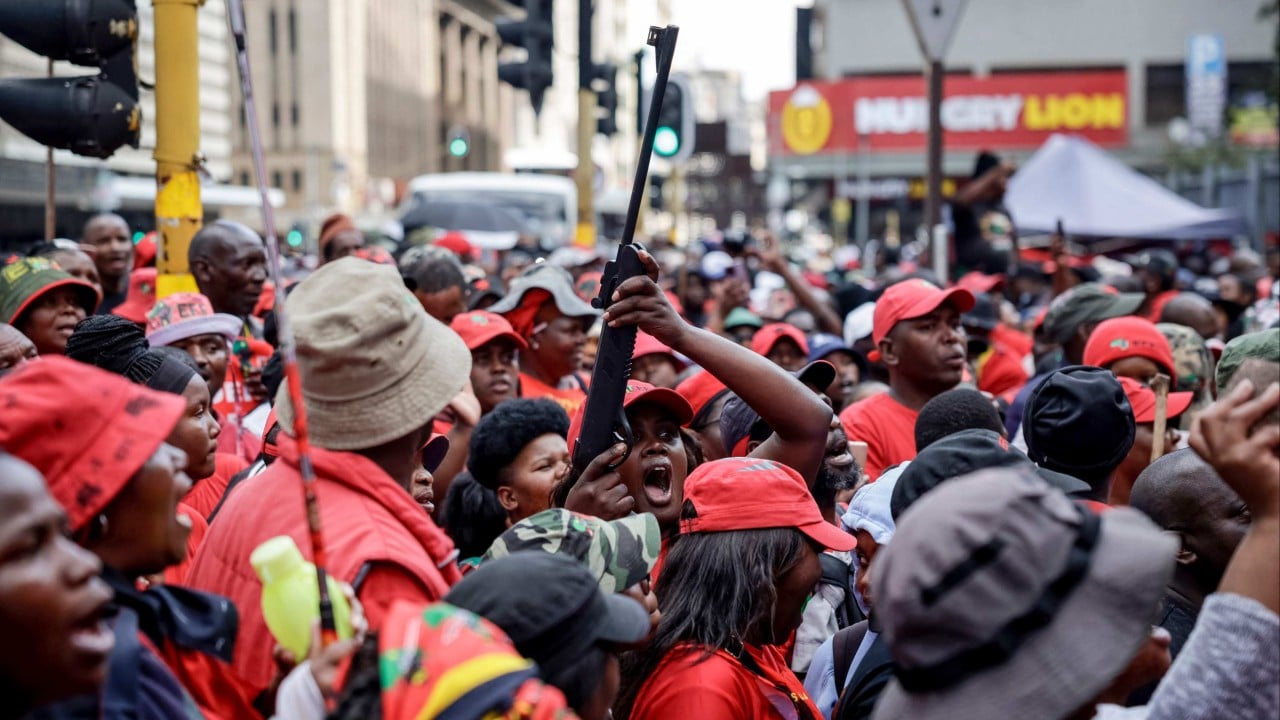
The incident occurred during the EFF’s fifth-anniversary celebrations in Mdantsane. In front of a packed stadium, Malema was captured on video receiving what appeared to be an assault rifle from a security guard, Adriaan Snyman, and firing it into the air multiple times. The sheer audacity of the act was staggering. In a country grappling with one of the highest violent crime rates in the world, a prominent lawmaker discharged a high-caliber weapon in a confined space filled with supporters.
The defense spent years attempting to obscure the mechanical reality of that night. They argued the flashes were pyrotechnics and the "rifle" was a prop used for symbolic effect. Ballistic experts and forensic analysis eventually stripped away those layers of denial. The court identified the weapon as a real firearm, specifically a 5.56mm caliber rifle. The sentencing reflects the gravity of mishandling such a weapon, emphasizing that political status provides no immunity from the Firearms Control Act.
Politics as a Shield
Malema has mastered the art of the courtroom spectacle. Every appearance is framed as a battle against a "white monopoly capital" judiciary or a politically motivated hit job by the ruling ANC. By turning legal proceedings into rallies, the EFF creates a pressurized environment where any guilty verdict is pre-emptively branded as an assault on the poor.
This strategy works because it exploits genuine frustrations within the South African electorate. When Malema stands on the steps of the court and claims he is being persecuted for "singing the songs of the struggle," he successfully pivots the conversation away from the specific crime—reckless endangerment—toward a broader narrative of systemic oppression. However, the five-year sentence signals that the judiciary is currently unwilling to let political narratives override forensic facts.
The Failure of Internal Oversight
One must ask how a Member of Parliament managed to obtain and fire an automatic weapon at a public event without immediate intervention from the South African Police Service (SAPS) members present. The delay in prosecution, which stretched over half a decade, points to a broader crisis in law enforcement. There is a palpable hesitation to confront high-ranking political figures, a fear that doing so will ignite civil unrest or accusations of bias.
This hesitation creates a vacuum where figures like Malema feel comfortable operating outside the law. If the police had acted on the night of the incident, the evidence would have been secured instantly, and the years of "was it a toy?" debates would have been avoided. The five-year sentence is an attempt by the court to retroactively restore a sense of order that the executive branch failed to maintain on the day of the rally.
The Adriaan Snyman Factor
Often lost in the headlines is the role of Adriaan Snyman, the security director who handed Malema the rifle. His conviction alongside the EFF leader is a critical component of this case. It addresses the "enabler" culture within private security and political entourages. By holding Snyman accountable, the court is sending a message to the private military and security industry: loyalty to a client does not supersede the law.
The relationship between political leaders and private security firms in South Africa is often opaque. These firms sometimes operate as paramilitary wings for political movements, providing more than just protection. In this instance, the security apparatus facilitated a criminal act to enhance a leader's "strongman" image. The sentencing of the man who provided the gun is just as significant as the sentencing of the man who pulled the trigger.
Implications for the EFF Leadership
The South African Constitution is clear on the eligibility of Members of Parliament. Anyone sentenced to more than 12 months in prison without the option of a fine is generally disqualified from serving in the National Assembly. A five-year sentence is a potential career-killer for Malema, provided the appeals process does not drag on for another decade.
Survival of the Red Berets
The EFF is a personality-driven movement. Unlike the ANC, which has a century of institutional weight, or the DA, which relies on a rigid administrative structure, the EFF is synonymous with Julius Malema. If he is removed from the equation, the party faces an existential crisis. There is no clear successor with his charisma or his ability to command a news cycle.
Opponents of the EFF view this as a necessary pruning of a radical element in South African politics. Supporters see it as a martyrdom that will only fuel the fire of their movement. But beneath the rhetoric lies a cold legal reality: a political party cannot operate as a law unto itself if it wishes to participate in a constitutional democracy.
The Ballistics of Populism
The use of a firearm was not accidental symbolism. It was a calculated display of power. In the iconography of the EFF, the "soldier" and the "struggle" are central themes. Firing a rifle is the ultimate manifestation of that brand. It suggests that the party is ready for "war" against the status quo.
The court’s decision to impose a heavy sentence suggests an understanding that this wasn't just about a gun. It was about the normalization of violence in political discourse. When a leader fires a weapon in a stadium, he is telling his followers that the tools of destruction are acceptable props for political expression. The five-year term is a firm rejection of that premise.
Judicial Independence Under Pressure
South Africa’s judiciary has remained one of the few functional pillars of the state. While the power grid fails and the railways are stripped for scrap, the courts have continued to deliver judgments against the most powerful men in the country, from Jacob Zuma to Julius Malema.
However, this independence is under constant threat. Every time a high-profile politician is sentenced, the judges are subjected to doxxing, threats, and public vilification by partisan supporters. The five-year sentence for Malema is a brave act in this climate, but its effectiveness depends entirely on the state's ability to actually enforce it. If the sentence is tied up in a perpetual loop of appeals and "medical parole" maneuvers, the message of accountability is lost.
Comparing the Precedents
When we look at other instances of political violence or illegal firearm use, the consistency of the law is often questioned. Critics of the Malema verdict point to unsolved political assassinations in KwaZulu-Natal or the lack of prosecution for state-sponsored violence. They argue that Malema is an easy target because his actions were caught on camera, while more "dangerous" criminals in government go free.
While there is some merit to the argument of inconsistent policing, it does not absolve the specific crime. One cannot argue for the right to fire an assault rifle into a crowd because someone else got away with corruption. The law must start somewhere. By starting with a high-profile case involving clear video evidence, the judiciary is attempting to set a baseline.
The Logistics of the Appeal
Malema’s legal team will undoubtedly move to appeal the conviction and the sentence. They will likely argue that the court failed to prove the weapon was capable of firing live rounds or that the sentencing is disproportionate for a first-time offender where no one was physically harmed.
This process will take months, if not years. During this time, Malema will remain a free man and continue his political activities. The danger for the South African state is that the delay will allow the narrative to shift from "criminal act" to "political persecution." The speed of the appeal process will be just as important as the original trial in determining whether this sentence holds any weight.
A Warning to the Political Class
The culture of impunity in South African politics has been a defining feature of the post-Mandela era. From the "Firepool" at Nkandla to the millions lost in the VBS Mutual Bank scandal—which, notably, the EFF leadership has been heavily linked to—the assumption has been that if you are powerful enough, the rules do not apply.
The Malema sentencing is a crack in that wall. It tells the political class that their theater has consequences. You can dance on a stage, you can shout into a microphone, and you can promise the earth to your followers, but the moment you pick up a weapon and threaten the safety of the public, the state will eventually catch up to you.
The rifle fire at Sisa Dukashe was meant to sound like a revolution. Instead, it has become the sound of a leader being boxed in by the very laws he swore to uphold as a member of the legislature. South Africa does not need leaders who treat weapons as toys or stadiums as firing ranges. It needs a return to the boring, stable, and essential rule of law.
The five-year sentence is not a victory for any political party, but it is a necessary defense of the public square. If a man can fire a rifle into a crowd and walk away because he holds a seat in Parliament, then the Constitution is nothing more than a piece of paper. The court has decided that the paper still matters.