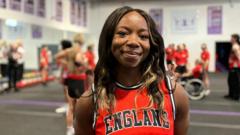
The tarmac at Heathrow is currently a staging ground for a quiet revolution. Dozens of athletes, many using wheelchairs or managing sensory processing disorders, are boarding flights bound for Orlando, Florida. They aren’t going for a holiday. These members of the Team England Adaptive Abilities (AA) squad are heading to the ICU Junior World & World Cheerleading Championships. While the general public often views cheerleading through a lens of pompoms and sideline support, this specific discipline is a brutal, high-stakes display of synchronization between disabled and non-disabled athletes. It is one of the most complex team dynamics in modern athletics, and England is currently a global powerhouse.
Adaptive Abilities cheerleading is built on a "Unified" model. It requires a precise ratio of athletes with disabilities (para-athletes) to those without. The goal is simple: create a routine where every member is essential, and the disability becomes a mechanical factor rather than a limitation. If a wheelchair user is at the base of a stunt, their core strength and wheel-locking timing must be as reliable as a gymnast's footing. One slip of a hand or a mistimed count doesn't just lose points; it creates a physical hazard for everyone on the blue mat.
The Mechanical Reality of the Blue Mat
The technicality of adaptive cheerleading is often misunderstood by those outside the sport’s inner circle. This isn't a "participation" event. The ICU (International Cheer Union) scoring system is rigid, focusing on technique, difficulty, and execution. For the England squad, the preparation involves a grueling 12-month cycle of conditioning that treats the human body and the wheelchair as a single machine.
When you watch a routine, you see the "flyer"—the athlete being tossed or lifted into the air. In adaptive divisions, the "base" supporting that flyer might be an athlete with a lower-limb impairment. This changes the physics of the lift. Instead of using leg drive to propel the flyer, the power must come entirely from the shoulders and the structural integrity of the chair. It is a grueling test of upper-body torque.
The England coaches don't look for sympathy; they look for stability. They analyze the center of mass for every stunt. If a flyer is transitioning from a "prep" to an "extension" (holding them fully above the head), the athletes on the ground must compensate for any involuntary tremors or muscle spasms their partners might experience. It is a dance of micro-adjustments that happens in milliseconds.
Funding the Dream on a Shoestring
Despite their status as defending champions and top-tier contenders, these athletes operate in a financial shadow. Unlike football or rugby, cheerleading in the UK does not benefit from massive injections of government cash or high-profile broadcast rights deals. For the athletes heading to Florida, the trip is largely self-funded.
The costs are staggering. Between flights, specialized equipment, medical chaperones, and the "pay-to-play" fees associated with international competition, an individual athlete can easily look at a bill exceeding £3,000. For many families, this is a prohibitive barrier. We are seeing a situation where the best athletes in the country might be left behind not because of a lack of skill, but because of a lack of capital.
This financial pressure creates a secondary level of stress. While American teams often have the backing of massive collegiate programs or private donors, the English squad relies on bake sales, crowdfunding, and small-scale local sponsorships. It is a scrappy, blue-collar approach to a world-class sport. The irony is palpable: England produces some of the most technically proficient adaptive cheerleaders in the world, yet the system forces them to beg for the right to represent their flag.
The Logistics of Inclusion
Taking a team of athletes with diverse physical and neurological needs across the Atlantic is a logistical nightmare. It involves more than just booking a block of hotel rooms. The coaching staff must manage "quiet rooms" for athletes with autism to prevent sensory overload during the deafening roar of the ESPN Wide World of Sports Complex. They have to coordinate with airlines to ensure that custom-built, £5,000 wheelchairs aren't crushed in the cargo hold—a frequent and devastating occurrence for disabled travelers.
The medical team is also under intense pressure. They aren't just there for twisted ankles. They manage complex medication schedules and monitor for autonomic dysreflexia, a potentially life-threatening condition for athletes with spinal cord injuries. The level of care required is akin to a touring medical clinic.
Why the Florida Gold Matters
Winning in Florida isn't just about a trophy for the mantelpiece. For the adaptive community in the UK, it is a proof of concept. Every gold medal won by Team England serves as a rebuttal to the "inspiration porn" narrative that often plagues disabled sports. These athletes don't want to be told they are "brave" for showing up; they want to be judged on the height of their basket tosses and the sharpness of their motions.
The rivalry with the United States is fierce. The Americans have the numbers and the infrastructure, but the English have developed a reputation for "clean" execution. In cheerleading, "clean" means perfection in unison—every arm at the same 45-degree angle, every head turning at the same beat. The English squad has mastered the art of the "visual," using the movement of wheelchairs to create geometric patterns that are impossible for standing teams to replicate.
The Evolution of the Sport
We are currently seeing a shift in how adaptive cheerleading is structured. The "Adaptive Abilities" category is expanding, with more focus on including athletes with visual impairments and hearing loss. This introduces new challenges. How do you time a backflip when you can't hear the music? The answer lies in tactile cues—a tap on the leg or a specific vibration through the floor.
England has been at the forefront of developing these cues. They use a system of non-verbal communication that allows the team to function as a single organism. This isn't just about sport; it is about communication theory in practice. They are rewriting the rulebook on how teams collaborate under pressure.
The Mental Toll of the Spotlight
There is a specific kind of pressure that comes with being a "first." Many of these athletes are the first from their towns or schools to reach this level. They carry the weight of being ambassadors for disability in a society that still struggles with basic accessibility.
When the lights go up in Orlando, the humidity is thick and the crowd is screaming. The mental fortitude required to hit a perfect routine in that environment is immense. Athletes must block out the distraction of cameras, judges, and the knowledge that one mistake could invalidate a year of sacrifice. The England squad utilizes sports psychologists to prepare for this specific sensory assault. They practice in high-noise environments to desensitize themselves to the chaos of the World Championships.
The Barrier of Recognition
A major hurdle remains the status of cheerleading itself. While the International Olympic Committee has recognized cheerleading, it still struggles to be seen as a "real" sport by the average sports fan in the UK. This lack of status trickles down into everything—from the quality of training facilities available to the team to the level of media coverage they receive.
If this were the England football team, their departure for a World Cup would be front-page news. Instead, the adaptive cheerleaders often find themselves relegated to the "and finally" segment of local news. This disparity is a bitter pill to swallow for athletes who train 20 hours a week on top of full-time jobs or education. They are elite performers operating in a vacuum of public indifference.
The Florida Gauntlet
The competition in Florida is a multi-day gauntlet. Preliminary rounds weed out the inconsistent, leaving only the powerhouses for the finals. The margin between gold and silver is often less than a single point. In the Adaptive Abilities divisions, judges look specifically for how well the "unified" partners integrated. If the non-disabled athletes appear to be doing all the heavy lifting, the score plummets.
True integration is the metric. The England squad’s strategy involves high-frequency transitions—moving athletes in and out of stunts rapidly to show that every person on the mat is a vital gear in the machine. It is a high-risk strategy. The more transitions you have, the more opportunities there are for a "drop." But it is this willingness to take risks that has put England on the map.
The Technical Breakdown of a Winning Routine
A winning routine is 2 minutes and 30 seconds of controlled violence. It starts with a "shout" or a "chant," a nod to the sport’s roots, but quickly pivots into high-level tumbling. Even in the adaptive divisions, you will see athletes performing standing back tucks and layout twists.
The "stunt" sequences are the heart of the performance. For Team England, this often involves "pyramids" where multiple groups link together. In the adaptive category, this might involve a wheelchair user being braced by two standing athletes while they lift a third athlete into the air. The physics of this require the wheelchair user to have immense core stability to prevent the chair from tipping under the shifting weight.
The Sensory Factor
For athletes with neurodivergence, the "performance" starts long before the music begins. The feel of the uniform, the smell of the hairspray, and the brightness of the stage lights can all be triggers. The England coaching staff has pioneered a "graduated exposure" model, slowly introducing these elements into practice sessions over months. By the time they reach Florida, the environment feels familiar rather than threatening. This level of athlete-centric coaching is what separates the English program from its competitors.
The Future of the Discipline
As the team prepares to take the floor, the focus is entirely on the next 150 seconds. But the implications of their performance will last much longer. A successful run in Florida will provide the leverage needed to lobby for more inclusive sports funding back home. It will provide the footage that inspires the next generation of disabled children to see themselves as athletes rather than spectators.
The true victory isn't the gold medal; it is the destruction of the "disabled" label as a synonym for "incapable." On the blue mat, there are only athletes, gravity, and the relentless pursuit of a perfect score.
The squad knows that once they step into that arena, the excuses stop. The judges don't care about the flight delays, the broken wheelchairs, or the lack of funding. They care about the extension of the arms and the height of the jump. England is ready to deliver.
Go to the gym. Find a local club. Look at the sheer athleticism of an adaptive stunt. Stop calling it "sweet" and start calling it "elite." Only then will the culture catch up to the reality of what these athletes are achieving.