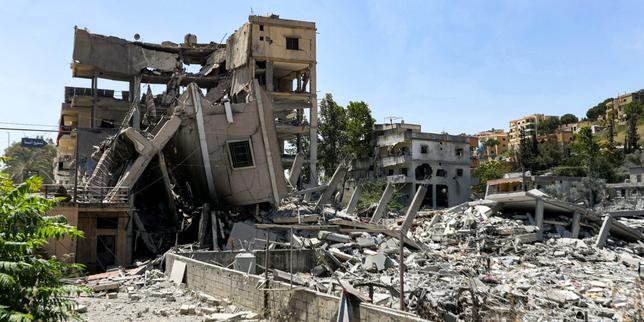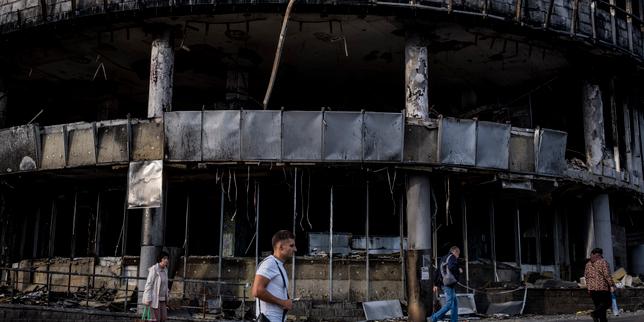
The relentless intensification of Russian missile and drone campaigns against Ukrainian territory is driving the national economy toward a critical threshold, threatening to shave over a percentage point off the gross domestic product as winter approaches. Beyond the immediate humanitarian cost of blackouts and shattered residential blocks, a quieter war of attrition is playing out across balance sheets, corporate ledgers, and state budgets. Moscow's strategy has evolved past isolated tactical bombardments, morphing into a calculated campaign designed to exhaust the financial and structural foundations that keep the Ukrainian state functioning.
The Anatomy of Industrial Attrition
When energy infrastructure becomes a primary target, the damage ripples outward with mathematical precision. Power plants, high-voltage substations, and regional distribution networks do not merely require physical reconstruction; their destruction halts the secondary and tertiary industries dependent on uninterrupted energy. Manufacturing plants operate at fractional capacities, supply chains fragment under rolling emergency blackouts, and corporate revenue plummets.
Consider a mid-sized metallurgical or machine-building facility in the central regions. Without steady grid power, reliance on diesel generators multiplies operational costs exponentially, rendering production economically unviable on global markets. When overhead costs surge while output drops toward zero, commercial enterprises default on loans, tax revenues evaporate, and the state finds itself attempting to patch gaping holes in public finances while simultaneously funding an existential defense effort.
The Fiscal Squeeze on Public Administration
The macro-level consequences are stark. Public finances are stretched to breaking point as tax receipts from devastated industrial sectors decline. National authorities have been forced to allocate massive emergency funding toward grid stabilization, emergency repairs, and civil protection, drawing resources away from long-term economic development.
Furthermore, international financial assistance, once viewed primarily as a tool for stabilization and growth, is increasingly absorbed by basic survival mechanics. Reports indicate that portions of foreign aid are being utilized simply to cover fundamental public sector obligations, including state salaries, leaving little room for structural economic stimulus. The compounding effect of these pressures creates a fiscal bottleneck that threatens to outlast short-term military aid packages unless countermeasures are scaled up proportionally.
Logistics and the Regional Ripple Effect
The economic shockwaves do not stop at Ukraine's borders. The disruption of agricultural processing and transport logistics affects regional and global food security. Grain silos, railway hubs, and port access points targeted during these aerial barrages create bottlenecks that stall export revenues. For an economy that historically relied heavily on agricultural and industrial exports to maintain a stable currency and trade balance, every week of logistical paralysis compounds the deficit.
As the winter season closes in, the pressure mounts on municipal heating systems and urban centers, demanding extraordinary diversion of capital toward emergency heating solutions rather than productive economic investments. The financial margin for error has vanished, leaving the national economy uniquely vulnerable to the rhythm of the air war overhead.