The fluorescent lights of a Denny’s in East San Jose do not flatter anyone, least of all a thirty-year-old engineer staring at the bottom of a lukewarm coffee mug.
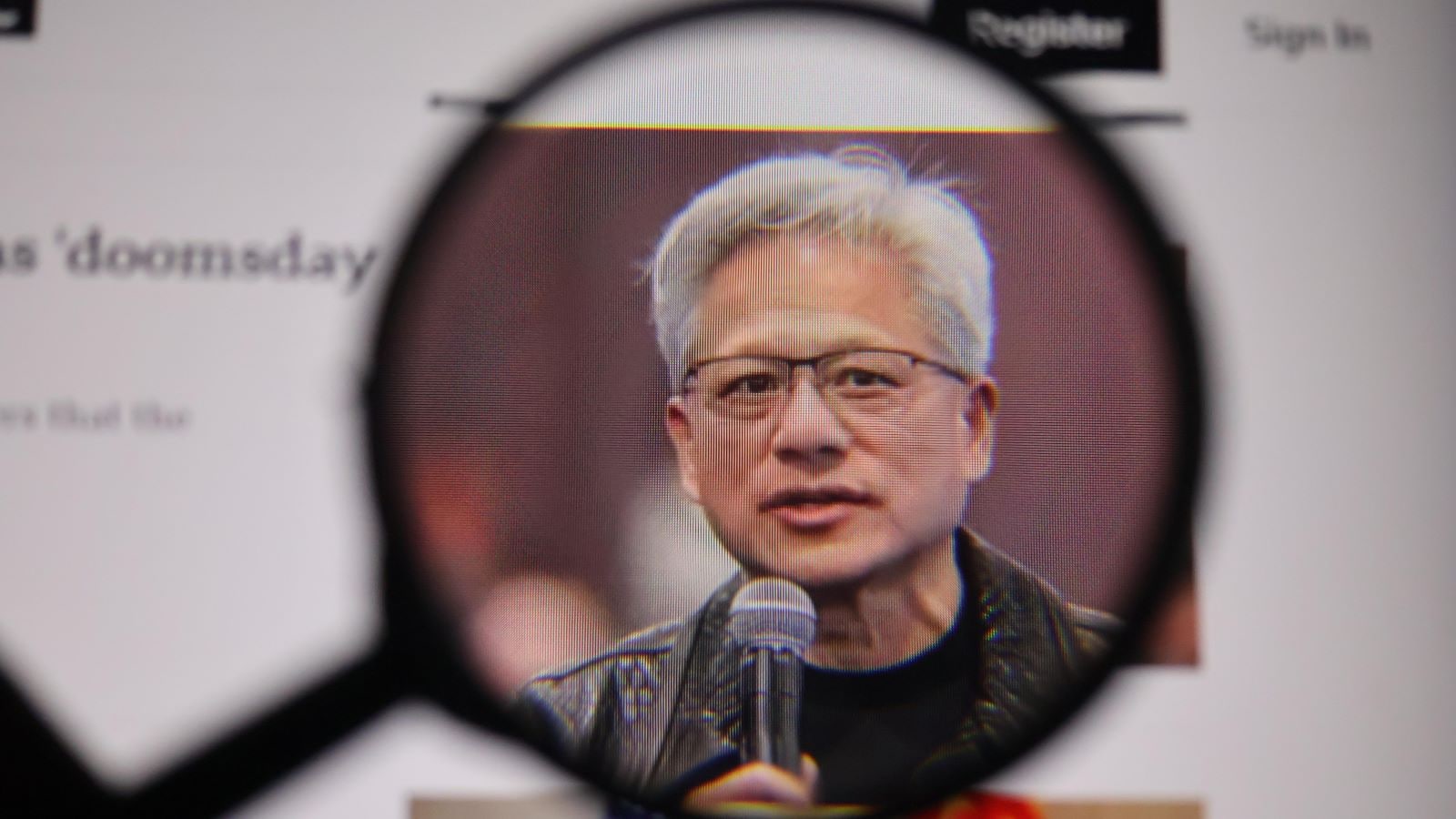
In 1993, before the three-trillion-dollar valuations, before the stadium keynotes where grown men wept like teenagers at a Beatles concert, and before the black leather jacket became the most recognizable uniform in Silicon Valley, Jensen Huang was just a guy trying to keep his booth warm. Alongside Chris Malachowsky and Curtis Priem, he sketched the future of graphics processing on paper napkins, fueled by cheap diner coffee and the terrifying certainty that if they failed, they would have to explain to their families why they walked away from safe, respectable jobs at Sun Microsystems and LSI Logic. Learn more on a similar topic: this related article.
Fast forward three decades. The diner booth is gone, replaced by the roaring arena of Computex in Taipei. Huang stands center stage, bathed in emerald light, signing autographs on the chest of a swooning fan. Wall Street analysts treat his quarterly earnings calls like papal encyclicals. At its peak, Nvidia wasn't just a semiconductor company; it was the sole tollbooth on the highway to artificial intelligence, commanding over eighty percent of the market for AI accelerators and minting millionaires out of mid-level software engineers.
Then, gravity remembered his name. Further analysis by MarketWatch explores comparable views on this issue.
When a leader ascends to the status of an infallible tech oracle, the fall does not look like a sudden cliff. It looks like a slow, agonizing erosion of certainty. It looks like a trillion dollars evaporating from a ticker symbol while the rest of the world quietly learns how to route around your moat. To understand how Jensen Huang tumbled from untouchable deity to embattled incumbent, you have to look past the stock charts and examine the quiet desperation of the people who built his empire—and the ones who finally decided they couldn't afford to pay his rent anymore.
The Architecture of a Golden Cage
Consider a hypothetical infrastructure lead—let’s call her Elena—working at a mid-sized cloud provider in Northern Virginia.
For two years, Elena’s entire professional existence revolved around a single, humiliating ritual: begging Nvidia for allocation. If she wanted H100 GPUs, she didn't just place an order; she auditioned. She had to prove her company’s clusters would be utilized efficiently, accept staggering price hikes without blinking, and sign multi-year commitments that devoured her capital expenditure budget whole. Inside the freezing, deafening aisles of her data center, where rows of server racks hummed like a jet engine preparing for takeoff, every green LED blinking back at her represented a massive transfer of wealth straight to Santa Clara.
Elena didn't stay loyal because she loved Nvidia's hardware. She stayed because of CUDA.
To understand why the tech world tolerated Huang’s near-monopoly for so long, think of CUDA not as a piece of software, but as a city built entirely out of proprietary bricks. For nearly twenty years, while competitors obsessed over making faster chips, Huang quietly gave away the tools that allowed developers to talk to those chips. Millions of lines of academic research, financial modeling, and neural network training were written specifically in CUDA’s dialect. Switching to a rival chip wasn't like changing brands of gasoline; it was like translating an entire library of ancient texts into a language nobody on your staff spoke yet.
For years, that software moat made Huang untouchable. He pushed the company forward at a relentless, punishing cadence—shifting from a two-year product cycle to an annual one, introducing the Blackwell architecture before customers had even finished unpacking their Hopper servers. Inside Nvidia’s headquarters, the flat organizational structure meant sixty vice presidents reported directly to Huang. He didn't hold one-on-one meetings; he preferred public critiques in front of peers, a high-pressure crucible designed to burn away complacency.
It worked brilliantly. Until the math stopped working for everyone else.
When the Bill Comes Due
I have sat in boardrooms where chief financial officers stared at AI infrastructure projections with the pale, hollow-eyed look of people watching a slow-motion car crash. The dirty secret of the generative AI boom was never the technology itself; it was the unit economics.
By late 2024 and into 2025, the industry hit a wall of cold, hard arithmetic. Hyperscalers—Microsoft, Google, Amazon, Meta—had poured hundreds of billions of dollars into Nvidia silicon, racing to build digital cathedrals for large language models. Yet the revenue flowing back from enterprise software subscriptions was a trickle compared to the ocean of cash flowing out to buy GPUs. You cannot spend fifty billion dollars on data centers to generate five billion dollars in chatbot upgrades forever.
Wall Street, fickle and merciless, began asking an uncomfortable question: Where is the return on investment?
That single question cracked the foundation of Huang’s empire. When money is cheap and hype is infinite, nobody complains about an eighty-percent gross margin on a thirty-thousand-dollar processor. When CFOs start demanding profitability, that margin stops looking like a triumph of engineering and starts looking like a target on your back.
Suddenly, Huang’s biggest customers became his fiercest competitors.
In windowless engineering labs in Redmond, Mountain View, and Cupertino, armies of silicon architects went to work with one explicit mandate: kill the Nvidia tax. Google doubled down on its custom Tensor Processing Units, training its flagship models entirely without Huang’s help. Amazon rolled out Trainium and Inferentia chips, offering cloud customers massive discounts to abandon green-team hardware. Even OpenAI, the very company whose ChatGPT launch ignited Nvidia’s historic surge, began quietly designing its own custom silicon alongside Broadcom.
Huang had spent decades warning his employees that Nvidia was always "thirty days from going out of business." It was his favorite mantra, a psychological trick to keep a dominant giant paranoid and hungry. The tragedy was that when the threat finally materialized, it didn't come from a scrappy startup in a garage. It came from the four richest companies in human history deciding they would rather build their own railroads than pay his freight rates.
The Stumbles at the Summit
Empires rarely collapse solely from external pressure; they usually fracture from the weight of their own complexity.
As Nvidia rushed to maintain its breathless annual release schedule, the cracks began to show in the silicon itself. The rollout of the Blackwell generation—touted by Huang as the engine of a new industrial revolution—hit unexpected design flaws in the packaging process, forcing costly delays and awkward explanations to anxious customers waiting on delayed server deliveries. Later, reports of overheating issues in high-density server racks forced data center operators to redesign cooling systems on the fly, eroding the aura of effortless perfection that had surrounded Nvidia’s engineering teams.
At the same time, the geopolitical floor beneath Huang’s feet gave way.
Semiconductors are no longer mere commercial goods; they are the ammunition of twenty-first-century statecraft. Caught in the tightening vise between Washington and Beijing, Huang watched one of his most lucrative markets systematically dismantled by export controls. Every time Nvidia engineered a slightly watered-down chip to comply with U.S. Commerce Department rules for Chinese buyers, regulators moved the goalposts again. Huang found himself flying to Washington to plead with lawmakers, warning that cutting off American chipmakers from China would only force Beijing to build a self-sufficient rival ecosystem.
He was right, of course. Huawei’s Ascend processors, once dismissed as generational laggards, rapidly closed the gap in domestic Chinese data centers. By trying to contain China’s AI ambitions, Washington inadvertently starved Nvidia of billions in high-margin revenue while subsidizing the rise of its most dangerous long-term adversary.
Meanwhile, the nature of artificial intelligence itself shifted beneath Huang’s feet.
For years, the industry believed that progress meant brute force: bigger models, larger datasets, and massive clusters of tens of thousands of GPUs humming together for months on end—a process known as training. Nvidia owned training completely.
Then came the rise of smaller, radically more efficient open-weight models and breakthroughs in test-time compute. Suddenly, the industry realized you didn't always need a nuclear power plant’s worth of Nvidia hardware to get brilliant reasoning from an AI model. The center of gravity began shifting from training giant models once to inference—running those models millions of times a day for everyday users. And in inference, where cost per token and energy efficiency matter far more than raw floating-point brute force, Nvidia’s expensive, power-hungry behemoths were suddenly vulnerable to nimble, specialized chips from startups like Groq, Cerebras, and revived legacy rivals like AMD.
The Human Toll of the Fall
When a tech giant stumbles, the headlines focus on market capitalization—numbers so abstract they lose all human meaning. A drop of five hundred billion dollars sounds like monopoly money.
Inside the glass-and-steel buildings of Nvidia’s Santa Clara campus, shaped like giant interlocking triangles, the shift felt far more intimate.
For years, Nvidia employees had been the envy of the Bay Area. Stories circulated of mid-level engineers worth twenty million dollars on paper, buying estates in Los Gatos in cash and quietly coasting in meetings—a phenomenon whispered about internally as "rest and vest." Huang himself had addressed the issue in an all-hands meeting, reminding staff that working at Nvidia was supposed to feel like a voluntary commitment to extreme excellence, not a retirement plan.
When the stock finally buckled under the weight of missed expectations, slowing hyperscaler capex, and antitrust probes from the Department of Justice and European regulators, that golden cushion deflated overnight. The internal culture, tolerable when everyone was getting fabulously wealthy every Friday, began to chafe. The grueling hours, the relentless public scrutiny from a CEO who read every email and questioned every assumption, suddenly felt heavier without the narcotic of an endlessly rising share price.
And what of Huang himself?
Watching him during those turbulent quarters was like watching a master tightrope walker suddenly feel the wind shift mid-step. The leather jacket was still there. The self-deprecating humor about his early days washing dishes at Denny’s remained intact. Yet in the earnings calls, beneath the practiced cadence and the sweeping visions of "sovereign AI" and "digital twins," a new defensiveness crept into his voice.
He was no longer merely evangelizing the future; he was justifying the present. When analysts pressed him on gross margin compression or the timeline for customers actually making money off his chips, Huang responded with grand philosophical narratives about a trillion-dollar modernization of global computing infrastructure. It was compelling theater. It was also the exact same pitch every infrastructure king makes right before the railroad boom goes bust.
The Illusion of Permanence
We have a terrible habit in Silicon Valley of confusing a temporary bottleneck with a permanent law of nature.
We did it with Cisco in 2000, when the internet’s plumbing seemed so indispensable that people genuinely believed the company’s valuation could grow to the sky forever. We did it with Intel in the 1990s, when the "Wintel" duopoly looked as unassailable as the Roman Empire, right up until mobile computing and missed manufacturing nodes reduced a proud giant to a cautionary tale.
Jensen Huang did not fail because he became a bad CEO. In many ways, he executed one of the greatest strategic pivots in corporate history, dragging a company built for teenage PC gamers into the absolute center of global geopolitics and scientific discovery. His vision was real. His work ethic was legendary.
His fall from grace was born out of something far simpler and far older than silicon physics: hubris disguised as inevitability.
In the relentless pursuit of dominance, Nvidia priced its partners into rebellion, pushed its engineering cadence past the breaking point of physical reliability, and allowed Wall Street to price in a future where competition simply ceased to exist. When the tide inevitably turned—when efficiency triumphed over brute force, when custom silicon matured, and when the bill for the AI gold rush finally landed on corporate desks—there was nowhere left for the stock, or the myth, to go but down.
Late at night, long after the markets close and the trading algorithms go quiet, the servers in those Northern Virginia data centers still hum. The green lights still blink in the dark.
Down the aisle, however, engineers are quietly wheeling in new racks filled with custom, unmarked processors—cooler, cheaper, and bearing no trace of the green logo that once ruled the world.