Pre-show staging at the Zhuhai Air Show has revealed a decisive shift in Chinese defense manufacturing, with main battle tanks, unmanned ground vehicles, and mobile counter-drone systems arriving alongside traditional aerospace hardware. Spotters and satellite imagery confirm that China North Industries Group Corporation (NORINCO) and other state-owned conglomerates are transforming the China International Aviation & Aerospace Exhibition into a comprehensive land-warfare showcase. Rather than treating ground armor and aerial drones as separate branches, Beijing is displaying integrated combat formations designed to survive and dominate battlefields saturated with cheap loitering munitions and reconnaissance unmanned aerial vehicles (UAVs).
The arrival of heavy ground hardware at an event historically built around fighter jets and commercial airliners is neither an accident nor a logistical quirk. It reflects hard lessons drawn from modern mechanized conflicts in Eastern Europe and the Middle East. Those wars proved that traditional armored columns without dedicated, mobile air defense are easy targets for commercial quadcopters and first-person-view (FPV) attack drones. By staging main battle tanks directly beside multi-layered anti-drone vehicles at Zhuhai, Chinese defense planners are signaling to both domestic commanders and foreign buyers that they have engineered an answer to the drone threat. For a different view, read: this related article.
Why Ground Armor Owns the Tarmac in Zhuhai
For decades, the Zhuhai Air Show served primarily as a stage for the People's Liberation Army Air Force (PLAAF) and the Aviation Industry Corporation of China (AVIC). Visitors came to see J-20 stealth fighters, transport aircraft, and surface-to-air missile batteries. Ground combat systems were relegated to the margins, often appearing as static models or isolated demonstrations on dirt tracks far from the main flight line.
That separation has collapsed. Similar reporting regarding this has been provided by The Guardian.
Over the past several exhibition cycles, NORINCO and China South Industries Group Corporation have steadily expanded their footprint at the Jinwan District exhibition center. The current staging includes upgraded variants of the VT-4 export tank, Type 15 light tanks optimized for high-altitude or amphibious terrain, and infantry fighting vehicles fitted with newly designed cage armor and active protection systems.
The strategic rationale behind this convergence rests on three distinct drivers:
- Export Market Consolidation: Foreign defense ministries operating on constrained budgets no longer want to negotiate separate contracts for armor, communications, and short-range air defense. Chinese state-owned enterprises are packaging entire mechanized brigades into turnkey export deals.
- Doctrine Alignment: The People's Liberation Army (PLA) has spent the last decade restructuring around joint operations. Displaying tanks, drones, and electronic warfare rigs in a single staging area mirrors how these units actually deploy in the field.
- Industrial Overcapacity: China's massive manufacturing base produces far more armored chassis, radar arrays, and electro-optical sensors than the PLA can absorb during peacetime. International exhibitions provide the necessary outlet to keep assembly lines running at scale.
When a foreign military delegation walks the static display in Zhuhai, they are not looking at isolated pieces of hardware. They are looking at a catalog for complete battlefield modernization. A buyer from the Middle East, Central Asia, or Africa can inspect an armored personnel carrier, evaluate the reconnaissance drone that launches from its roof, and examine the laser defense truck meant to protect both from incoming threats.
Anatomy of the New Anti-Drone Ecosystem
The most revealing hardware spotted in the pre-show staging consists of dedicated counter-unmanned aerial systems (C-UAS). Early anti-drone setups were clumsy, improvised affairs—often nothing more than commercial signal jammers bolted onto the beds of pickup trucks. The systems arriving in Zhuhai represent purpose-built military hardware integrated onto heavy 8x8 wheeled chassis and tracked armored vehicles.
Understanding how these vehicles operate requires looking at the kill chain required to stop a small, low-flying drone. Unlike a conventional fighter jet, a small quadcopter has a tiny radar cross-section, flies close to the ground amid terrain clutter, and emits very little heat. A single sensor cannot reliably find it, and a single weapon cannot economically destroy it. Firing a million-dollar surface-to-air missile at a five-hundred-dollar drone is a losing financial proposition.
Chinese engineers have addressed this asymmetry by building layered, multi-sensor engagement platforms that combine kinetic and non-kinetic effectors on a single hull.
Radar and Electro-Optical Fusion
Detection begins with active electronically scanned array (AESA) micro-radars mounted on rotating masts or fixed flat panels around the vehicle's turret. These radars operate at high frequencies, typically in the Ku-band or X-band, allowing them to pick out slow-moving objects no larger than a seagull against ground clutter. Once the radar cues a target, high-definition electro-optical and infrared (EO/IR) gimbals slew toward the coordinates to visually confirm the threat and calculate precise range data.
Directed Energy and Electronic Attack
Once a target is locked, the vehicle's fire-control computer selects the cheapest effective countermeasure. If the incoming drone relies on radio frequency links for navigation or operator control, directional electronic warfare pods flood the specific frequency bands with noise, severing the connection and forcing the drone to crash or return to base.
For autonomous drones immune to jamming, high-energy laser weapons mounted on the roof take over. Drawing power from auxiliary diesel generators and high-density battery banks inside the hull, these solid-state lasers focus a thermal beam onto the drone's airframe or optical seeker, burning through critical components within seconds. The cost per shot is effectively the price of the diesel fuel required to run the generator.
Kinetic Last-Ditch Defense
Lasers struggle in heavy rain, thick fog, or dense battlefield smoke, and electronic jamming fails against fiber-optic-guided drones. To cover those blind spots, the Zhuhai anti-drone vehicles retain hard-kill kinetic options. These include rapid-fire 30mm autocannons firing programmable airburst munitions—shells timed to detonate milliseconds before impact, creating a dense cloud of tungsten pellets directly in the drone's flight path—alongside pods of miniature, low-cost interceptor missiles designed specifically for targets flying under 3,000 meters.
Unmanned Ground Vehicles Move From Novelty to Doctrine
Alongside manned tanks and anti-drone trucks, spotters have documented a noticeable surge in unmanned ground vehicles (UGVs) rolling off transport trailers at the Zhuhai site. For years, robotic ground platforms at defense expos were little more than remote-controlled bomb disposal carts or fragile demonstrators ill-suited for mud, rubble, and electronic interference.
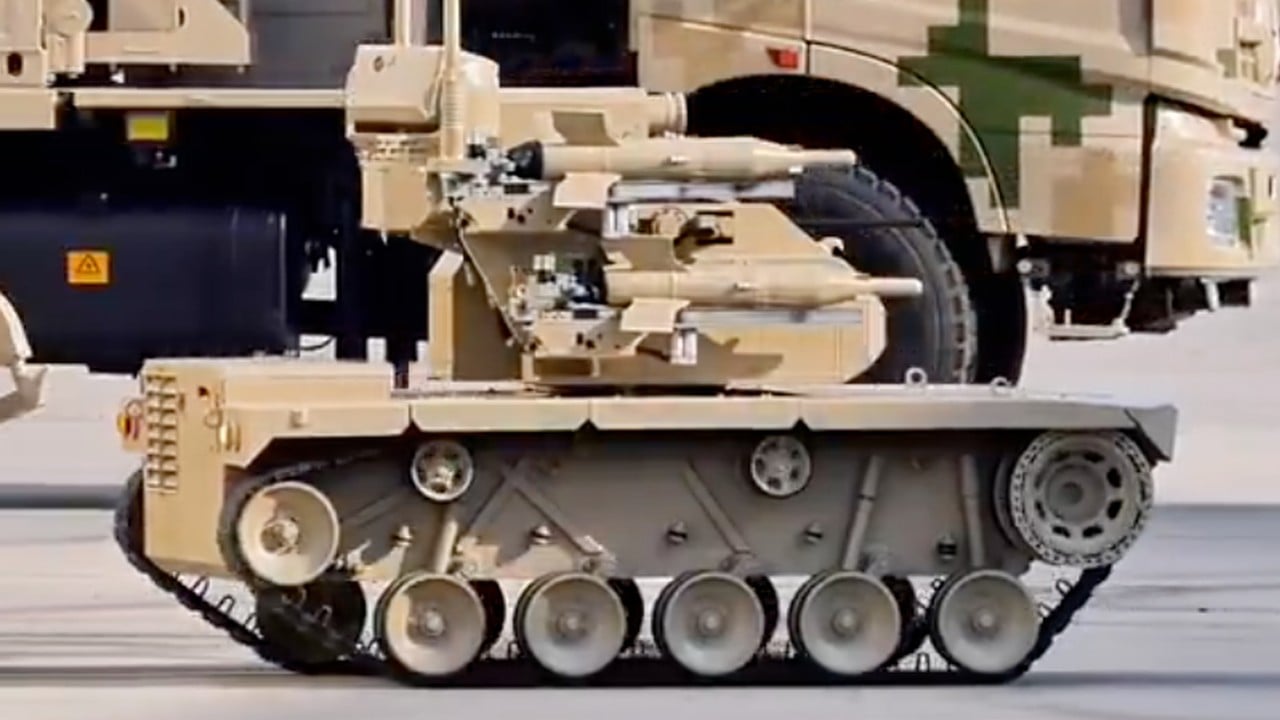
The current generation of Chinese UGVs shows clear signs of maturation. Tracked and wheeled robotic platforms roughly the size of compact cars are appearing with modular payloads:
- Armed Reconnaissance: Tracked chassis equipped with stabilized remote weapon stations housing heavy machine guns, automatic grenade launchers, and anti-tank guided missiles.
- Logistics and Casualty Evacuation: Flatbed robotic mules designed to haul ammunition, water, and batteries across the final, most dangerous kilometer of the front line without exposing human drivers to artillery or drone strikes.
- Tethered Drone Carriers: Ground robots carrying tethered quadcopters on their rear decks. By feeding power and data up a thin cable, the UGV allows the drone to hover continuously for hours as an elevated communications relay or radar platform without running out of battery life.
Consider a hypothetical example of how these elements interact during an urban assault. Instead of sending a manned infantry squad down a contested street, a platoon commander deploys two armed UGVs ahead of the main battle tanks. The robots draw fire, forcing hidden defenders to reveal their positions. Overhead, a tethered drone launched from a trailing UGV spots the muzzle flashes and beams targeting data directly to the tank's fire-control system, while an accompanying anti-drone vehicle scans the rooftops for enemy FPV teams attempting to ambush the column.
That level of machine-to-machine coordination requires robust, jam-resistant tactical data links—a quiet but critical area where Chinese defense contractors have invested heavily.
The Export Strategy Behind the Spectacle
Staging this hardware in Zhuhai is a calculated commercial play aimed squarely at shifting global defense supply chains. Western defense manufacturers face severe production backlogs, strict export control regimes, and high unit costs. A country seeking to modernize its armored forces with American or European systems often faces multi-year waiting lists, political conditions attached to how the weapons can be used, and price tags that strain national budgets.
China offers an alternative model built on speed, political non-interference, and aggressive pricing.
When NORINCO displays an upgraded VT-4 tank next to an SH-15 self-propelled howitzer and a mobile laser anti-drone system, it is pitching an integrated ecosystem that can be delivered within months rather than years. Furthermore, Beijing routinely offers technology transfer, local assembly agreements, and flexible financing terms that Western firms cannot match.
This strategy has already yielded concrete results across multiple regions:
- The Middle East: Gulf states looking to diversify their security partnerships have increasingly turned to Chinese drone and counter-drone technology, attracted by systems that have been tested in harsh desert conditions without the legislative hurdles required for U.S. Foreign Military Sales.
- Africa and Latin America: Developing nations facing asymmetric insurgencies or border security challenges favor Chinese wheeled armored vehicles and light drones because they are rugged, relatively simple to maintain, and priced within reach of modest defense budgets.
- Central and Southeast Asia: Militaries operating in mountainous or jungle terrain gravitate toward specialized platforms like the Type 15 light tank, which can traverse bridges and mountain passes that would collapse under the weight of a 65-ton Western main battle tank.
By putting these systems through live-fire and dynamic mobility demonstrations on the Zhuhai test grounds, Chinese firms allow prospective buyers to watch the hardware perform in real time rather than relying on glossy brochures.
Hardware Realities and Unresolved Vulnerabilities
Despite the impressive scale of the hardware staging at Zhuhai, seasoned defense analysts separate exhibition-floor polish from battlefield reality. Static displays and choreographed mobility runs take place under ideal conditions—clear skies, flat terrain, minimal electromagnetic interference, and well-rehearsed crews. Real combat rarely offers those luxuries.
Several critical questions surround the new generation of Chinese armor and counter-drone systems:
First, electromagnetic fratricide remains a persistent headache for any army operating dense concentrations of drones and anti-drone jammers simultaneously. When an electronic warfare vehicle blasts high-powered interference across multiple frequency bands to blind enemy quadcopters, it risks severing the communications links of friendly reconnaissance drones and unmanned ground vehicles operating in the same sector. Managing spectrum deconfliction in real time requires sophisticated automated battle-management software that has never been tested in a high-intensity, peer-level conflict.
Second, power generation and thermal management remain severe bottlenecks for mobile laser weapons. Firing a high-energy laser repeatedly generates immense heat and drains massive amounts of electrical power. In humid or dusty environments, atmospheric scattering degrades laser beam quality, drastically reducing effective range. Until solid-state lasers achieve higher wall-plug efficiency and compact cooling systems, kinetic guns and missiles will remain indispensable—meaning anti-drone vehicles will still run out of ammunition during prolonged swarm attacks.
Third, the human element cannot be automated away. Operating an armored vehicle packed with AESA radars, electro-optical turrets, electronic warfare suites, and drone control stations places an immense cognitive load on a three- or four-person crew. Without extensive, realistic training under degraded conditions, crews can easily become overwhelmed by false alarms, sensor clutter, and rapid target prioritization.
Finally, China's defense industry has not fought a major conventional war since 1979. While Chinese engineers aggressively study foreign conflicts and incorporate lessons at remarkable speed, their equipment lacks the iterative refinement that only comes from sustained combat operations. Every armored vehicle and counter-drone rig parked on the tarmac in Zhuhai represents a sophisticated hypothesis about how future wars will be fought—a hypothesis that remains untested against a determined, technologically matched adversary.
What the Zhuhai Lineup Signals for Global Security
The convergence of heavy tanks, robotic ground vehicles, and mobile drone killers at the Zhuhai Air Show marks the end of an era in defense exhibitions. The traditional boundary between aerospace and land warfare has dissolved, replaced by a unified battlespace where every vehicle on the ground must either operate a drone or defend itself against one.
For defense ministries and intelligence agencies worldwide, the hardware rolling into Zhuhai provides an unmistakable baseline of Chinese military-industrial capability. Beijing is no longer merely copying foreign designs or filling low-end export niches. It is mass-producing integrated, multi-domain combat systems tailored specifically to counter the defining threats of modern warfare, and it is actively marketing those solutions to the rest of the world.
Any military planner still treating unmanned systems and traditional heavy armor as separate procurement tracks needs only look at the staging yards in Zhuhai to see how quickly that doctrine is becoming obsolete.