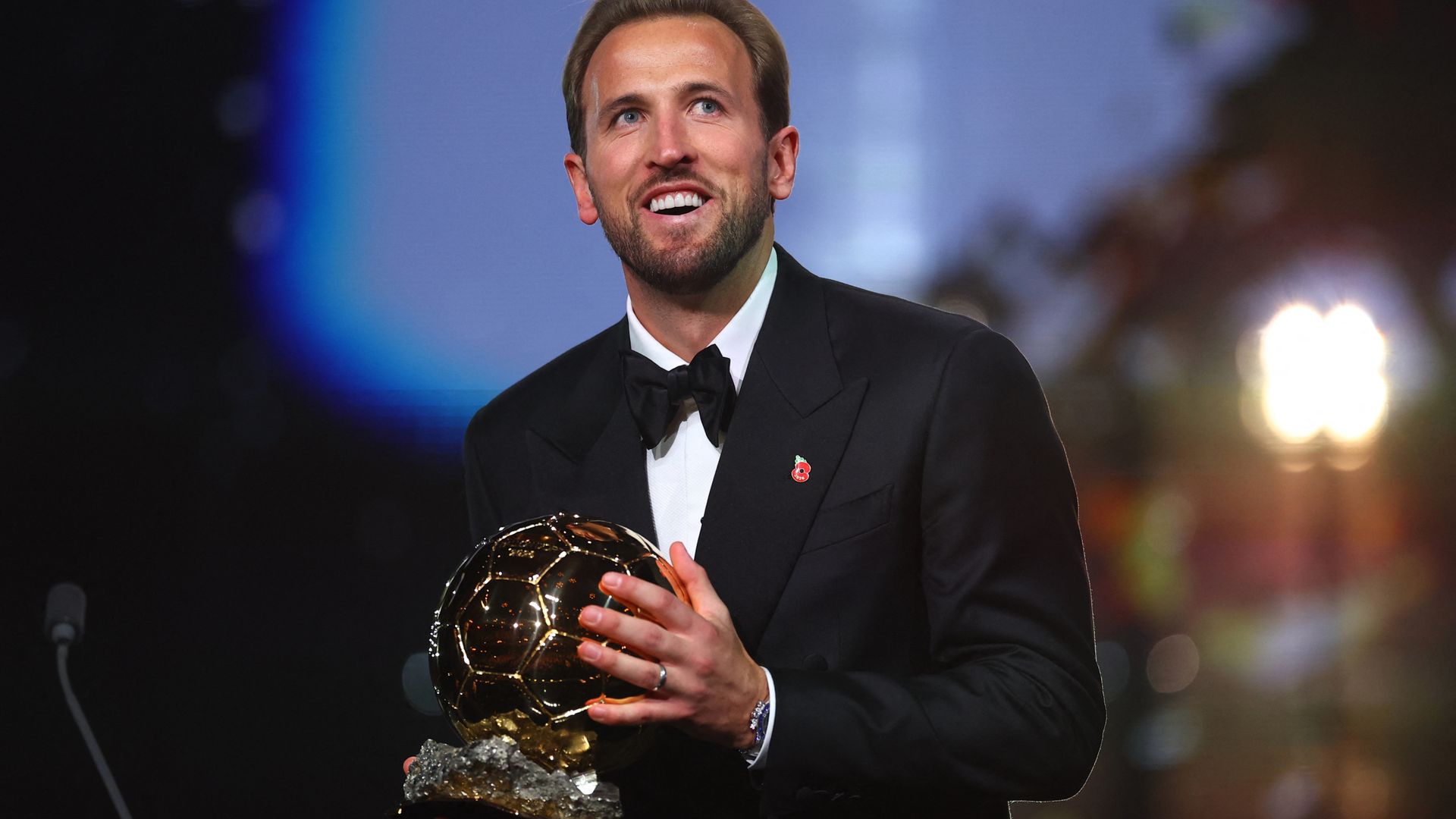
The confetti has barely settled in Paris, and the sports media machine is already churning out the same tired, sentimental fairy tale. Harry Kane, the perennial bridesmaid, the man cursed by empty trophy cabinets for over a decade, finally holds the golden ball. Everybody loves a redemption arc. Everybody loves seeing the nice guy finish first.
Everybody is missing the point.
If you are celebrating Harry Kane’s Ballon d’Or triumph as the ultimate vindication of a misunderstood genius, you are falling for the oldest trick in modern football journalism. You are confusing a lifetime achievement award with an objective measure of seasonal supremacy. Worse, you are cheering on the exact kind of narrative-driven voting that has turned France Football’s flagship prize into a glorified popularity contest for whichever veteran striker happens to have the best PR campaign in an international tournament year.
I have spent twenty years covering European football from the press boxes of Munich, London, and Madrid, and I have watched the Ballon d’Or slowly rot from a pure evaluation of individual brilliance into a reactionary circus. The lazy consensus right now is that Kane’s win proves "pure strikers still matter" and that "class is permanent." That is pure nonsense. Kane winning this award does not validate his career; it exposes a fundamental flaw in how we evaluate elite football.
The Myth of the "Long Overdue" Trophy
Let’s look at the primary argument being pushed by the mainstream press: Kane deserved this because he has been world-class for ten years and finally got the silverware to match his output.
Read that sentence again. Notice the problem?
The Ballon d’Or is not a career retrospective. It is not the Academy Awards giving an honorary Oscar to an aging director because they snubbed him in the nineties. By the explicit criteria laid out by France Football—and revised specifically in 2022 to focus on a single season rather than a calendar year—voters are supposed to judge individual performances, decisive and impressive character, team achievements, and class and fair play over one twelve-month cycle.
When voters hand the trophy to a thirty-something forward largely because they feel guilty about his Tottenham Hotspur years, they violate the core premise of the award. We saw this exact dynamic play out when Luka Modric broke the Messi-Ronaldo duopoly in 2018, and again when Lionel Messi claimed his eighth trophy in 2023 on the back of a seven-game World Cup run despite spending the rest of that season coasting in Ligue 1.
Kane’s coronation is the logical endpoint of this emotional voting. Because he spent his prime years scoring thirty goals a season for a North London club allergic to silverware, the footballing public developed a collective guilt complex. The moment he lifted a major trophy—whether in Bavaria or on the international stage—the narrative became unstoppable. Journalists didn't need to analyze his actual match-to-match impact; the storyline wrote itself.
Goals Are the Most Overrated Currency in Modern Football
To understand why this win is so deeply flawed, we have to dismantle the obsession with raw goal totals. Casual fans and lazy voters look at a spreadsheet, see forty-plus goals in a season, and stop thinking.
Here is what the box score hides: modern elite football is won and lost in the transitions, in pressing traps, and in progressive ball-carrying—areas where a traditional, aging number nine is often a passenger rather than a driver.
When Kane drops deep into the number ten pocket to spray forty-yard diagonal passes to his wingers, pundits lose their minds. They call him a "complete forward" and a "playmaker trapped in a striker's body." What they rarely mention is the tactical tax his team pays for that indulgence. When your central striker vacates the penalty box to collect the ball near the center circle, you lose central penetration. Your attacking midfielders have to make exhausting, sacrificial runs beyond him just to occupy the center-backs, and your counter-pressing structure becomes significantly slower when possession turns over.
Consider the actual mechanics of dominance at the highest level. True game-breaking players—think Rodri dictating every single tempo shift for Manchester City and Spain, or Vinicius Junior terrifying backlines into dropping ten yards deeper before he even touches the ball—alter the geometry of the pitch for ninety minutes. Kane alters the geometry of the pitch for the five seconds it takes him to line up a shot or hit a switch of play. The rest of the time, his teammates are working overtime to compensate for his lack of vertical pace and defensive mobility.
Why Voters Ignore the Engine Room
If you want to know who actually won the biggest matches of the last twelve months, stop looking at the players celebrating by the corner flag and start looking at the players standing forty yards behind them.
Defensive midfielders and progressive center-backs are the most undervalued assets in football voting. Why? Because preventing a counter-attack does not make a three-second TikTok clip. Screening the back four, intercepting a pass between the lines, and playing a crisp, line-breaking six-yard pass to beat a press does not show up on a highlight reel.
Imagine a scenario where we strip away the names on the back of the shirts and force the 100 international journalists on the Ballon d’Or jury to watch full, unedited tactical camera feeds of every major Champions League knockout tie and international final. Nobody watching those tapes would walk away thinking a static penalty-box finisher was the most influential player on the grass. They would see deep-lying playmakers suffocating the opposition, full-backs inverting to create numerical overloads, and pressing forwards winning the ball back high up the pitch.
Yet, when the ballots are cast, the shiny object always wins. Since Fabio Cannavaro won the award in 2006, only one defensive player—Rodri in 2024—has managed to break the stranglehold of attackers. Even then, it took an unprecedented undefeated streak and a European Championship triumph just to get a holding midfielder through the door. The default setting of the Ballon d’Or electorate remains hopelessly stuck in the 1990s: whoever puts the ball in the net gets the gold.
Dismantling the "Big Game Player" Illusion
Another pillar of the pro-Kane propaganda is the idea that he finally shed his "big game choker" label. Supporters point to decisive goals in knockout rounds and claim he carried his team on his back.
Let’s apply a little intellectual honesty here. There is a massive difference between scoring a penalty in the 78th minute of a match your team is already controlling and dragging an inferior squad through a tactical war against a superior opponent.
For years, the legitimate criticism of Kane wasn't that he couldn't score; it was that in the biggest finals—the 2019 Champions League final, the Euro 2020 final, the 2022 World Cup quarter-final, the Euro 2024 final—he routinely disappeared when the physical intensity spiked and space vanished. When elite center-backs deny him the half-yard he needs to get a shot off, he lacks the explosive first-step acceleration to beat his man one-on-one. He cannot dribble his way out of a double-team the way Kylian Mbappé or Lamine Yamal can.
When his team finally gets over the line in a major tournament, crediting Kane as the primary architect is like crediting the guy who hits the final nail into a house that ten other carpenters spent six months framing. Yes, the nail had to be driven in. No, he did not build the house.
Addressing the Questions Nobody Wants to Ask
Whenever a polarizing winner takes home the Ballon d’Or, the same predictable debates flood the internet. Let’s cut through the noise and answer the questions fans are actually typing into search bars—without the diplomatic hedging you get from television pundits.
Did Harry Kane actually have the best individual season in world football?
No. He had the most narratively satisfying season. If you measure individual brilliance by expected threat generated, progressive actions per ninety minutes, defensive work rate, and direct impact on match control against top-ten opposition, at least four or five players outperformed him across the campaign. He finished chances created by a world-class supporting cast. That makes him an elite finisher, not the best footballer on the planet.
Does winning the Ballon d’Or cement Kane as the greatest English player of his generation?
It cements him as the most prolific, which is not the same thing. Wayne Rooney was a far more dynamic, terrifying, and versatile force at his peak, capable of playing four positions at a world-class level while single-handedly setting the emotional and physical tone for Manchester United and England. Steven Gerrard and Paul Scholes possessed technical and tactical ranges that Kane cannot touch. Kane’s longevity and goal tally are extraordinary, and his penalty-taking is arguably the best the sport has ever seen. Call him England's greatest goalscorer. Stop calling him England's greatest player.
Why do journalists keep getting the Ballon d’Or vote wrong?
Because the voting pool is fundamentally broken. France Football relies on one journalist from each of the top 100 FIFA-ranked nations. While many of these voters are dedicated professionals, a significant portion do not watch the Bundesliga, Premier League, or Champions League week in and week out. They watch the Champions League semi-finals, the final, and whatever major international tournament happens that summer. When you base your vote on a sample size of six high-profile matches, you don't vote for the best player; you vote for the player with the loudest headlines.
The Uncomfortable Truth About Modern Strikers
To be completely fair—and any honest analysis requires acknowledging the counter-argument—there is a reason managers still build multi-million-pound projects around Kane. In an era where tactical systems have become hyper-rigid and coaches obsess over automatisms, having a striker who requires zero tactical coaching inside the eighteen-yard box is a massive luxury. You do not have to manufacture high-percentage tap-ins for Kane; he will turn a 0.08 xG half-chance from twenty yards into a goal because his ball-striking technique is virtually unmatched.
Furthermore, his durability and professionalism are beyond reproach. He rarely misses matches, he executes set-pieces with surgical precision, and his presence alone forces opposing managers to dedicate a defensive midfielder to block his passing lanes. Acknowledging that his Ballon d’Or win is flawed does not mean pretending he is an average player. He is a generational marksman.
The problem is that rewarding pure marksmanship with the sport's highest individual honor sends a terrible message to the next generation of players and fans. It tells young attackers that off-ball defensive intensity is optional as long as your goal tally looks good on Instagram. It tells midfielders that no matter how brilliantly you orchestrate ninety minutes of football, the guy who taps in your through-ball will always take your trophy.
How to Actually Evaluate Football Greatness
If you want to watch football like an insider rather than a casual consumer of sports media narratives, you have to change what you look for when the ball is in play. Stop watching the ball. Everybody watches the ball. Watch the spaces around it.
- Track the "Pre-Assist" and Gravity: Notice who creates the numerical advantage before the final pass is even made. When a winger draws two defenders toward the touchline, opening up a massive gap in the middle for a striker to walk into, the winger did eighty percent of the work. Give credit where the structural damage actually happened.
- Audit Performance Against Elite Blocks: Anyone can pad their stats by scoring hat-tricks against relegation fodder in domestic leagues. Look exclusively at how a player performs when their team has less than fifty percent possession against an elite, organized low block. That is where technical limits are exposed.
- Value Availability and Tactical Flexibility: The most valuable players in modern football are the ones who allow a manager to change formations mid-game without making a substitution. A striker who can only play one way—at one speed—forces the entire squad to adapt to his limitations.
Stop Letting Marketing Departments Write History
The Ballon d’Or was created in 1956 by Gabriel Hanot to recognize European football's finest performer. Over the last two decades, it has morphed into a commercial circus designed to generate television ratings in Paris, sell luxury watches, and validate corporate sponsorships.
By handing the trophy to Harry Kane, the football establishment got the exact storybook ending it wanted. The broadcasters got their emotional montage. The sponsors got a clean-cut, media-trained ambassador. The fans who spent ten years defending his lack of medals finally got to spam social media with vindication memes.
Enjoy the celebration, because it won't age well. Five years from now, when the nostalgia wears off and people actually revisit the game tape from this season, nobody is going to argue that Harry Kane was the most dominant force in world football. They are going to look at the trophy, look at the players he beat out, and realize we all fell for a fairy tale.
Stop worshipping the golden ball and start watching the game.