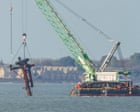
Salt hangs heavy on the tongue when you stand on a sea wall in Kent and stare out toward the gray horizon of the Thames estuary. You can taste the brine. You can smell the damp mud flats exposed at low tide, and if you listen long enough beneath the cry of gulls and the distant hum of freighters, you feel a quiet, unsettling weight in your chest.
Out there, barely a mile and a half from Sheerness, lies the rusted skeleton of the SS Richard Montgomery. An American Liberty ship built in the hurried urgency of World War II. A vessel that ran aground on a sandbank in August 1944 with roughly 1,400 tonnes of munitions—bombs, cluster munitions, and high explosives—packed into her holds.
Most people read a headline about masts being removed from a bomb-laden ship in the Thames and picture a neat engineering fix. A crane. A torch. A check mark on a clipboard.
It is never that simple.
When I first stood along the Kent coast years ago watching the tide roll in over shifting silt, what struck me wasn't the drama of a movie action sequence. It was the sheer, grinding patience of decay. Steel doesn't explode all at once after eighty years underwater; it rusts, it thins, it groans under the weight of tidal currents that push millions of tonnes of water back and forth twice every single day. And for decades, towering above the waterline like crooked fingers pointing at the sky, stood the ship's masts.
To understand why those masts mattered so much, you have to understand how a sunken hull behaves when gravity, salt water, and shifting sediment conspire over generations.
A Lever Waiting to Pull
A mast on a cargo ship isn't just a pole for rigging or lights. In structural terms, it is a lever—and a tall one at that.
Think of a lever the way any child learns it on a seesaw. Push down gently at the far end, and you can lift something remarkably heavy near the fulcrum. Now flip the physics sideways and underwater. A tall steel mast sticking out of a half-submerged wreck catches wind, waves, and the drag of moving air and water. Every gust, every swell, every shift in load applies a turning force—a bending moment—down into the hull plates below.
Even when a ship sits mostly buried in sand and mud, the upper structure acts like a sail that refuses to come down. Over decades, corrosion eats away at rivets and welds that were never engineered to survive eighty winters in brackish water. If a mast weakens, buckles, or topples under storm pressure, or if corroded hull metal gives way beneath the strain, the shock doesn't stay neatly confined to the top of the wreck. It transfers straight down into the structure holding thousands of pounds of aging explosives.
Let's be clear: this is an analogy to help picture structural leverage, not a claim that a falling mast acts like a firing pin on a bomb. Explosives don't detonate simply because a piece of metal creaks nearby. Yet munitions that have sat in seawater for more than eight decades are an unpredictable variable. Chemical stabilizers inside old ordnance degrade over time. Casings corrode. Shifting cargo inside a collapsing hull can create friction, crush hazards, or sudden structural drops that no engineer wants to test in real life.
That is why removing the masts isn't a cosmetic tidy-up. It is about taking weight and leverage off an aging, unstable frame before the river itself forces the issue.
The Invisible Stakes Along the Water
To see why officials lose sleep over a wreck lying quietly in the estuary, consider a hypothetical scenario.
(Note: The following scenario is hypothetical, constructed to illustrate the geographic and physical stakes around the wreck rather than depict an actual event.)
Picture a Tuesday morning in late autumn. Low cloud hugs the estuary. Along the shoreline of Sheerness and the Isle of Sheppey, people are drinking tea, walking dogs along the promenade, or heading into work. Out in the channel, a commercial vessel navigates past yellow marker buoys that warn mariners to keep their distance.
Beneath the surface, corrosion—which has been nibbling silently at the Richard Montgomery's hull for generations—finally reaches a tipping point in one section of the broken ship. Suppose a large section of rusted plating collapses inward, or shifting sand undermines a weakened bulkhead. Nothing dramatic happens on camera—no Hollywood fireball, no instant mushroom cloud—but a heavy steel beam drops onto munitions cases weakened by eighty years of saltwater immersion.
Even if the resulting blast is smaller than worst-case models fear, a large detonation in a confined waterway sends a shockwave through water and air alike. Water transmits shock waves with brutal efficiency. Nearby riverbanks, coastal defenses, port infrastructure, and communities just a couple of miles away would feel the concussion in their windows and their bones. Worse still, a major explosion could throw debris, disrupt shipping lanes vital to London and the southeast, and force urgent evacuations along low-lying marshland where escape routes are limited.
Scary? Yes. Confusing? Often.
I will admit openly: when you look at numbers like "1,400 tonnes of explosives," your brain struggles to convert tonnage into real-world meaning. Is that a lot? How far does a blast travel? Why hasn't someone just pumped the explosives out decades ago?
Those are fair questions, and the honest answer is that maritime salvage on a wreck this old is full of trade-offs where every option carries risk. Disturbance itself can be dangerous. Cutting into a corroded hull, moving unstable munitions, or jarring weakened steel can trigger the very outcome everyone is trying to prevent. Sometimes the most cautious move is reducing external stresses—like tall masts catching wind and force—while monitoring the wreck closely and adapting as conditions change.
Human Lives Tied to a Quiet Channel
Behind every engineering decision in the Thames estuary are real people whose daily lives intersect with the water.
Take a hypothetical character—let's call her Clara, a coastal resident who grew up watching the tide turn outside her bedroom window. (Clara is a hypothetical composite character used to ground the human experience of living near a regulated wreck.) For Clara, the Richard Montgomery isn't an abstract footnote in a history book. It is a permanent fixture of the horizon, marked by exclusion zones and cautionary warnings. When winds whip across the estuary in November, rattling windowpanes and turning gray water white-capped, you don't need a degree in naval architecture to wonder what kind of stress the old ship is taking out there.
Then there are the marine engineers, hydrographers, and salvage specialists who work around the site. Their job requires steady nerves and unglamorous precision. Visibility underwater in the Thames estuary is notoriously poor—often murky, silt-heavy, and swept by strong currents. Divers and technicians don't get crystal-clear tropical water; they get cold tides, tight weather windows, and strict safety margins.
What happens next when masts are removed from a wreck like this? Removing the upper structure lowers windage and reduces structural strain on the remaining hull, buying time and lowering one category of mechanical risk. Yet the core dilemma remains: the explosives are still down there, resting in an environment that never stops moving.
Consider what happens next as the river keeps flowing: silt shifts, tides rise and fall, and salt continues its slow chemical work on every remaining millimeter of steel. Removing the masts solves a specific structural vulnerability, not the entire legacy of 1944. It is a calculated step in managing an ongoing hazard, not a magic wand that makes the past disappear.
Why an Eighty-Year-Old Wreck Still Demands Our Attention
It is tempting to treat World War II history as something safely sealed inside museums, black-and-white photographs, and remembrance ceremonies. We like our history finished. Neat. Bound in cloth.
The Thames estuary refuses to cooperate with that comfort.
A wartime cargo ship sitting off the Kent coast is a reminder that industrial warfare leaves physical footprints that outlive the soldiers, the shipbuilders, and the political borders of the era. The munitions aboard the Richard Montgomery were forged in a moment of global crisis to help end a war. Eighty-plus years later, those same munitions sit in quiet water, forcing modern engineers to weigh physics, metallurgy, tides, and human safety all at once.
People often ask whether the wreck is going to blow up tomorrow, or whether removing the masts means the danger is suddenly gone. Neither extreme captures reality. The reality is subtler and more demanding: it is a long-term engineering and environmental watch where every reduction in structural strain matters, and complacency is the biggest enemy of all.
Down at low tide, where wet mud gleams like pewter under a pale sky, the estuary looks almost peaceful. A gull wheels overhead. Water laps softly against stone. Yet out past the shallows, beneath the gray swell, a rusted ghost from 1944 still holds its breath—and every careful cut made above the waterline is an effort to keep it from ever having to let it go.


