At four in the morning, the East China Sea smells of diesel, cold brine, and rusted iron.
Picture a fictional fisherman named Kenji, sixty-two years old, standing on the wet deck of his trawler off the coast of Yonaguni, Japan’s westernmost inhabited island. Seventy miles to the west lies Taiwan. Three hundred miles beyond that sits mainland China. For forty years, Kenji’s greatest worry was a sudden typhoon or a bad catch of tuna. Today, he watches grey silhouettes slip through the morning fog—coast guard cutters, surveillance drones humming like angry hornets high above the swells, and destroyer hulls cutting clean lines across the horizon.
Kenji doesn't read white papers from Tokyo's Ministry of Defense. He doesn't parse geopolitical spreadsheets in Washington or Beijing. Yet his weathered hands feel the vibration of a tectonic shift in global power every time he hauls in his nets.
For decades, the world grew comfortable with a very specific version of Japan. We saw a pacifist economic miracle—a nation that traded battleships for bullet trains, aircraft carriers for consumer electronics, and imperial ambition for quiet, polite diplomacy. After the devastation of 1945, Article 9 of the Japanese Constitution renounced war as a sovereign right. For generations, Tokyo kept its military spending capped at an unofficial, sacred ceiling of roughly one percent of its Gross Domestic Product. It was a psychological guardrail as much as a fiscal one.
That guardrail is gone.
When Tokyo began charting a course toward a massive, multi-year defense surge—an effort scaling toward the staggering half-trillion-dollar mark over a decade, anchored by its historic push to double annual defense spending to two percent of GDP—the international press treated it like an accounting story. Analysts talked about procurement timelines, long-range cruise missiles, and fiscal deficits.
They missed the point entirely. Money is never just money when nations start counting it in hundreds of billions. A budget of that magnitude is a flare fired into a dark sky. And the message written in its light is aimed squarely at Beijing.
The Ghost of 1945 Meets the Reality of Now
To understand why this shift feels so visceral if you have ever walked the quiet streets of Hiroshima or stood beside the Peace Memorial Park in Nagasaki, you have to understand the weight of Japanese memory. I remember standing in a Tokyo commuter train years ago during an unannounced civil defense drill, watching hundreds of exhausted office workers stare blankly at emergency alerts flashing on their phones. Nobody panicked. Nobody yelled. Instead, a heavy, suffocating silence settled over the carriage—the quiet dread of a people who know, deep in their bones, what happens when the sky falls.
Pacifism in post-war Japan was never mere naivety. It was scar tissue.
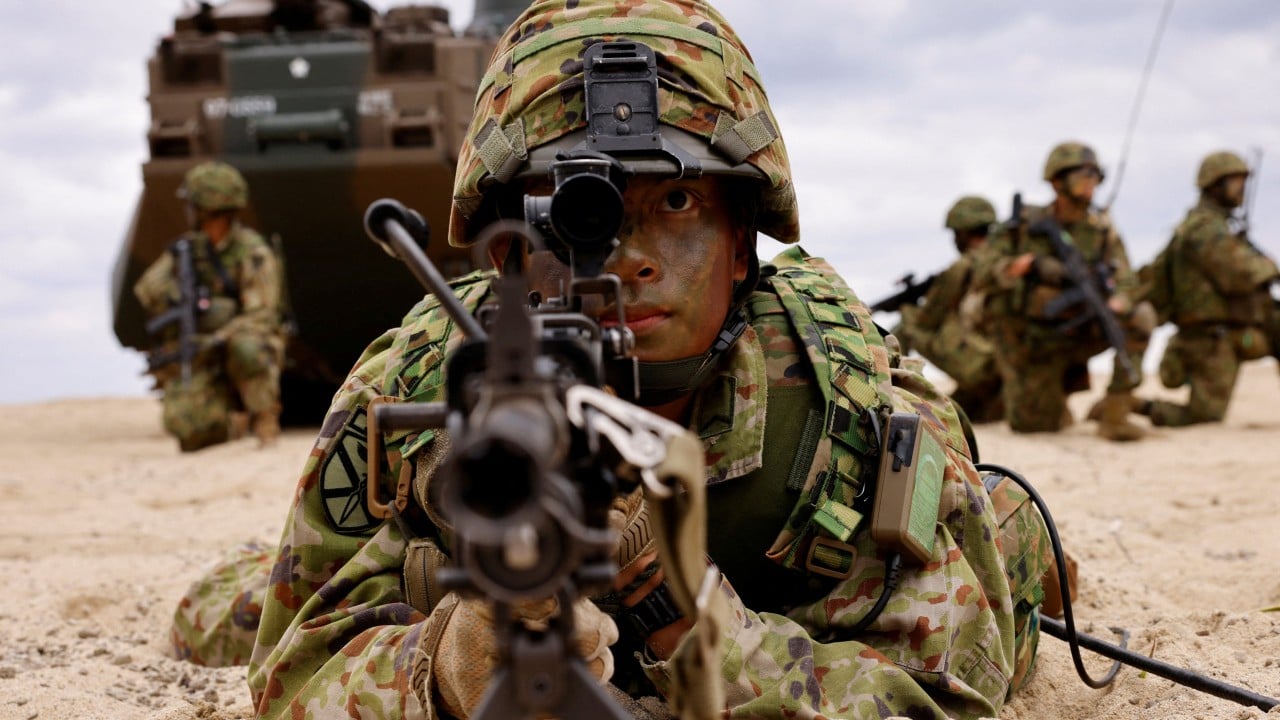
So when a nation carrying that much historical trauma decides to buy hundreds of American Tomahawk cruise missiles, convert helicopter carriers to launch F-35B stealth fighters, and harden underground command bunkers across its southwestern islands, it isn't doing so out of sudden nostalgia for empire. It is doing so because the neighborhood has changed, and the locks on the front door no longer hold.
Consider the metaphor of a quiet suburban homeowner who has spent seventy years tending a garden while relying on a big, strong neighbor down the street to keep burglars away. For decades, that arrangement worked. Then, a new gang moves into the cul-de-sac, buys heavy machinery, builds walls across shared driveways, and starts testing the homeowner’s window latches at night. Meanwhile, the strong neighbor down the street starts arguing with his own family about whether he can afford to keep patrolling the block.
What does the gardener do? He stops buying fertilizer and starts buying steel shutters.
Decoding the Signal Sent to Beijing
If you sit inside Zhongnanhai, the walled compound in Beijing where China’s top leaders map out the century, Japan’s half-trillion-dollar trajectory reads less like a budget and more like an equation with too many uncomfortable variables.
For twenty years, Beijing’s military modernization has been relentless. The People’s Liberation Army Navy now boasts more ships than the United States Navy. Chinese hypersonic missiles are designed specifically to push American aircraft carriers far back into the Pacific, creating what military planners call an anti-access, area-denial bubble. In Beijing’s ideal scenario, any regional crisis—most notably over Taiwan—would be decided quickly, locally, before Washington could muster the political will or logistical muscle to intervene.
Japan’s defense surge shatters that timeline.
First, it tells Beijing that geography is no longer an advantage. Look at a map of the First Island Chain—that string of archipelagos running from the Japanese mainland down through Okinawa, Taiwan, and the Philippines. It acts like a natural stone wall penning China’s navy into the coastal seas. By fortifying its southwestern islands with anti-ship missiles, electronic warfare units, and radar installations, Japan is effectively turning that island chain into a gauntlet. A Chinese fleet trying to break out into the open Pacific wouldn't just face American submarines; it would have to run past hundreds of mobile, hidden launchers tucked into Japanese cliffsides.
Second, Tokyo is buying what strategists politely call "counterstrike capabilities." For seventy years, Japan’s Self-Defense Forces were strictly a shield—designed only to swat away incoming arrows, never to strike the archer. Acquiring missiles capable of reaching targets over a thousand miles away changes the entire geometry of deterrence. It means that if missiles ever rain down on Japanese soil, bases and command centers on the Chinese mainland are no longer sanctuaries.
Third—and perhaps most alarming to Beijing—Japan is proving it won't wait for permission to act. By deepening security pacts with Australia, the United Kingdom, the Philippines, and South Korea, Tokyo is weaving a web of regional alliances that doesn't rely solely on Washington’s mood swings. Beijing has spent years trying to divide Asian nations, picking them off one by one with trade incentives or maritime pressure. Japan is using its checkbook and its diplomacy to stitch them back together.
The Invisible Price Tag
Wait. Before we turn this into a neat triumph of strategy, let’s be honest about the cracks beneath the surface. Anyone who tells you this transition is clean, inevitable, or painless is selling you a fantasy.
Walk through any provincial town in rural Japan—places where shuttered storefronts outnumber open ones and the average age hovers near sixty—and ask a shopkeeper how they feel about half a trillion dollars going toward missiles and radar arrays. You won't get a lecture on maritime choke points. You will get a tired sigh.
Japan is the most rapidly aging society on earth. Its public debt already towers above two hundred and fifty percent of its economic output—the highest in the developed world. The yen has spent years bruised and battered against the dollar, driving up the cost of imported energy, wheat, and the very American weapons systems Tokyo is rushing to buy.
Every yen routed toward a stealth jet is a yen not spent on elder care, childcare subsidies, or revitalizing hollowing-out rural economies. When Japanese lawmakers debated raising corporate, income, and tobacco taxes to fund this defense buildup, public support fractured immediately. People understand the threat in the waters near Taiwan. They feel the anxiety every time North Korea lobs a ballistic missile over Hokkaido or Chinese coast guard vessels linger near the disputed Senkaku Islands.
Yet understanding a threat and paying for the shield are two very different emotions.
There is also the terrifying arithmetic of escalation. History teaches us a grim lesson about security dilemmas: when one country builds walls to feel safe, its neighbor sees a fortress being prepared for a siege, and builds bigger siege engines in response. Beijing already frames Japan’s military buildup as a revival of twentieth-century militarism—a narrative rich with historical grievance that plays powerfully to domestic audiences in China.
Could Tokyo’s massive investment actually accelerate the very conflict it is designed to prevent? Could it convince hawks in Beijing that their window of opportunity is closing fast, tempting them to act before Japan’s new defenses are fully online in the 2030s?
Nobody in Tokyo, Washington, or Beijing has a guaranteed answer. Anyone who claims otherwise is guessing in the dark.
Why Silicon, Shipyards, and Supply Chains Matter More Than Tanks
If you want to see where this half-trillion-dollar wave actually lands, don't look at parade grounds. Look at factories.
Modern warfare isn't won by the country with the most soldiers marching in lockstep; it is won by the country that can keep factories humming, satellites blinking, and microchips flowing when everything else is burning. Japan’s defense surge is quietly rewiring its industrial base from the inside out.
For decades, major Japanese conglomerates treated defense contracts like an embarrassing side hustle. Companies like Mitsubishi Heavy Industries, Kawasaki, and NEC made tiny profit margins building small batches of equipment exclusively for the Japanese government, barred by strict export rules from selling abroad.
Now, the floodgates are creaking open. Tokyo has rewritten its arms export guidelines, allowing the sale of co-developed next-generation fighter jets—built alongside Britain and Italy—and opening pathways to replenish depleted Western stockpiles of Patriot air-defense interceptors. Defense startups, once unthinkable in polite Tokyo venture capital circles, are suddenly attracting engineers who used to build consumer robotics and automotive sensors.
Think about what this means for the global economy. When Japan pours hundreds of billions into dual-use technologies—cyber defense, space surveillance, artificial intelligence, quantum cryptography, and resilient semiconductor supply chains—it isn't just building a military. It is insulating the global tech ecosystem against a sudden blockade in the Taiwan Strait.
If conflict ever erupted around Taiwan, the world wouldn't just lose a democratic island; it would lose the foundries that fabricate over ninety percent of the planet's most advanced semiconductors. Your phone, your car, your hospital's MRI machine, and your power grid all trace their lineage back to those factories. Japan’s defense buildup is, at its core, an insurance policy written to keep the modern world’s nervous system intact.
The Quiet Transformation of a Nation
Let’s return to the water.
Back off the coast of Yonaguni, the morning fog eventually burns off, revealing a sea that looks deceptively calm—a flat sheet of hammered silver stretching toward the horizon. Our hypothetical fisherman, Kenji, throttles down his engine and begins hauling his lines, his knuckles white against the cold rope.
Not far away, construction crews on the island are expanding port facilities and laying fiber-optic cables designed to withstand tremors, typhoons, and electronic jamming. New radar domes sit like giant white golf balls atop the green hills where wild horses still graze.
For seventy-five years, Japan tried to prove to the world—and to itself—that a great power could survive on commerce, culture, and goodwill alone. It built a society of extraordinary safety, quiet grace, and deep aversion to violence. Letting go of that identity hurts. You can hear the grief in the voices of elderly peace activists protesting outside the Diet building in Tokyo, holding faded signs that warn against repeating the sins of their fathers.
Yet history rarely asks nations what kind of world they prefer. It asks what kind of world they are prepared to survive.
Beijing spent twenty years testing the waters of the Western Pacific, assuming that rich, aging democracies would always choose comfort over confrontation, profit over principle, and hesitation over resolve. Japan’s half-trillion-dollar wager is the clearest possible rebuttal to that assumption. It is a quiet, stubborn declaration from an archipelago that knows the price of war better than almost any nation alive: the era of easy peace is over, and the guard at the gate is awake.