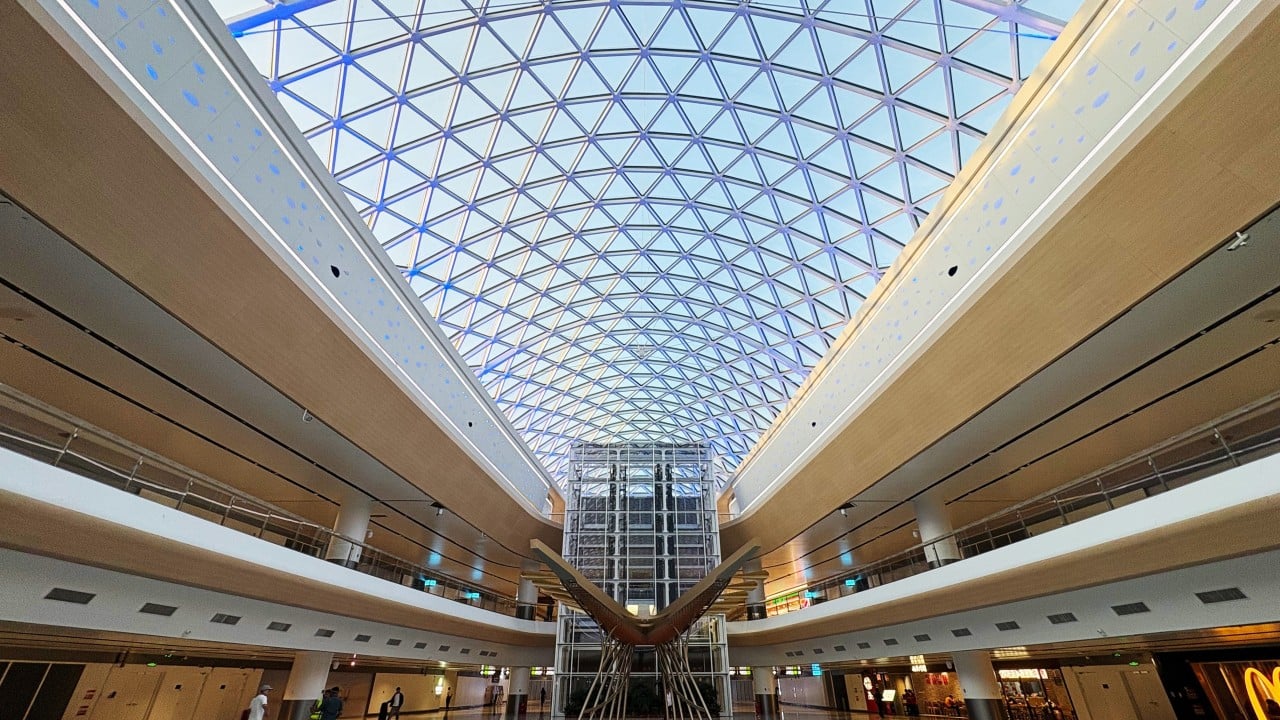
Beijing and Shanghai usually hog the spotlight when people talk about Chinese aviation. That’s a mistake. Right now, the real center of gravity sits in southern China, where Guangzhou Baiyun International Airport just pulled off one of the most aggressive infrastructure flexes in modern aviation history.
After pouring roughly US$8 billion (around 54 billion yuan) into its massive Phase III expansion, Guangzhou Baiyun didn't just add a few extra boarding gates. It reclaimed its title as China’s busiest airport, edging out Shanghai Pudong and Beijing Capital while rewriting the rules on how mega-hubs operate in the Greater Bay Area.
If you haven't transited through southern China recently, you're operating on outdated mental maps. The airport that once felt stretched to its absolute breaking point during peak Canton Fair rushes now boasts five runways and three massive terminals, pushing its annual passenger capacity toward the 120-million mark.
Why Guangzhou’s Comeback Matters More Than You Think
Most aviation headlines treat passenger rankings like a sports scoreboard. Who’s number one? Who dropped to second? Honestly, the raw trophy doesn't matter nearly as much as the geography behind it.
Guangzhou sits at the northern anchor of the Guangdong-Hong Kong-Macao Greater Bay Area. Within a tight 100-kilometer radius, you have five major international airports fighting for airspace and high-yield travelers—Hong Kong International, Shenzhen Bao’an, Macau, Zhuhai, and Guangzhou Baiyun. For decades, Hong Kong owned the lucrative international transfer market while mainland airports handled domestic feeder traffic.
That dynamic has shifted permanently. By completing the Phase III expansion—which brought Terminal 3 and two brand-new runways (the fourth and fifth) online—Guangzhou solved its biggest historical bottleneck. Airspace and runway slots were choking its growth. Now, China Southern Airlines, which uses Baiyun as its primary fortress hub, has the physical tarmac to run massive wave-bank schedules connecting Southeast Asia, Australia, Europe, and secondary Chinese cities without the chronic afternoon delays that used to plague the Pearl River Delta.
What $8 Billion Actually Buys in Modern Aviation
Spending US$8 billion on concrete and glass sounds abstract until you look at the sheer operational scale of the Phase III project. Ground broke on this expansion back in September 2020, right when global aviation was flat on its back during the pandemic. While Western hubs froze capital expenditures and shelved terminal upgrades, Chinese planners doubled down.
Here is what that capital delivered on the ground:
- Five operational runways. Adding the fourth and fifth runways turned Baiyun into a true multi-directional airfield, dramatically cutting taxi times and letting air traffic controllers run parallel departures and arrivals even during brutal summer typhoon seasons.
- Terminal 3. Designed with sweeping architectural curves inspired by blooming kapok flowers—Guangzhou’s city flower—T3 isn't just pretty. It adds hundreds of thousands of square meters of floor space specifically engineered for widebody international turnarounds.
- A legitimate high-speed rail integration. This is the part most international travelers miss. Baiyun isn't just an airport anymore; it's a multi-modal rail station. High-speed trains and intercity rail lines plug directly beneath the terminal complex, linking Guangzhou’s tarmac straight to downtown Guangzhou, Shenzhen, Dongguan, and Foshan.
Think about what that rail link means in practice. A business traveler in Dongguan or northern Shenzhen doesn't always need to cross the border into Hong Kong for a long-haul flight anymore. They can hop a fast train straight into Baiyun’s basement and clear customs under one roof.
The Numbers Behind the Crown
Let’s look at how Baiyun got back on top. Guangzhou actually held the title of the world's busiest airport briefly in 2020, largely because China’s domestic market bounced back faster than the rest of the planet. Once global borders reopened in 2023 and 2024, traditional giants like Atlanta (ATL), Dubai (DXB), and Tokyo Haneda (HND) surged back up the global charts, while Shanghai Pudong’s massive international network roared back to life.
In 2024, Guangzhou Baiyun handled roughly 76.3 million passengers, running neck-and-neck with Shanghai Pudong’s 76.8 million. It was a razor-thin margin. Shanghai had the edge in long-haul transpacific and European frequencies, while Guangzhou dominated domestic connectivity and Southeast Asian routes.
Once the Phase III capacity came online, the dam broke. With fresh slot allocations granted by the Civil Aviation Administration of China (CAAC) and aggressive international route restorations by China Southern, Baiyun’s monthly passenger throughput pushed past Pudong’s. More importantly, cargo volume surged alongside passenger numbers. Baiyun already ranks among the top cargo hubs on earth, acting as the primary air-freight artery for cross-border e-commerce giants shipping out of Guangdong’s manufacturing belt.
What Most Travelers Get Wrong About Transiting Through Guangzhou
If you ask frequent flyers about transiting through mainland China five years ago, you’ll hear horror stories. Confusing terminal transfers, strict transit visa headaches, sluggish Wi-Fi, and endless security re-screenings made hubs like Beijing and Guangzhou feel like an obstacle course compared to Singapore Changi or Seoul Incheon.
Holding onto those old assumptions will cost you money today.
First, China’s sweeping expansion of visa-free transit policies—extending visa-free stays up to 240 hours (10 days) for citizens of dozens of countries—completely changed the math on booking a layover in Guangzhou. You don't have to sit trapped in a sterile transit lounge anymore. You can walk out, take the metro into Tianhe or Liwan for dim sum, sleep in a real hotel, and catch your onward flight the next day without paying a dime for a visa.
Second, the physical connection times inside Baiyun have tightened dramatically. Back when Terminal 2 opened in 2018, travelers constantly misjudged the distance between T1 and T2. With Terminal 3 joining the mix, the airport relies heavily on automated people movers and unified baggage handling systems. Still, you need to pay close attention to which terminal your airline uses. China Southern anchors Terminal 2 and spills into the new capacity, while various Star Alliance, Oneworld, and low-cost carriers split between Terminal 1 and the newer facilities.
The Fierce Regional Battle Nobody Outside Asia Talks About
Reclaiming the mainland crown is one thing. Keeping it while Hong Kong International Airport (HKIA) opens its own three-runway system is another fight entirely.
Right down the Pearl River estuary, Hong Kong spent roughly HK$141.5 billion (over US$18 billion) building its third runway and expanding Terminal 2. Meanwhile, Shenzhen Bao’an International Airport has been expanding its own satellite concourses and third runway at breakneck speed. You now have three mega-hubs within an hour's commute of each other, all fighting for the same pool of pearl river delta passengers and cargo.
Critics argue this creates massive overcapacity. They point out that international long-haul demand between China and North America still hasn't fully recovered to 2019 levels due to airspace restrictions and geopolitical friction. If transpacific flights stay capped, where do all these extra runway slots go?
The answer lies south and west. Guangzhou isn't waiting around for US airlines to add flights. Instead, Baiyun has become the undisputed gateway between China and the Global South—specifically ASEAN nations, the Middle East, Australia, and Africa. When you look at flight boards in Guangzhou today, you see dense frequencies to Bangkok, Kuala Lumpur, Jakarta, Singapore, Dubai, Riyadh, Sydney, and Nairobi. That geographic pivot insulates Baiyun from North American route sluggishness far better than Beijing or Shanghai.
Practical Tips If You’re Flying Through Guangzhou Baiyun
If you’re booking flights between Europe, Australia, Southeast Asia, or mainland China anytime soon, Guangzhou Baiyun is going to pop up on your search results—often at prices 20% to 40% cheaper than flying through Hong Kong, Tokyo, or Doha. Here is how to handle it without friction:
- Check your terminal 48 hours before departure. With three sprawling terminals operating simultaneously, showing up at T1 when your flight leaves from T3 is a brutal way to miss boarding. Confirm your exact terminal code on your airline’s app, not just a third-party booking receipt.
- Buffer at least 2.5 hours for international-to-domestic transfers. Even with automated e-gates and streamlined baggage transfers on single-ticket itineraries, clearing Chinese immigration and customs during morning arrival banks takes time. Don't book a 75-minute connection just because an algorithm says it's legal.
- Set up Alipay or WeChat Pay before you land. Cash is practically extinct inside Baiyun’s terminals. Link an international Visa or Mastercard to Alipay before boarding your first flight so you can buy coffee, grab a SIM card, or tap directly onto the Guangzhou Metro turnstiles without standing in currency exchange lines.
- Use the 240-hour visa-free transit window. If you have a layover longer than eight hours, bring a printed copy of your onward ticket to a third country and use the dedicated temporary entry permit counter at immigration. Guangzhou’s city center is roughly 40 minutes away via Metro Line 3.
Guangzhou Baiyun didn't reclaim China’s top aviation spot by accident. It took US$8 billion, five years of relentless construction during a global downturn, and a complete rethink of how trains and planes connect. Next time you price out a long-haul ticket across Asia, stop skipping over CAN in your search filters—you might just save a few hundred dollars while transiting through China’s newest aviation powerhouse.