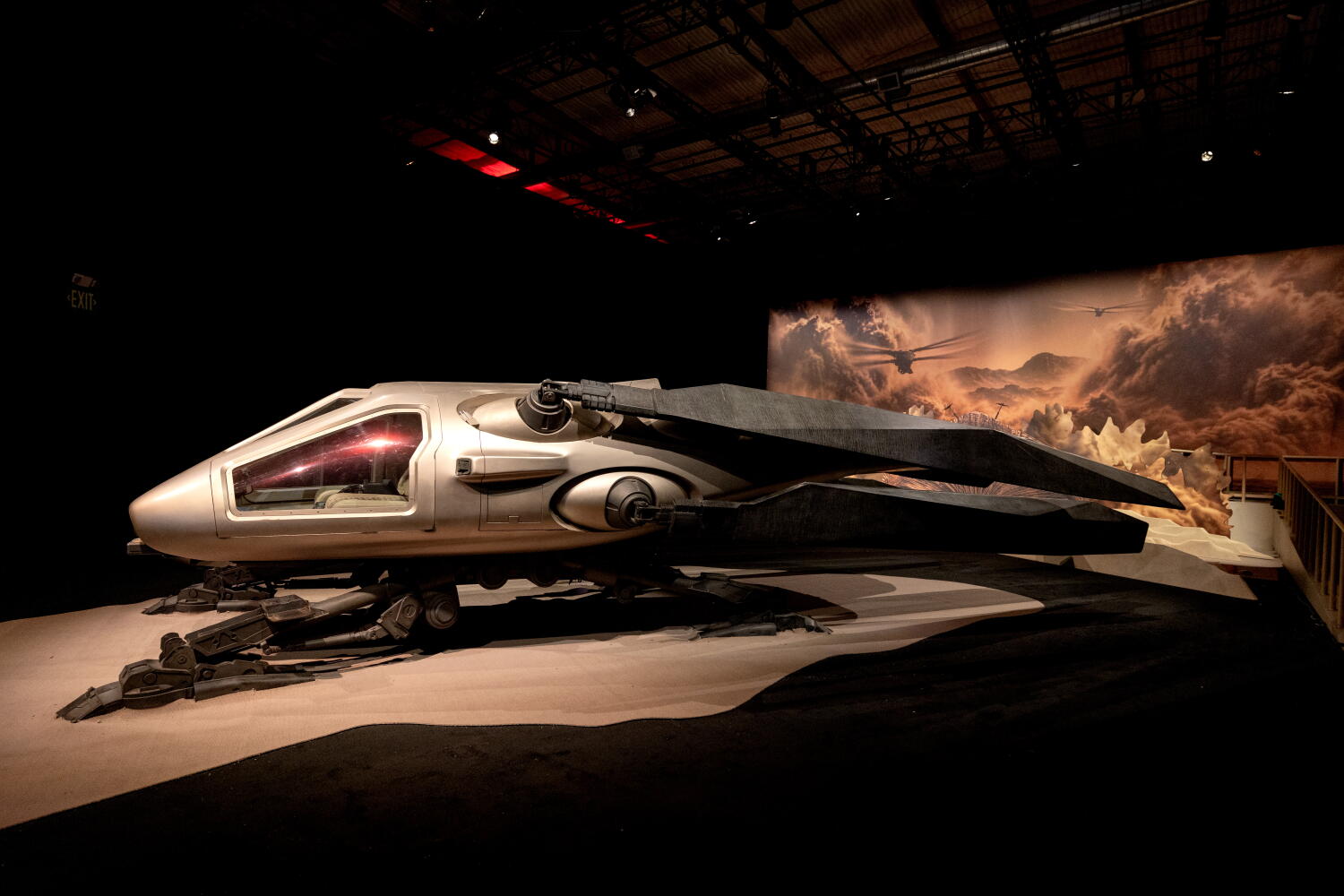
Heat.
That is the first thing you notice when you step off the air-conditioned asphalt of a Los Angeles studio lot and cross the threshold into Arrakis—not the polite, dry warmth of a Southern California afternoon, but a heavy, spice-scented pressure that settles directly onto your sternum. Behind you, a security guard in a polo shirt checks his watch near a taco truck; ahead of you, twenty feet of weathered canvas and brutalist plaster rise out of a soundstage floor like a fortress carved from bone.
For decades, going to the movies meant sitting passively in the dark while someone else had an adventure on a rectangle of glowing vinyl. You bought a twelve-dollar tub of popcorn, silenced your phone, and watched Paul Atreides learn how to walk without rhythm across a screen fifty feet away. Now, tucked inside a cavernous warehouse in the heart of Los Angeles, Warner Bros. and a small army of set designers, theatrical actors, and acoustic engineers have decided that watching is no longer enough. They want you to smell the cinnamon-tinged air of the deep desert, negotiate with a suspicious Fremen smuggler for a vial of synthetic water, and feel the sub-bass rumble of an approaching sandworm vibrate right up through the soles of your sneakers.
On paper, L.A.’s immersive Dune experience looks like another clever marketing stunt dreamed up by a Hollywood studio desperate to keep a multi-billion-dollar franchise alive between theatrical releases. That is the cynical reading, and honestly, it is the one I carried with me when I first walked through the doors. Yet standing there in the dim amber glow of a makeshift sietch, watching a thirty-something accountant from Pasadena genuinely hesitate before answering an actor’s question about House Harkonnen, I realized something far stranger was happening. We are witnessing the quiet collapse of the fourth wall—and the birth of a strange new hunger among adults who no longer want to observe their favorite stories, but to inhabit them.
The Architecture of a Lie
To understand why a room full of sand-colored drywall and hidden subwoofer arrays can make a grown adult’s pulse spike, you have to understand what happens to the human brain when three senses agree on a lie.
Consider a hypothetical visitor—let’s call him Marcus, a software engineer from Seattle who flew down to Los Angeles specifically for a weekend pass. Marcus knows, intellectually, that he is standing inside a climate-controlled building less than three miles from a freeway interchange. He saw the fire exit sign before the lights dimmed. He paid roughly eighty dollars for a timed-entry ticket, signed a standard liability waiver, and tucked his car keys into his front pocket. By every rational metric, Marcus is completely safe.
Then the heavy pneumatic door seals behind his group.
Immediately, the lighting drops to the bruised violet of an Arrakeen twilight, stripping away the visual cues that anchor us to modern reality. A low-frequency hum—tuned just below the threshold of conscious hearing—begins to rattle the fillings in his teeth, mimicking the geological dread of tectonic plates grinding beneath open dunes. The air smells sharply of cardamom, ozone, and dry cedar. When a woman wrapped in layered, sun-bleached linen steps out from behind a sandstone pillar and demands to know why an off-worlder is trespassing in her territory, Marcus doesn't laugh. His shoulders tense. His voice drops an octave. He answers her in character.
The industry calls this environmental storytelling, though that phrase sounds far too sterile for what actually occurs in the room. A better analogy is lucid dreaming with training wheels. When you watch a film, your brain constantly filters the images through a layer of critical distance; you admire the cinematography, notice a familiar actor, or wonder how they pulled off a visual effect. Inside a physical, multi-sensory build, that critical distance evaporates because your nervous system is too busy processing spatial threat and social performance. You aren't critiquing the costume design when the person wearing it is standing eighteen inches from your face, waiting for you to make a choice that determines whether your group gets locked in a holding cell or handed a coded map.
I spent twenty minutes inside the experience simply watching people’s posture change. Visitors walk into the lobby slouched, scrolling through Instagram, complaining about L.A. traffic. Ten minutes into the desert, their spines straighten. They whisper. They trade glances with strangers in their cohort as if they have been surviving together in the deep erg for months. It is absurd, theatrical, and weirdly moving.
What Hollywood Actually Built in the Dark
Strip away the sci-fi mythology, and the physical reality of L.A.’s Dune installation is a masterclass in theatrical illusion built on a surprisingly tight footprint.
Unlike permanent theme park lands—such as Disney’s Star Wars: Galaxy’s Edge, which cost upwards of a billion dollars and sprawls across fourteen acres of concrete in Anaheim—urban pop-up experiences operate like high-budget guerrilla theater. They occupy temporary spaces: converted warehouses, historic soundstages, or empty retail anchors in downtown districts. The Dune build relies heavily on forced perspective, textured foam sculpted to mimic wind-eroded rock, and directional audio zones that allow two entirely different scenes to play out thirty feet apart without bleeding into one another.
Here is how the mechanics actually work for anyone planning to step onto the sand:
- The Pacing and Structure: Rather than a free-roaming sandbox where you wander aimlessly, the experience runs on a tightly choreographed ninety-minute loop. Groups of twelve to fifteen guests are pulsed through roughly seven interconnected zones every fifteen minutes, guided—and occasionally misled—by live performers.
- The Sensory Rigging: Hidden scent diffusers pump custom-blended spice aromas into the ventilation ducts, while directional heat lamps create sudden thermal shifts as you move from shadowed stone corridors into open desert clearings.
- The Interactive Economy: Guests aren't just handed a script. Depending on the tier of ticket purchased, visitors receive physical props—metal solaris coins, stamped transit papers, or water-discipline tokens—that can be traded with actors to unlock hidden rooms or alternate story branches.
- The Physical Reality: Despite the promotional imagery of endless dunes, you will not be trudging through knee-deep beach sand. For accessibility and fire-code compliance, the floors are treated resin and packed composite painted to look like wind-rippled dust, though loose gravel and uneven thresholds mean open-toed shoes are a terrible idea.
What separates this production from the wave of lazy, Instagram-bait "experiences" that flooded major cities over the last five years is the caliber of the improvisation. Anyone who has suffered through a mediocre pop-up knows the telltale signs: cheap vinyl backdrops, teenagers in ill-fitting polyester costumes reciting memorized paragraphs, and an obvious funnel straight into a gift shop selling forty-dollar tote bags. Here, the performers—many of them trained in L.A.’s deep pool of improv and immersive theater troupes like Sleep No More alumni—treat the lore like sacred text. If you ask a Harkonnen patrol officer about the Bene Gesserit, he won't blink or break character; he will sneer, check your transit papers twice, and warn you that keeping company with witches is a fast way to lose your tongue.
The Invisible Economy of Escapism
Why now? Why are thousands of adults in Los Angeles—a city notoriously jaded about movie magic, where half the people in line at the coffee shop work in post-production—willing to clear their Friday nights and pay concert-ticket prices to pretend they are smuggling spice?
The answer has very little to do with Frank Herbert’s 1965 novel and almost everything to do with the exhaustion of modern digital life.
We live inside glowing rectangles. We work on laptops, socialize through group chats, date on apps, and unwind by staring at streaming menus until we fall asleep. Even our hobbies have been flattened into screens. Over the past decade, as entertainment became infinitely accessible and frictionless, it also became strangely weightless. When you can stream a two-hundred-million-dollar sci-fi epic on your phone while waiting for a dental cleaning, cinema loses its sense of occasion. It becomes background noise.
Immersive entertainment is the violent pendulum swing back toward physicality. Psychologists who study play and adult leisure have long noted that humans crave "embodied cognition"—experiences where our physical bodies are required to solve problems in real space. That is why escape rooms exploded across strip malls in the 2010s, why murder-mystery dinners made a quiet comeback, and why festivals like Burning Man or Renaissance Faires continue to draw crowds that rival major sporting events. People are starved for friction. They want to touch rough plaster, smell smoke, feel slightly uncomfortable, and participate in a story where their physical presence actually matters.
Studios, of course, have followed the money with ruthless precision. Box office receipts have become notoriously volatile, and streaming subscribers churn the moment a flagship series finishes its eight-episode run. Live, location-based entertainment offers something a digital subscription never can: scarcity, social proof, and an unpiratable experience. You cannot torrent a room full of actors and sub-bass vibrations. You have to show up, put your phone in a sealed pouch—yes, cameras are strictly restricted in the core narrative zones to preserve the illusion—and be fully present for an hour and a half.
Where the Illusion Cracks
Still, walking into Arrakis comes with real frustrations that glossy promotional trailers conveniently edit out.
For one, the quality of your night depends heavily on the strangers grouped alongside you. Because the experience relies on collective improvisation, a single loudmouth trying to crack jokes or derail an actor’s monologue can shatter the atmosphere for everyone else in the room. During my walkthrough, a guy in a vintage Lakers jersey spent ten minutes trying to get a Fremen warrior to break character by quoting Star Wars lines. The actor handled it with icy grace—accusing him of speaking in the gibberish of a water-starved madman—but for those ten minutes, the spell broke, and we were all painfully aware that we were standing on a concrete floor in Culver City.
There is also the thorny question of cost versus duration. Standard admission hovers near seventy-five dollars before taxes and fees, while VIP packages—which include early entry, a themed cocktail in an off-world cantina, and a guaranteed side-mission—push well past a hundred and forty. For a ninety-minute experience, that translates to roughly a dollar a minute. If you are a die-hard Dune devotee who knows the difference between a crysknife and a kindjal, every hidden prop and whispered reference feels like an electric shock of recognition. If you are a casual fan dragged along by a partner, the dense lore and dim lighting can occasionally feel less like an adventure and more like an expensive pop quiz you forgot to study for.
And then there is the lingering discomfort of what happens when corporate intellectual property swallows authentic avant-garde art. Immersive theater was pioneered by underground collectives working in abandoned hotels and crumbling factories, creating strange, ambiguous stories that lingered in your psyche for weeks. Watching major studios adopt those exact techniques to promote sequels and sell branded merchandise feels slightly bittersweet—like watching an indie punk band license their best riff to a luxury car commercial. The craft is undeniable, even when the commercial motive sits right beneath the sand.
The Moment the Sandworm Hits
Yet even knowing every trick behind the curtain, I cannot shake the final ten minutes of the experience.
Near the end of the route, the actors herd your group into a narrow canyon passage, urging everyone to press their backs against the cold stone walls as a storm front rolls in. The amber lights cut out completely. For three full seconds, there is nothing—no music, no voices, just the sound of fifteen strangers breathing in the pitch dark.
Then the floor begins to move.
It is a trick of hydraulic actuators beneath the floorboards paired with infrasound speakers hidden behind the rock face, a bit of theme-park engineering executed with surgical timing. Wind machines blast warm, dust-scented air down the corridor. Strobe flashes reveal the towering, segmented silhouette of a sandworm’s maw roaring past a mesh screen just inches from the crowd. Beside me, a woman in her forties—someone who had spent the first half of the tour checking her Apple Watch and looking mildly skeptical—let out an involuntary, breathless gasp and grabbed the sleeve of her husband’s jacket.
When the heavy exit doors finally swung open, dumping us back out into the cool Los Angeles night beneath the hum of streetlights and distant sirens, nobody reached for their phones right away. People stood blinking on the sidewalk, laughing quietly, brushing invisible dust off their sleeves as if they had genuinely just survived a crossing in the deep desert.
We know the walls are foam. We know the spice is essential oil and the sandworm is hydraulics and code. But standing on that sidewalk under the fluorescent glow of a parked food truck, watching twenty adults reluctantly trade Arrakis back for the ordinary world, it is impossible to pretend the magic wasn't real.


