The coffee in Caracas does not merely brew; it commands the morning. It arrives thick, dark, and sweet, a ritual that anchors the start of every day in the Venezuelan capital. On a seemingly ordinary Tuesday, Maria was lifting a ceramic espresso cup to her lips when the world unraveled.
It started not with a sight, but with a sound. A low, guttural growl that seemed to vibrate directly through the soles of her shoes rather than travel through the air. It was the sound of bedrock shearing miles beneath the earth's surface. Within two seconds, the ceramic cup smashed against the tiled floor. The walls began to sway with a terrifying, rhythmic violence.
When a powerful earthquake strikes, we tend to look at the numbers. We look at the Richter scale, the epicenter coordinates, and the statistical radius of the tremors. But the true story of a tectonic shift is never found in the data. It is found in the sudden, total stripping away of human certainty.
The Illusion of Solidity
We live our lives assuming the ground is a constant. We build skyscrapers of concrete, map out intricate transit systems, and stack our fragile lives on top of a crust that we treat as a permanent floor. It is a necessary fiction. If we constantly remembered that we are floating on fractured tectonic plates drifting over a sea of molten rock, we would never dare to build anything at all.
Venezuela sits directly atop a complex geological boundary. The Caribbean and South American plates are locked in a slow-motion wrestling match, grinding past each other at a rate of just a few millimeters per year. Usually, this movement is silent. It is invisible. But the friction builds up like a tightly wound spring. When that spring snaps, the release of energy is catastrophic.
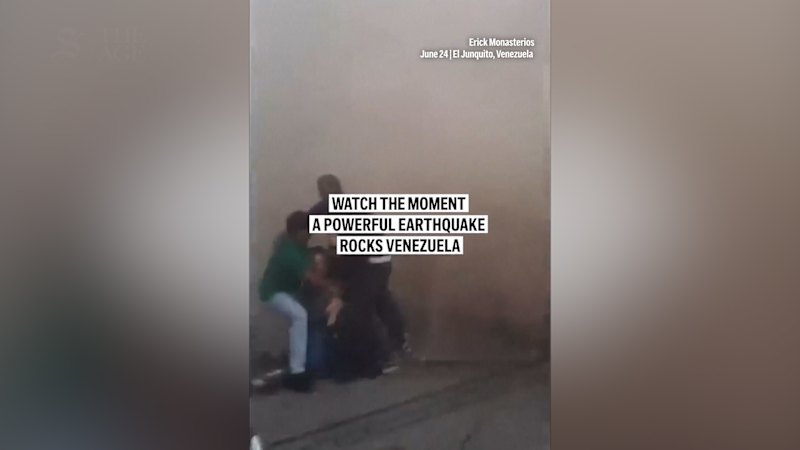
During this specific tremor, the physical manifestation of that energy was captured on dozens of smartphones and security cameras. In a local grocery store, rows of glass bottles cascaded onto the floor in a synchronized explosion of olive oil and red wine. In an office building downtown, concrete pillars—engineered to withstand immense vertical pressure—flexed and groaned under the unfamiliar horror of horizontal displacement.
To watch the footage is to witness the instant transformation of everyday objects into lethal hazards. A ceiling fan becomes a spinning pendulum of blades. A heavy wooden bookshelf turns into a falling wall of bricks. The very architecture designed to protect us becomes the threat.
A City in Suspension
The tremor lasted for less than a minute. In the timeline of a human life, sixty seconds is nothing. It is the time it takes to read a few paragraphs or wait for a traffic light to change. But inside an earthquake, time stretches into an agonizing eternity. Every second demands a choice. Do you run outside into a rain of falling glass? Do you cower under a desk and pray the ceiling holds?
Consider what happens next: the shaking stops, but the terror deepens.
The immediate aftermath of a major earthquake is defined by an eerie, suffocating silence. The traffic stops. The ambient hum of air conditioners and refrigerators dies as the power grid fails. Then, the screaming begins. It is followed quickly by the car alarms, thousands of them, triggered by the vibrations, wailing in a discordant symphony across the valley of Caracas.
For Maria, standing in her kitchen surrounded by shards of porcelain and spilled coffee, the silence was the worst part. The phone lines were dead. The internet was gone. In the modern world, isolation is a psychological wound. To be cut off from information in the wake of a disaster is to be trapped in a dark room where every shadow looks like a monster. Is another, larger tremor coming? Is the building safe? Are the people you love still breathing?
The Invisible Ripples
The international news cycle covers these events with a predictable cadence. A breaking news banner flashes on a screen in New York or London. A shaky video clip plays, showing a building swaying or people running into the streets. A spokesperson gives a brief statement about structural integrity and emergency response protocols. By the next morning, the algorithm has moved on to something else.
But the ripple effects of a major earthquake endure for years.
There is the economic toll, of course. In a country already navigating complex financial realities, the sudden necessity of repairing critical infrastructure—bridges, water mains, electrical substations—strains systems that were already pushed to their limits. A crack in a highway flyover isn't just a maintenance issue; it is a severed lifeline for a neighborhood that relies on that road for food and medical supplies.
The deeper damage, however, is psychological. Long after the debris is cleared and the drywall is patched, the trauma remains embedded in the collective consciousness of the citizens. Every minor vibration—a heavy truck passing on the street, a sudden slam of a door—triggers a spike of adrenaline. The mind becomes a hyper-vigilant radar, constantly scanning for the next betrayal by the earth.
The Architecture of Survival
Earthquakes are entirely natural phenomena, but their consequences are entirely human. We cannot control the movement of tectonic plates. We cannot predict the exact second a fault line will slip. What we can control is how we prepare, how we build, and how we respond.
The science of seismic engineering is a testament to human ingenuity. It is an acknowledgment of our vulnerability. Engineers design buildings not to fight the earthquake, but to dance with it. They use base isolators that act as shock absorbers, allowing the foundation to move independently of the structure above. They use flexible materials that bend without breaking.
But high-tech engineering requires capital, resources, and rigorous oversight. In older neighborhoods or informal settlements built on steep hillsides, those engineering principles are often absent. The disparity in risk is stark. A tremor that causes minor cracks in a modern office tower can cause catastrophic collapses in communities where homes are constructed from unreinforced brick and corrugated metal.
The true measure of a society's resilience is not how its finest buildings fare, but how its most vulnerable citizens survive.
The dust eventually settles. The power returns, grid by grid. People venture back inside their homes, stepping over the cracks in the plaster, looking at their walls with a newfound sense of distrust. They sweep up the broken glass and the spilled coffee. They rebuild because there is no other choice.
Maria found another cup. Her hands shook slightly as she poured the water, her ears still ringing with the ghost of that subterranean growl. The ground beneath her feet was still, for now. But the innocence of the morning was gone, replaced by the permanent realization that the stability of our world is nothing more than a fragile truce with the forces beneath us.