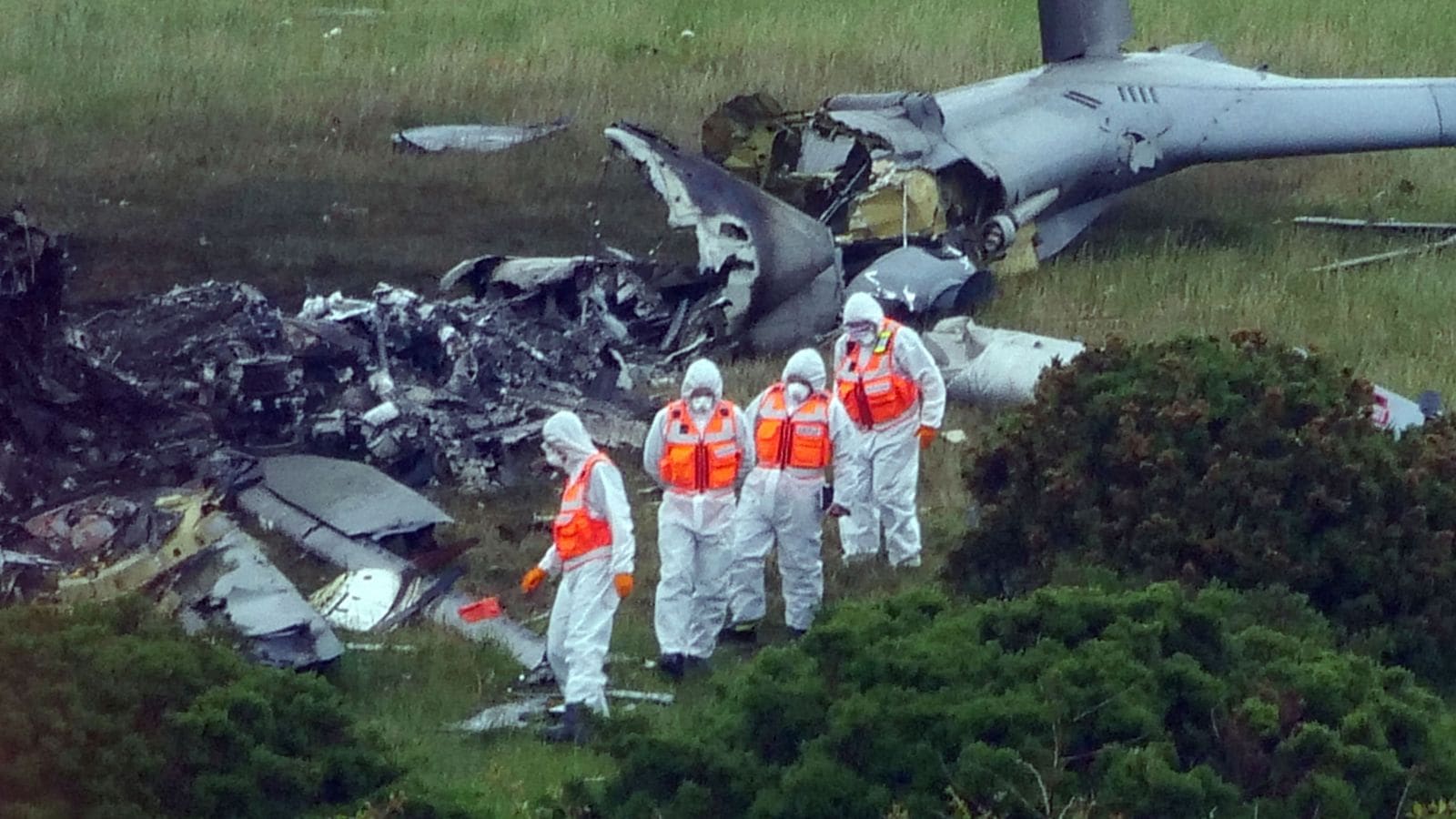
The mud of Dartmoor does not care about glass ceilings. It clings to combat boots with the same heavy, suffocating malice whether those boots belong to a legacy Marine or a history-maker. To earn the right to wear the coveted green beret of the Royal Navy Commandos, you must endure the kind of physical misery that makes most human beings break. You run miles through freezing bogs, carry weights that compress your spine, and face the grueling 30-mile march across the wildest terrain in England.
Lieutenant Commander Sarah-Jayne Mulvihill did not just survive that misery. She mastered it.
When she completed the grueling All Arms Commando Course, she became the first—and at the time, the only—serving female Royal Navy Commando. It was an achievement carved out of sheer grit, determination, and an refusal to let expectations dictate her boundaries. But the tragedy of military life is that the boundaries we conquer on the ground offer no protection against the cruelty of the skies.
A sudden, catastrophic shudder. The terrifying sound of metal failing under immense stress. In an instant, a routine flight transforms into a desperate struggle for survival, ending in a plume of smoke in the Iraqi desert.
The crash of the Lynx helicopter near Basra did not just claim a piece of military hardware. It tore a hole through the fabric of three families, shattered a historic legacy, and left a nation grappling with the immense, often invisible cost of service. We often read headlines about military casualties as clinical data points. Three killed. One helicopter lost. But statistics are a coward's way of looking at war. They blunt the sharp edges of grief. To truly understand what was lost in that desert sand, we have to look past the uniform and into the human heart.
The Weight of the Green Beret
To understand the magnitude of Lieutenant Commander Mulvihill’s journey, one must understand the sheer exclusivity of the Commando brotherhood. The Royal Marines Commandos are an elite amphibious fighting force. For decades, their ranks were entirely male, guarded by physical standards designed to weed out all but the most resilient.
When the military opened these pathways, it was not an invitation to a lowered bar. The standards remained brutal.
Imagine standing at the starting line of the endurance course. The rain is driving sideways. Your lungs burn with the taste of copper and cold air. Every muscle in your body is screaming at you to stop, to lie down in the heather and let the truck pick you up. Now imagine carrying not just your gear, but the unspoken expectations of every woman who might want to follow in your footsteps.
That is the invisible backpack Mulvihill carried.
She was 32 years old, an officer of exceptional caliber, who served as a flight commander. Her colleagues did not speak of her as a token or a symbol; they spoke of her as a force of nature. She possessed that rare combination of sharp professional competence and a warmth that could anchor a room full of stressed-out personnel. In the high-stakes environment of an active deployment, that kind of presence is oxygen.
The Final Flight
The deployment to Iraq was supposed to be another chapter in a distinguished career. The city of Basra was a volatile patchwork of shifting alliances and hidden dangers, a place where the air was permanently thick with heat, dust, and tension. In that environment, helicopters are the lifeblood of operations. They move people, they gather intelligence, they provide the eye in the sky that keeps the ground troops alive.
It was a Saturday afternoon. The Lynx helicopter, a reliable workhorse of the British military, lifted off into the shimmering heat haze. Along with Mulvihill, the crash claimed the lives of Wing Commander John Coxen and Lieutenant David Dobson.
They were not rookies. They were experienced, highly trained professionals who understood the risks of their environment. Yet, when the mechanical failure struck, the margins for error vanished.
The investigation into the crash would later detail the technical specifics—the terrifying reality of a tail rotor failure or mechanical malfunction that robs a pilot of control in a matter of seconds. But the technical reports cannot capture the finality of that moment. They cannot capture the silence that falls over a base when a bird goes missing from the radio net.
The Ripple Effect of Grief
When a soldier dies, the military apparatus moves with practiced, solemn efficiency. The flags are lowered. The repatriation ceremonies are planned with meticulous precision. The brass buttons are polished, and the uniforms are pressed.
But behind the formal military honors lies a raw, chaotic grief that defies protocol.
Consider her husband, Lee. He was also serving in the military, stationed at the very same base in Iraq when the crash occurred. To lose the person who holds your heart is a devastating blow under any circumstances. To lose them while deployed in the same theater of war, hearing the sirens, seeing the smoke on the horizon, is a nightmare of unimaginable proportions.
The grief rippled outward from the desert to a quiet corner of Kent, where her family waited for news that would never come. It rippled through the ranks of the Royal Navy, where young female recruits looked at Mulvihill’s photograph on the wall of achievement and saw a future that had been cruelly cut short.
The tragedy of her death was compounded by its timing. She was at the peak of her powers, a trailblazer who had already proven everything she needed to prove, yet stayed in the fight because she believed in the mission and the people beside her.
Beyond the Pioneer
There is a danger in remembering pioneers only for the barriers they broke. It reduces a rich, complex human life into a historical footnote. Mulvihill was the first female Royal Navy Commando, yes, but she was also a friend who loved a laugh, a leader who looked out for her junior sailors, and a woman who loved her family fiercely.
The green beret she earned wasn't a trophy to be displayed on a shelf. It was a testament to a daily choice to give everything for her country.
The true legacy of her service is found not in the fact that she was the first, but in the reality that she will not be the last. She demystified the path. She proved that the standard could be met through sheer force of will, irrespective of gender. She left the door open for the women who would come after her, ensuring that when the next female sailor steps up to face the grueling trials of Dartmoor, she will look into the mirror and see a reflection that has already been validated by a hero.
The desert wind eventually sweeps away the tracks of the helicopters and the scars of the crash site. The headlines fade into archives, replaced by newer, louder tragedies. But the impact of a life lived with purpose does not evaporate. It stays in the quiet determination of the recruits who train under the same grey skies, drawing strength from the memory of the woman who showed them how to fly.