The Billion-Dollar Bait
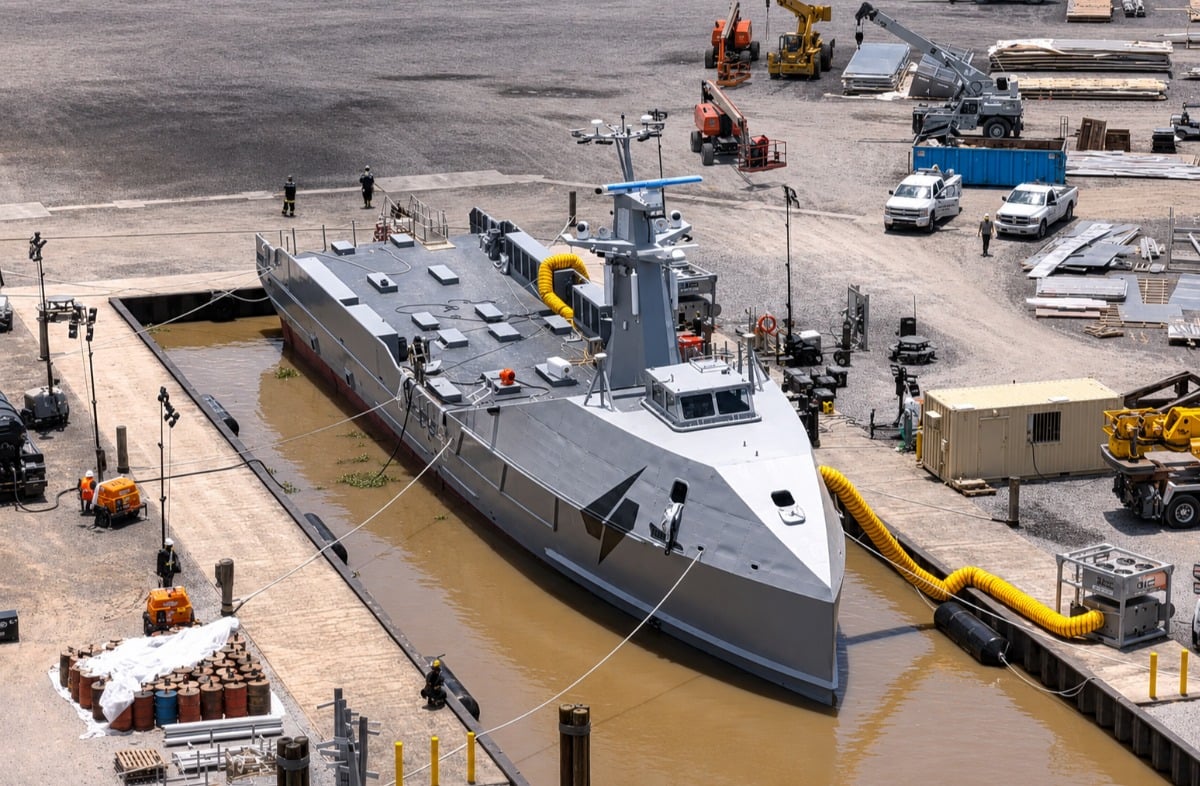
The defense tech press is currently swooning over Saronic launching its first Marauder autonomous surface vessel into the water. The narrative is predictably intoxicating: a 24-foot, software-driven, readily manufacturable boat that will supposedly swarm adversaries, solve the Navy’s mass problem, and rewrite the rules of naval engagement.
It is a beautiful story. It is also a fundamental misunderstanding of modern naval warfare.
The defense establishment has fallen in love with the hardware silhouette of autonomy while completely ignoring the brutal physics of electronic warfare, logistics, and attritable reality. We are treating autonomous vessels like software updates on water. In reality, we are building highly sophisticated, uncrewed targets that offer a fraction of the utility advertised, at a price point that will quickly cease to be "cheap."
I have spent years watching defense primes and venture-backed startups pitch the same dream: "Just remove the human, and the cost plummets while capability skyrockets." It works in a PowerPoint deck. It fails the moment a high-intensity conflict begins.
The launch of the Marauder is not a glimpse into a dominant future. It is a symptom of a procurement strategy that mistakes technological novelty for combat capability.
The Myth of the Attritable Autonomous Swarm
The core premise of vessels like the Marauder is "attritability"—the idea that these platforms are cheap enough to lose in high numbers. Proponents argue that if an adversary spends a million-dollar missile to sink a hundred-thousand-dollar autonomous boat, we win the economic calculus.
This argument is economically illiterate.
First, consider the actual cost of a combat-effective autonomous surface vessel (ASV). The hull, fiberglass, and electric or diesel propulsion systems are cheap. The autonomy stack, the redundant satellite communication arrays, the optical sensors, the electronic support measures (ESM), and the payload integration are not. By the time you equip a 24-foot boat with the sensor suite necessary to detect a stealthy Chinese Type 052D destroyer before that destroyer detects it, your "cheap" boat costs as much as a high-end missile.
Second, adversaries do not need to waste expensive anti-ship cruise missiles on a 24-foot boat. The Black Sea proved that small uncrewed vessels can be highly effective in specific, constrained environments against a blacked-out, complacent fleet. But it also proved how fast the counter-tactics evolve. Cheap, laser-guided rockets, heavy machine guns with thermal optics, and commercial-grade electronic jamming can neutralize small surface craft at a fraction of the cost of the vessel itself.
Imagine a scenario where fifty autonomous vessels are launched to penetrate a contested strait. If the adversary shifts the frequency of their localized jamming array, severing the command-and-control link, those fifty vessels do not swarm; they drift. You have not forced the enemy to deplete their missile magazine. You have merely littered the ocean with expensive marine debris.
The Line-of-Sight Lie
Every discussion about autonomous warships evades the absolute tyranny of the electromagnetic spectrum.
An uncrewed vessel requires data. It needs to send telemetry and receive targeting authorization, or it needs to possess an onboard artificial intelligence capable of making lethal decisions entirely on its own.
The second option is a legal and ethical minefield that the Pentagon is nowhere near crossing for macro-scale kinetic operations. Therefore, these vessels rely on the first option: connectivity.
The Satcom Vulnerability
To operate over the vast horizons of the Pacific, a vessel like the Marauder must communicate via satellite. In a peer conflict, those satellite links will be the very first things targeted, degraded, or completely severed. The moment low-earth orbit (LEO) constellations are jammed or attacked, an autonomous fleet becomes blind and mute.
The Line-of-Sight Reality
Without satellite links, these boats are restricted to line-of-sight communications. On a 24-foot hull, the antenna height is severely limited. Due to the curvature of the earth, a line-of-sight radio link from a small boat to a command ship cuts out at roughly 8 to 12 miles.
If your "long-range autonomous warship" requires a manned, multi-billion-dollar destroyer to steam within 10 miles of it just to keep the data link alive, you have not extended your operational reach. You have simply created a tethered buoy that drags your most valuable assets directly into the enemy's weapon engagement zone.
The Logistics Nightmare of the Low-Maintenance Fantasy
The loudest selling point for autonomous warships is the elimination of hotel load—no kitchens, no berths, no plumbing, no life support. This supposedly reduces maintenance and operational footprints to zero.
This ignores how ships actually function at sea.
Salt water is a corrosive, relentless enemy. On a manned vessel, sailors spend an enormous percentage of their day performing preventative maintenance: clearing sea strainers, fixing fuel line seals, wiping salt crust off optical lenses, and resetting tripped circuit breakers.
+-----------------------------------+-----------------------------------+
| Manned Vessel Maintenance         | Autonomous Vessel Reality         |
+-----------------------------------+-----------------------------------+
| Real-time mechanical triage       | Single point of mechanical failure|
| Manual clearing of sea strainers  | Clogged intake aborts mission     |
| Dynamic optical lens cleaning     | Salt spray blinds sensors         |
| Redundant on-site troubleshooting | Requires recovery vessel towing   |
+-----------------------------------+-----------------------------------+
When a sea strainer clogs on an autonomous boat three hundred miles out at sea, there is no sailor to clear it. The engine overheats. The vessel shuts down.
To maintain a fleet of hundreds of small autonomous vessels, the Navy will require a massive, specialized fleet of manned motherships just to launch, recover, refuel, and fix these "maintenance-free" craft. We are creating a massive logistical tail to support a teeth-to-tail ratio that looks catastrophic upon closer inspection.
Dismantling the People Also Ask Fallacies
When the defense industry looks at autonomous surface vessels, it asks fundamentally flawed questions. Let's address them directly.
Can autonomous warships replace traditional destroyers?
Absolutely not. A destroyer is an airborne early warning platform, an anti-submarine warfare hub, an air defense umbrella, and a command center wrapped into one nuclear- or gas-turbine-powered fortress. A 24-foot autonomous boat cannot carry the SPY-6 radar arrays or the Vertical Launch System (VLS) cells required to intercept ballistic missiles. If you replace destroyers with autonomous boats, you lose the ability to project power and defend air space. You swap a shield for a handful of pebbles.
Don't autonomous vessels lower the risk to human life?
Only if you view the conflict through a straw. If your autonomous fleet fails to deter or stop an adversary because it was jammed or mechanically crippled by salt water, the adversary advances. The ultimate risk to human life increases exponentially if you lose a war because you bet your defense on fragile tech instead of survivable, lethal platforms. Stripping humans from the platform does not strip risk from the theater.
Isn't rapid software iteration the key to winning future naval wars?
Software matters, but it cannot override hardware constraints. You can iterate your machine-learning algorithm every fifteen minutes, but if the hull cannot survive Sea State 5, or if the payload capacity is limited to a few hundred pounds, your software is just orchestrating a highly calculated sinking. The tech industry treats the ocean like a clean lab environment. The ocean always wins.
The Real Value Proposition (Which Everyone is Ignoring)
Am I saying autonomy on the water is useless? No. I am saying the current focus on autonomous warships—vessels meant to fight and destroy other ships—is a dead end.
The real, unglamorous value of platforms like the Marauder lies in dull, passive, non-kinetic tasks.
- Continuous Undersea Surveillance: Tending passive sonar arrays in choke points for weeks at a time to track submarine movements.
- Decoy Operations: Emitting massive electromagnetic signatures to mimic a carrier strike group, forcing an enemy to look in the wrong direction.
- Deceptive Logistics: Running automated supply routes to isolated islands to drop off ammunition and medical supplies, freeing up manned assets.
These roles do not look good in promotional videos. They do not feature sleek hulls firing missiles into the sunset. But they are the only roles where the hardware limitations of a small, uncrewed boat do not invalidate the mission.
Stop Funding the Hardware Sideshow
The rush to put autonomous hulls in the water is driven by venture capital timelines and political pressure to look innovative, not by naval doctrine. Capital is being poured into building new hulls when it should be poured into solving the fundamental constraints of long-range secure communications, edge-computing target recognition, and mechanical reliability under extreme maritime conditions.
Building a 24-foot boat that can navigate via GPS from point A to point B is a college engineering project, not a military breakthrough. If the defense tech ecosystem continues to celebrate the mere existence of these platforms without demanding answers to the electronic warfare and logistical realities they face, we are setting ourselves up for a catastrophic wake-up call.
Stop looking at the shiny new boat. Look at the jamming environment it will actually have to survive. Turn off the marketing videos, look at the physics of the Pacific, and realize that we are building an exquisite fleet of floating targets.