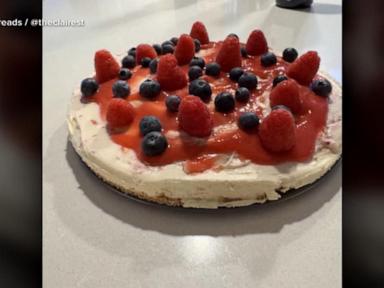
The air in the room was thick with the smell of extinguished matchsticks and cheap paraffin wax. It is a scent that occupies a very specific corner of the human psyche—the smell of the "moment before." Everyone was leaning in. The camera was steady. In the center of the frame sat a cheesecake, its surface glossy and pristine, ivory-colored and heavy with the promise of a perfect sugar rush. It was more than a dessert. It was the physical manifestation of another year survived.
Then, the floor rose up to meet it.
We have all seen the video by now. It has been sliced, diced, and shared across every platform until the pixels are beginning to fray at the edges. A woman holds the cake. She smiles. The box, perhaps betrayed by a weak cardboard tab or a momentary lapse in structural integrity, gives way. The cheesecake does not just fall; it surrenders to physics. It hits the carpet with a dull, wet thud—the kind of sound that signifies the absolute end of an era.
The internet laughed, of course. We are biologically wired to find the sudden subversion of expectations hilarious, especially when it involves someone else's misfortune and a dairy product. But if you look past the viral slapstick, there is a quiet, devastating tragedy written in the slumped shoulders of the birthday girl.
The Architecture of Anticipation
Every celebration is a fragile construction project. We spend days, sometimes weeks, building a mental image of how a milestone will feel. We curate the guest list, we select the perfect outfit, and we obsess over the centerpiece. In this case, the centerpiece was a cheesecake.
Consider the anatomy of a cheesecake for a moment. Unlike a standard sponge cake, which is mostly air and structural integrity, a cheesecake is an exercise in excess. It is dense. It is heavy. It requires a specific temperature to maintain its dignity. It is, quite literally, a high-stakes dessert. When a sponge cake falls, it might bounce or crumble. When a cheesecake falls, it undergoes a total molecular collapse.
This is the invisible tax we pay for caring about things. The more weight we give to a moment—the more "density" we pack into a single evening—the more catastrophic the failure feels when gravity takes over. The woman in the video wasn't just losing a forty-dollar grocery item. She was watching the climax of her own story hit the floor before the protagonist could even take a bite.
The Digital Colosseum
Why did millions of people stop their day to watch a dessert die?
We live in an era of hyper-curation. Our feeds are gorged on "perfect" reveals: the gender reveal that goes off without a hitch, the surprise proposal in front of the Eiffel Tower, the flawlessly frosted multi-tiered wedding cake. These images create an artificial standard of reality that is exhausting to maintain.
When that cheesecake hit the floor, it was a glitch in the Matrix.
It was a reminder that the universe does not care about your lighting or your follower count. Gravity is the ultimate equalizer. Seeing that cake go "flat" offered the audience a strange kind of catharsis. It was the permission we all needed to admit that our lives, too, are often one weak cardboard flap away from a mess on the carpet.
The viral frenzy wasn't just about the comedy of a falling cake. It was about the relatability of the ruined moment. We have all been the person holding the box. We have all felt that sickening lurch in the gut when we realize that the thing we were holding onto—a job, a relationship, a dream, or a dessert—is no longer within our grasp.
The Physics of the Flop
Let’s look at the mechanics. A standard nine-inch cheesecake weighs roughly four pounds. When dropped from waist height, it strikes the ground with enough force to liquefy the structural bonds of the graham cracker crust.
There is no "five-second rule" for a cheesecake on a carpet.
The fibers of the rug act like a thousand tiny straws, immediately wicking away the moisture while simultaneously donating lint and dust to the cream cheese mixture. It is a total loss.
In the video, there is a split second of silence after the impact. It is the loudest silence in the world. It’s the sound of a brain trying to negotiate with reality. Maybe I can scoop it up? Maybe if I flip it over, no one will notice? But the eyes tell a different story. The eyes see the splat for what it is: a permanent change in the timeline.
This is where the human element eclipses the "viral" element. In the footage, you see the transition from shock to a forced, painful laughter. It’s a defense mechanism. If we don’t laugh at the cheesecake on the floor, we have to acknowledge the cruelty of a world where a birthday can be derailed by a piece of paperboard.
The Myth of the Perfect Pivot
We are often told that the mark of a great person is how they handle failure. We are expected to "pivot." We are told to "make lemonade."
But sometimes, you can't make lemonade. Sometimes, you just have a face full of lemons and a ruined carpet.
The pressure to turn every disaster into a "learning moment" or a "funny story for later" is a modern pathology. It robs us of the right to be genuinely upset about the small things. To the woman in the video, that cake represented the "specialness" of her day. To have it taken away by a physical fluke is an affront to the effort of celebration.
The true story isn't the fall. It's the aftermath.
It's the friends who, after the camera stopped rolling, probably helped her scrape the remains into a trash bag. It's the person who went out to the 24-hour pharmacy to buy a pint of ice cream as a consolation prize. It's the way we patch the holes in our lives with the mundane when the spectacular fails us.
The Ghost of Birthdays Past
We remember the disasters far more vividly than the successes. Ask anyone about their best birthday, and they might struggle to give you details. Ask them about the time the cat knocked over the candles or the time the grill caught fire, and they will give you a play-by-play.
The fallen cheesecake has now entered the permanent lore of that family. Ten years from now, they won't remember the gifts she received. They will remember the "Year of the Floor Cake."
There is a strange sort of immortality in failure. By falling flat, that cake achieved a level of fame that a perfectly sliced dessert never could have dreamed of. It became a shared cultural touchstone, a tiny tragedy that bound strangers together in a collective cringe.
We watch because we are relieved it wasn't us. We watch because we know, deep down, that it eventually will be.
The box is always heavier than we expect. The cardboard is always thinner than it looks.
The woman stands over the ruin, her hands empty, the ghost of a wish still hovering in the air where the candles used to be. The camera cuts to black, but we stay in that room for a moment longer, staring at the spot on the rug where the party ended and the real world began.