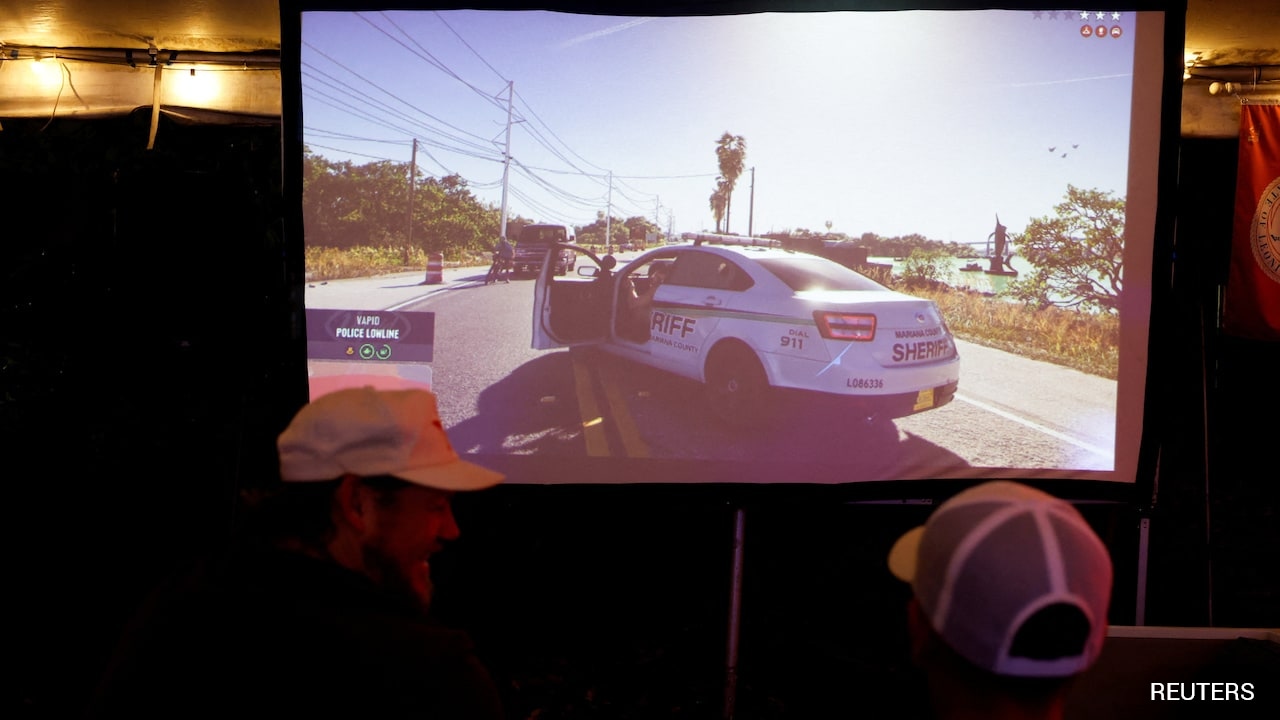
Every major gaming outlet just slapped a 10 out of 10 on Grand Theft Auto VI, and you should not trust a single word of it.
The industry press is currently tripping over itself to declare Rockstar Games the undisputed savior of modern entertainment. They are writing breathless essays about lighting physics, sweat bead rendering, and the sheer square mileage of Leonida. They want you to believe the hype. They want you to view a decade-long development cycle and a reported billion-dollar budget as an artistic triumph rather than a terrifying symptom of a broken business model. Recently making news in this space: Thirteen Years of Waiting and One Impossible Thursday in Vice City.
The lazy consensus is that universal critical acclaim equals a healthy, thriving medium. It does not. When an entire press corps marches in lockstep to praise a single corporate product on launch week, you are not witnessing objective criticism. You are watching access journalism operating at maximum capacity, combined with the psychological weight of sunk-cost fallacy on a global scale.
The Access Economy and the 10-Out-of-10 Tax
Let us look at the actual mechanics of how a blockbuster review gets written. I have spent fifteen years analyzing publishing contracts, media embargoes, and studio PR playbooks, and the leverage dynamic for a title of this magnitude is completely lopsided. Additional information into this topic are detailed by Reuters.
When a publisher holds the keys to the biggest cultural event of the decade, they do not need to bribe journalists. They simply control the oxygen. If an outlet publishes a lukewarm 7 out of 10 during the launch window, they do not get invited to the next preview event. Their traffic plummets because algorithmic search favors consensus enthusiasm during peak hype cycles. Worse, their comment sections turn into toxic wastelands fueled by tribal fans who equate a critique of a video game with a personal insult.
Therefore, the 10 out of 10 score is not an assessment of perfection. It is a tax paid by media outlets to remain inside the velvet rope.
Critics praise the graphical fidelity because graphical fidelity is objective and safe. Nobody gets death threats for pointing out that ray-traced reflections on a wet Miami street look impressive. By focusing almost exclusively on technical horsepower and environmental density, reviewers avoid asking the uncomfortable structural questions about whether the actual core gameplay loop has evolved past 2013.
The Illusion of Innovation in Open-World Design
Strip away the photorealistic skin of Vice City, and what is actually underneath?
Rockstar’s signature mission design has relied on the exact same rigid, linear scripting for over twenty years. Drive to the yellow marker. Listen to exposition while driving. Follow a strictly choreographed sequence of events where stepping ten feet outside the invisible boundary triggers an instant mission failure screen.
In an era where games like The Legend of Zelda: Tears of the Kingdom, Elden Ring, and Baldur's Gate 3 proved that players crave systemic freedom and emergent problem-solving, Rockstar doubles down on cinematic railroading. Critics call this "prestige storytelling." In reality, it is frictionless tourism disguised as interactive entertainment.
Imagine a scenario where an indie studio released a game with clunky shooting mechanics, archaic cover systems, and missions that punish players for experimenting with their environment. Critics would eviscerate it within hours. Because it wears a multi-billion-dollar coat of paint, those exact same flaws are rebranded as "deliberate pacing" and "authentic weight."
What Players Are Actually Buying
If you are searching online to see whether Grand Theft Auto VI is worth the seventy-dollar price tag, you are asking the wrong question. For the sheer volume of single-player content, the upfront cost is a bargain compared to almost any other form of entertainment.
The real question you should be asking is how aggressively the single-player experience has been engineered to funnel you into the online monetization engine.
Take-Two Interactive did not greenlight a decade of development out of pure artistic altruism. They did it because Grand Theft Auto Online generated over eight billion dollars in revenue through microtransactions, Shark Cards, and recurring subscription models. The single-player campaign is the loss leader—the glittering storefront window designed to get you through the door so you stay in the ecosystem for the next twelve years.
- The Single-Player Hook: Establishes emotional attachment to the map, the vehicles, and the social satire.
- The Friction Point: Deliberately slows down progression economies just enough to make grinding feel tedious.
- The Monetization Pivot: Transfers your familiarity with the world into an online multiplayer environment where status is directly tied to real-world currency.
Reviewers rarely factor this long-term economic architecture into their launch-day scores because the online component usually launches weeks later, or its most predatory monetization hooks are patched in after the review window closes. You are buying a Trojan horse, and the critics are busy admiring the woodwork.
The Unspoken Cost to the Rest of the Industry
There is a massive downside to celebrating this kind of hyper-consolidated success, even if you genuinely love the game. Every time a single mega-franchise absorbs all the oxygen, capital, and player hours in the market, the middle tier of game development dies a little faster.
Wall Street executives and publishing CEOs look at Rockstar’s launch numbers and learn the wrong lessons. They do not see a studio with unmatched institutional talent and the rare luxury of unlimited time. They see a mandate to cancel five mid-budget, experimental games to fund one bloated live-service gamble.
I have watched major studios burn hundreds of millions of dollars chasing the open-world dragon, resulting in massive layoffs when their knock-off fails to capture a fraction of Rockstar’s cultural footprint. By treating Grand Theft Auto VI as the pinnacle of what video games should be, the press actively encourages the creative homogenization of the entire sector.
To be completely fair, my contrarian stance has an obvious blind spot: millions of players do not want systemic complexity or experimental mechanics. After a forty-hour workweek, most people want a gorgeous, high-budget sandbox where they can turn their brain off, drive fast cars, and laugh at sharp cultural parody. Rockstar delivers that specific escapism better than anyone on earth, and denying the sheer technical craft required to build a world this dense would be intellectually dishonest.
How to Actually Consume Blockbuster Releases
Stop letting aggregate review scores dictate your purchasing decisions or validate your excitement. Metacritic is a measure of consensus safety, not artistic truth.
If you want to experience Grand Theft Auto VI without falling victim to the hype machine, change how you engage with it:
- Wait thirty days before buying. Let the launch-week euphoria evaporate. Watch unedited gameplay streams rather than curated trailers or sponsored early-access footage to see what the minute-to-minute movement actually feels like.
- Treat the campaign as a standalone product. Play through the story, explore the map at your own pace, and uninstall it the moment the credits roll. Refuse to engage with the online economy until it proves it respects your time more than your wallet.
- Audit your own gaming diet. For every seventy dollars you spend on a mega-franchise, spend thirty dollars on an independent studio taking genuine mechanical risks.
The rave reviews are not a sign that gaming has reached its zenith. They are proof that marketing budgets have become so vast, and the industry press so dependent on access, that critical resistance has effectively collapsed. Enjoy the spectacle in Vice City if you want, just do not mistake a billion-dollar fireworks show for a revolution.