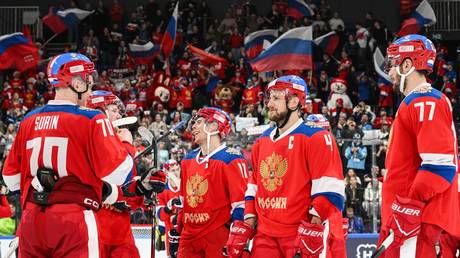
International sports federations operate under a structural contradiction that turns judicial compliance into an existential crisis. When a supranational sports tribunal orders the International Ice Hockey Federation (IIHF) to readmit Russian national and club teams, the resulting institutional outrage is not merely political theater. It is a rational reaction to a severe asset-liability mismatch. Legal bodies adjudicate narrow questions of charter compliance and discriminatory exclusion, while sports governing bodies must manage the physical, financial, and logistical realities of tournament execution. To understand why an ice hockey federation reacts with hostility to a binding legal directive, one must dissect the operational mechanics of international tournament governance, the economic architecture of European hockey, and the game-theoretic trap created when member nations refuse to share the ice.
The Structural Mismatch Between Sports Law and Federation Operations
At the core of the conflict lies a fundamental divergence in risk exposure. The Court of Arbitration for Sport (CAS) and internal appeal panels evaluate eligibility through the lens of lex sportiva—the transnational legal framework governing athletic competition. Under these statutes, blanket bans based on nationality violate foundational principles of political neutrality and individual merit unless an overriding, legally defensible justification exists.
For the tribunal, the mandate ends when the ruling is published. The tribunal bears zero operational risk for the enforcement of its decree.
Conversely, the IIHF functions as an event-production and rights-management enterprise whose solvency depends entirely on the voluntary participation of its constituent national associations. When an external or internal judicial body mandates the reintegration of Russian teams, it forces the federation to internalize three distinct categories of operational cost that the ruling completely ignores.
- Sovereign Border and Visa Friction: A federation can grant competitive eligibility, yet it cannot issue Schengen visas or override national security directives. Since 2022, multiple European host nations—including Finland, Sweden, Latvia, and the Czech Republic—have instituted strict entry bans on Russian citizens, explicitly extending to athletes and support staff. A legal order to readmit a team into a tournament hosted in Prague or Tampere creates an immediate, unsolvable logistical impasse.
- Security Cost Escalation: Even where entry is legally permissible, the presence of Russian state-affiliated teams transforms a standard sporting event into a high-risk geopolitical flashpoint. Host organizing committees must absorb exponential increases in perimeter security, intelligence coordination, and crowd control. These costs are unbudgeted and uninsurable under standard event policies.
- Commercial Contagion: Major corporate sponsors in Western Europe and North America operate under strict Environmental, Social, and Governance (ESG) mandates and sanctions-compliance frameworks. Reintroducing a sanctioned state's athletic apparatus triggers immediate force majeure and morality clauses in broadcast and sponsorship agreements.
The federation’s public frustration reflects the impossibility of reconciling a binary legal order with a multi-variable operational environment.
The Economics of the European Hockey Ecosystem
To quantify why the IIHF resists readmission so fiercely, one must examine the revenue concentration of international ice hockey. Unlike global football, where broadcast and commercial revenues are distributed across dozens of high-value markets, elite international hockey relies on a hyper-concentrated core of six to eight nations.
The IIHF World Championship—the primary financial engine that funds global hockey development, junior tournaments, and federation overhead—generates the vast majority of its commercial value from a tight geographic cluster: Canada, the United States, Sweden, Finland, the Czech Republic, Switzerland, Germany, and Slovakia.
In economic terms, these nations represent the federation’s core liquidity providers. They supply the host cities, the in-arena ticket buyers, the high-value television rights fees, and the multinational corporate sponsors.
Russia, despite its historical prestige and deep talent pool, operates as a distinct and largely insulated commercial market. While the Kontinental Hockey League (KHL) commands significant domestic capital, the international federation’s ability to monetize Russian participation has been severely degraded by Western financial sanctions, currency controls, and the withdrawal of Western broadcasters from the Russian market.
When a legal ruling forces the IIHF to choose between accommodating Russian readmission and retaining the full cooperation of its Nordic and Central European member associations, the financial calculus is asymmetrical.
- Scenario A (Compliance with Readmission): The federation obeys the legal order. In response, the Finnish, Swedish, and Czech federations—backed by their respective governments and domestic sponsors—refuse to host tournaments featuring Russian teams or threaten boycotts. The IIHF loses its primary venue infrastructure and its highest-margin broadcast territories.
- Scenario B (Resistance and Delay): The federation exhausts every procedural avenue, cites safety and logistical force majeure, and delays implementation. It faces legal sanctions or reputational damage within the Olympic movement, yet it preserves the commercial viability of its flagship annual tournaments.
The federation's anger is the predictable output of an organization being legally compelled to execute a strategy that destroys its own balance sheet.
The Safety and Integrity Mechanism as a Legal Shield
Because international sports law generally prohibits exclusion based purely on geopolitical alignment, federations must construct a defensible legal firewall. In the governance of international hockey, that firewall is built entirely on the concept of event safety and competitive integrity.
When the IIHF initially suspended Russian and Belarusian teams, it avoided framing the decision as a political punishment. Instead, the federation council invoked its statutory obligation to ensure the safety of all participants, officials, and spectators, alongside the practical impossibility of running tournaments amidst widespread travel bans and player-safety threats.
This framing relies on a specific causal chain:
- Geopolitical hostility creates an acute risk of civil unrest, athlete harassment, and venue disruption.
- National governments refuse to guarantee the physical security of Russian delegations or deny them entry altogether.
- The federation lacks a private security apparatus capable of overriding sovereign border controls or neutralizing state-level security threats.
- Therefore, exclusion is not a discriminatory choice, but a mandatory risk-management measure required to preserve the physical execution of the tournament.
When an appellate body overturns a suspension, it typically does so by attacking the evidentiary standard of this causal chain. Tribunals demand concrete, contemporaneous proof that a specific tournament cannot be safely executed, rejecting generalized assertions of geopolitical tension.
This creates an adversarial dynamic between the administrators and the jurists. Administrators operate on forward-looking risk mitigation; they cannot wait for a stadium riot or a diplomatic incident to prove that a threat was real. Jurists operate on retrospective evidentiary standards; they refuse to validate preemptive restrictions without hard proof of imminent harm. When the jurists strike down the ban, they strip the federation of its primary legal shield while leaving the underlying physical threats completely intact.
The Boycott Game Theory and the Multi-Lateral Stalemate
The most acute operational nightmare triggered by a readmission order is the certainty of decentralized boycotts. The IIHF does not exercise command-and-control authority over sovereign national sports federations. It functions as a cartel of independent national bodies.
If Russian teams are forcibly reinserted into the international tournament matrix, the decision triggers a classic multi-player prisoner's dilemma among the remaining member states.
Consider the incentive structure facing the Swedish Ice Hockey Association or the Finnish Ice Hockey Association. Domestic public opinion in both countries remains overwhelmingly opposed to sporting normalization with Russia. Domestic corporate sponsors—ranging from telecommunications firms to state-owned gaming monopolies—have explicitly tied their funding to the exclusion of Russian state symbols and teams. Furthermore, player unions and individual NHL stars have signaled reluctance to participate in tournaments where Russian teams compete.
For a Nordic or Baltic federation, the cost of playing against Russia is immediate domestic financial collapse and severe political backlash. The cost of boycotting a single IIHF tournament is a temporary competitive penalty.
Once a single major hockey nation declares a boycott, a cascade effect ensues:
- Competitive Devaluation: A World Championship or Olympic qualifying tournament missing Finland, Sweden, and the Czech Republic loses its sporting legitimacy. Winning a gold medal in a depleted field carries diminished athletic and commercial value.
- Broadcast Contract Breach: Television networks acquire rights based on guaranteed inventory of top-tier matchups. If marquee nations withdraw, broadcasters trigger rebate clauses, slashing the rights fees paid to the IIHF.
- Host City Defection: No municipality in democratic Europe will underwrite the logistical costs of hosting a tournament tainted by boycotts and protests.
The IIHF knows that a legal ruling ordering readmission does not actually result in Russian teams playing against Sweden, Finland, or Canada. It simply replaces a centralized, orderly suspension with a chaotic, decentralized collapse of the tournament schedule.
The NHL Variable and the Fractured Governance of Elite Hockey
Complicating the IIHF’s predicament is its unique structural subordination to the National Hockey League (NHL). Unlike FIFA in football or FIBA in basketball, the IIHF does not control the premier professional league in its sport. The NHL is a private, North American commercial cartel that operates outside the IIHF’s regulatory jurisdiction.
This power dynamic strips the IIHF of the disciplinary tools available to other international federations.
In sports where the international federation sits at the top of the regulatory pyramid, a national association that threatens a boycott can be threatened with expulsion from future World Cups, suspension of development grants, and bans on its domestic clubs competing in continental championships.
In ice hockey, those threats are hollow. The best players from Sweden, Finland, the Czech Republic, Canada, and the United States earn their livings in the NHL. The NHL does not recognize IIHF disciplinary bans unless mutually agreed upon through specific transfer agreements. If the IIHF attempts to punish a European federation for refusing to play against Russia, it risks alienating the very federations it needs to negotiate with the NHL over Olympic participation and player transfer fees.
Moreover, the NHL has established its own parallel international competition architecture—such as the 4 Nations Face-Off and future World Cup of Hockey iterations—organized jointly with the NHL Players' Association (NHLPA). These tournaments operate entirely outside the IIHF’s legal framework. They are commercial exhibitions, not governed by Olympic charters or CAS jurisdiction, allowing the NHL and NHLPA to invite or exclude nations purely on commercial and political viability.
Every time a legal tribunal forces the IIHF into an untenable geopolitical position, it accelerates the migration of elite international hockey away from the IIHF and toward private, NHL-controlled commercial events. The federation’s outrage is driven by the realization that judicial compliance directly erodes its monopoly over the sport's premier international assets.
The Olympic Charter Friction and IOC Delegation
The IIHF’s institutional frustration is compounded by the ambiguous leadership of the International Olympic Committee (IOC). The IOC has consistently sought to thread a needle: maintaining rhetoric around the unifying power of sport and individual athlete rights while delegating the actual operational enforcement of neutral-athlete frameworks to individual international federations.
This delegation creates a severe agency problem.
The IOC sets high-level ideological guidelines—suggesting that athletes holding Russian passports should be allowed to compete as Individual Neutral Athletes (AIN) provided they do not actively support the war and have no ties to military or security agencies. However, the IOC does not run the world championships of individual sports. It pushes the administrative burden of vetting, security, and schedule integration onto the international federations.
For individual sports like tennis, fencing, or swimming, processing neutral athletes is administratively feasible. A tennis player enters a tournament as an independent contractor; their presence does not require a national delegation, a team bench, or synchronized national logistics.
Team sports present a fundamentally different structural reality. You cannot disaggregate a twenty-five-man ice hockey roster, coaching staff, medical team, and equipment managers into "individual neutral athletes" without creating a de facto national team. Even stripped of flags and anthems, a team composed entirely of Russian players represents the Russian hockey system.
When a sports tribunal applies precedents derived from individual sports to a high-contact, national-identity-driven team sport like ice hockey, it ignores the physics and sociology of the game. The IIHF is left holding the operational bag for an ideological framework designed for individual track-and-field athletes.
The Limitations of Judicial Intervention in Geopolitical Conflicts
The recurring clash between sports tribunals and governing bodies exposes a structural flaw in the architecture of global sports governance. Arbitration panels are designed to resolve commercial disputes, doping violations, and contract disagreements within a stable political order. They are structurally unequipped to adjudicate crises where sovereign national security, war, and international sanctions intersect with athletic competition.
Attempting to solve a geopolitical boycott through a legal decree suffers from three fatal limitations:
- Lack of Enforcement Mechanisms: A tribunal can annul a suspension, but it cannot compel a sovereign state to open its airspace, issue visas, or deploy riot police to protect a visiting team.
- Inability to Price Externalities: Legal rulings treat competitive eligibility as an absolute right, failing to account for the catastrophic financial externalities imposed on third-party stakeholders, sponsors, and host cities.
- Erosion of Institutional Legitimacy: When a governing body is forced to issue rules that its members openly defy, the authority of the governing body collapses. A rule that cannot be enforced without destroying the tournament is worse than no rule at all.
By treating the exclusion of a warring state’s national team as a simple matter of regulatory non-compliance, the legal apparatus undermines the very stability it purports to protect.
Strategic Execution for Federation Leadership
To survive the collision between binding legal mandates and the operational realities of European hockey, the IIHF cannot rely on passive compliance or rhetorical outrage. The federation must execute a structural pivot that isolates its core commercial assets from judicial overreach while satisfying the strict letter of sports law.
First, codify objective, non-political tournament viability thresholds into the IIHF Statutes. Rather than relying on ad-hoc council votes citing generalized safety concerns—which are easily overturned by appellate panels—the federation must amend its bylaws to establish hard operational triggers for tournament participation. If a participating national association cannot secure unconditional visa clearance for its entire delegation across all scheduled host nations at least 120 days prior to puck drop, or if its participation triggers documented force majeure cancellations from a threshold percentage of tournament broadcast and commercial partners, automatic administrative withdrawal must occur. This shifts the legal basis of exclusion from subjective political judgment to objective, auditable contractual impossibility.
Second, ring-fence flagship commercial properties through joint-venture structures. The federation must insulate the top division of the IIHF World Championship from the rigid jurisdictional constraints of Olympic-style governance. By restructuring the commercial rights and hosting agreements of the elite World Championship into a dedicated operating entity governed by commercial contract law rather than pure association bylaws, the IIHF gains the structural flexibility utilized by the NHL. Participation in commercial invitational tiers can then be tied explicitly to commercial viability, broadcast market access, and mutual hosting reciprocity.
Third, transfer vetting and security indemnification entirely to the applicant federation. If a tribunal mandates the readmission of Russian teams under neutral status, the IIHF must establish an uncompromising financial and compliance bond. The returning federation must post a non-refundable escrow deposit sufficient to cover 100 percent of the incremental security, insurance, and venue-hardening costs required by host nations, alongside independent third-party vetting fees to verify non-affiliation with military or sanctioned entities. If the applicant federation cannot or will not fund the true operational cost of its reintegration, its entry remains administratively incomplete.
Compliance with a legal mandate does not require institutional suicide. By converting political resistance into hard financial, logistical, and contractual requirements, the federation forces the legal system to confront the true economic cost of reintegration—shifting the burden of impossibility back onto those demanding entry.