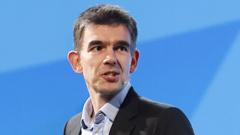
The BBC has officially handed the keys to the kingdom to a man who has never spent a single day in a television newsroom. On Wednesday, March 25, 2026, the BBC Board confirmed Matt Brittin, the former Google EMEA president, as the 18th Director General of the corporation. He arrives as a cleanup specialist following the messy departure of Tim Davie, who resigned after a catastrophic scandal involving a doctored edit of a Donald Trump speech. Brittin’s appointment is not just a change in leadership; it is a fundamental bet that the future of British public broadcasting lies in Silicon Valley’s data-driven efficiency rather than the traditional instincts of the Fourth Estate.
He takes over on May 18, inheriting a $10 billion defamation lawsuit from the White House and a Royal Charter that expires in 2027. If he fails to secure a new funding settlement, the BBC as we know it ceases to exist.
The end of the editorial DG
For over a century, the Director General has been the "Editor-in-Chief" of the nation. They were usually journalists or producers who worked their way up through the mahogany-clad corridors of Broadcasting House. Brittin breaks that lineage completely. While he is a former Olympic rower and a McKinsey alumnus, his career has been defined by the relentless pursuit of digital market share at Google.
By choosing a tech executive, the BBC Board has tacitly admitted that the role of Director General has become too large for one person. Brittin will be the strategist and the diplomat, but he cannot be the editorial conscience. To compensate for his lack of broadcast experience, the corporation will appoint a Deputy Director General specifically tasked with overseeing editorial standards. This decoupling of "the business" from "the news" is a radical departure. It suggests the BBC is no longer a news organization that happens to have a massive budget, but a massive tech entity that happens to produce news.
The Trump litigation and the Davie fallout
Tim Davie’s tenure did not end because of the license fee or a lack of hits. It ended because of a 12-second clip. The Panorama documentary that allegedly spliced Donald Trump’s January 6 speech to imply a direct call for violence triggered a cascade of failures. When the White House called the edit "dishonest," the BBC’s internal defenses crumbled. Davie, along with News CEO Deborah Turness, realized their positions were untenable as the litigation reached the $10 billion mark.
Brittin’s first task is to manage the legal fallout. The BBC’s current defense—that Trump’s reelection proves no harm was done to his reputation—is a high-stakes gamble in a U.S. court. If that defense fails, Brittin will be the one presiding over the largest financial settlement in the history of public media. He is being brought in specifically because he understands the language of global litigation and the temperament of American power players.
The 2027 Charter cliff edge
Beyond the courtroom, the existential threat is the Royal Charter. The current agreement expires on December 31, 2027. Without a renewal, the BBC loses its legal right to broadcast and its guaranteed funding. Culture Secretary Lisa Nandy has floated the idea of a "permanent charter" to strip away political interference, but the funding model remains a toxic debate.
- The License Fee: Declining rapidly. Evasion is at 12.5%, and millions of younger viewers have simply opted out.
- Subscription: A logistical nightmare that would destroy the BBC’s mandate for "universal" service.
- Ad-funding: Resisted by the public and feared by commercial rivals like ITV and Sky.
Brittin’s background makes him the perfect candidate to argue for a hybrid model. He knows how to monetize digital platforms better than anyone else in the UK. At Google, he oversaw a region that contributed billions to Alphabet’s bottom line. The BBC Board hopes he can find a way to extract value from the BBC’s vast archive and digital presence without alienating the "Auntie" traditionalists who still view the license fee as a civic duty.
Internal culture and the accountability gap
The incoming Director General is walking into a building currently defined by low morale and a string of high-profile HR failures. From the Huw Edwards scandal to recent bullying allegations involving MasterChef's Gregg Wallace, the BBC has looked like an organization that has lost its grip on its own staff.
The unions, specifically Bectu, are already signaling a cautious welcome, but they are wary. Brittin’s "Google-style" management—often characterized by flat hierarchies and high-speed pivots—might clash with the bureaucratic, unionized reality of the BBC. He has promised to "listen, learn, and lead," but the pace of change he is used to might cause more friction than the BBC can currently withstand.
A gamble on relevance
The BBC is currently losing the battle for attention. YouTube has already overtaken the broadcaster in several key audience metrics among the under-35s. For the first time, the man running the BBC is someone who helped build the very platform that is killing it.
This isn't just a hire. It’s a surrender to the reality that the BBC can no longer survive on prestige alone. It needs to be a platform. It needs to be an algorithm. It needs to be as efficient as the search bar Brittin used to sell.
Would you like me to analyze the specific legal arguments the BBC is using to fight the $10 billion Trump lawsuit in the U.S. courts?