The blue book feels the same in your hand. It has that familiar, stiff buckram texture and the gold-foiled crest of the Great Seal on the cover. But when you flip to the first few pages—the pages that define who you are to the rest of the world—the air in the room changes.
For decades, the American passport has been a masterpiece of subtle security. It was a document of fine lines, watermarks, and invisible threads that only screamed their presence under a UV light. It was bureaucratic. It was neutral. Now, it has become a portrait.
The Face on the Page
Consider a traveler named Elias. He is standing in a fluorescent-lit line at Heathrow or Changi or Schiphol. He has been flying for fourteen hours. His eyes are bloodshot, his shoes are off, and his belt is coiled in a plastic bin three stations back. He hands his passport to a border agent who has seen ten thousand faces today.
Usually, the agent looks at the data chip. They look at the holograms. But now, they look at the signature.
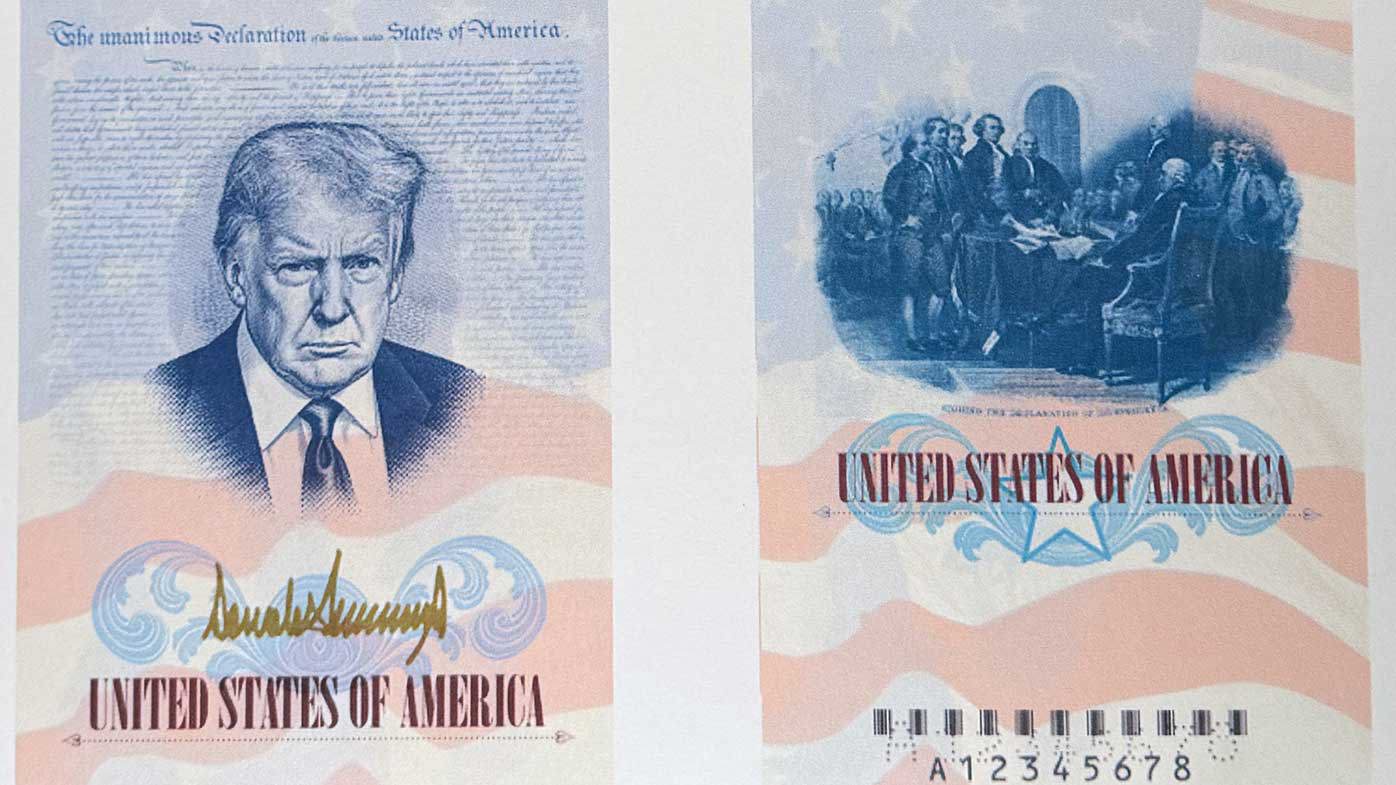
The new iterations of the United States passport feature the distinct, jagged, and unmistakably bold signature of Donald Trump, rendered in a gold-toned ink that catches the light differently than the standard black print of the past. Beside it, his likeness. This isn't just a renewal of a travel document; it is the transformation of a tool of utility into a vessel of branding.
For the traveler, the passport is a shield. For the government, it is a ledger. But for the person whose face is now etched into the polycarbonate data page, it is a legacy that travels across every border on the planet.
The Weight of a Symbol
We often forget that symbols have mass. They sit in our pockets and drawers, silently broadcasting an identity we didn't necessarily choose for ourselves but are required to carry.
Historically, the U.S. passport has featured quotes from past leaders—Washington, Lincoln, MLK Jr. These were snippets of philosophy meant to represent the "American Idea." They were fading echoes of history. By placing a contemporary, highly recognizable face and a stylized "golden" signature into the document, the State Department has moved from the philosophical to the personal.
This change shifts the very nature of the interaction at the border.
When Elias hands over that book, he isn't just presenting his citizenship. He is presenting a specific era of American power. The signature—sharp, vertical, and aggressive—acts as a stamp of ownership. It is a reminder that the document is "granted" by the sovereign. In a world where visual brand recognition is the highest form of currency, the gold ink serves as a high-contrast watermark of a new American aesthetic.
Precision and Power
The technical shift is just as jarring as the visual one.
The State Department's transition to these new design elements involves more than just a change in font. It requires a recalibration of the printing process to ensure the gold-hued ink meets the rigorous anti-counterfeiting standards of the International Civil Aviation Organization.
Gold is notoriously difficult to replicate in a way that doesn't look cheap or muddy. To achieve that specific "golden" luster for the signature, the printers utilize optically variable ink. It shifts. It dances. If you tilt the page, the signature breathes.
This isn't merely for show. Security features are most effective when they are easy for a human to verify but impossible for a machine to forge. A border agent doesn't need a magnifying glass to see if that signature is right. They know the shape. The world knows the shape.
The signature has become its own security feature.
The Human Cost of Hiding
But what does this do to the person holding the book?
Identity is a fragile thing when you are far from home. In a foreign land, your passport is the only thing that proves you exist. When that document becomes polarized, the experience of travel changes.
Imagine a young student studying in Berlin or a business consultant landing in Mexico City. They open their passport to check a visa stamp, and they are met with that bold, golden scrawl. For some, it is a badge of pride, a symbol of a country that is finally "signing its work" with a flourish. For others, it feels like an intrusion of domestic politics into their private movements.
The "Golden Signature" isn't just ink on paper. It is a choice.
It marks a departure from the "faceless bureaucrat" model of government. For a century, the goal of the passport was to be as boring as possible to ensure the traveler remained the protagonist of their own journey. Now, the document has a co-star. The traveler shares the page with a personality that dominates the visual field.
A New Architecture of Identity
The physical build of the new passport is sturdier. The data page is now a rigid piece of polycarbonate, similar to a credit card, which houses the signature and the portrait in a multi-layered sandwich of plastic.
This change was meant to make the document last ten years without fraying. Ironically, the material meant to ensure the passport's longevity also ensures the permanence of the image within it. You cannot scratch it off. You cannot fade it out. It is laser-engraved into the very bones of the document.
The gold signature sits atop this layers-deep fortress of security. It is the final flourish on a document that is harder to break than any that came before it.
As we move further into an era where our physical documents are being replaced by digital biometrics, the "Golden Passport" stands as a defiant return to the material world. It is a heavy, shiny, tactile reminder of who is in charge of the gates.
The Silent Conversation at the Gate
Back in the line at the airport, Elias finally reaches the front.
He places the blue book on the counter. The agent picks it up. The light hits the signature. For a split second, there is a flicker of recognition—not of Elias, but of the name written in gold.
The agent looks up at Elias. They look back at the book. They scan the chip.
In that moment, the passport is doing exactly what it was redesigned to do. It is commanding attention. It is forcing a reaction. It is no longer a quiet piece of paper; it is a loud statement of presence.
Elias takes his passport back, feels the weight of the polycarbonate, and tucks it into his jacket pocket, right over his heart. He walks through the gate. The gold signature stays hidden in the dark of his pocket, waiting for the next border, the next light, and the next person who needs to know exactly who signed the order for his passage.
The ink is dry, but the story it tells is only beginning to circulate.