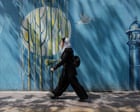
The scent of saffron and exhaust fumes still hangs over Vali-e-Asr Street, just as it always has. In the upscale cafes of North Tehran, the espresso machines hiss with a rhythmic, mechanical confidence. Young women slide their headscarves back just an inch further than they might have dared a year ago, their hair catching the afternoon light. To a casual observer—a tourist with a fresh visa or a businessman looking for an emerging market—it looks like a city that has finally caught its breath.
It is a lie. Or rather, it is a performance.
Tehran has become a masterclass in the art of the "veneer." When we talk about a veneer, we aren't just talking about a thin layer of wood over a cheap table. We are talking about a collective, unspoken agreement to act as if the floor isn't vibrating. Beneath the polished surface of the daily commute and the bustling bazaars, the city is vibrating with a frequency that is hard to hear but impossible not to feel.
The Mathematics of a Quiet Morning
Consider a hypothetical citizen. Let’s call her Maryam. She is thirty-two, an architect by training, and currently works three jobs because her primary salary is being devoured by an inflation rate that feels less like a statistic and more like a predator.
In the morning, Maryam buys a loaf of Barbari bread. She notices it is thinner than last week. The price stayed the same, but the weight changed. This is the "normality" of Tehran. It is a world where the math never quite adds up, yet everyone is expected to show their work.
The official numbers suggest that inflation is hovering somewhere near 40%, but if you ask Maryam, the reality is lived in the price of meat, which has more than doubled in the span of a single season. This isn't just about money. It’s about the erosion of the future. When a bag of groceries costs a significant percentage of a weekly wage, the concept of "saving" or "planning" becomes a cruel joke. You don't plan for a wedding or a new apartment in a house that is perpetually on fire. You just try not to inhale the smoke.
The Visibility of Absence
If you walk through the Laleh Park, you see the ghosts of the "Woman, Life, Freedom" protests. They aren't there in the form of graffiti—most of that has been scrubbed away by midnight crews—but in the way people look at each other.
There is a specific kind of eye contact in Tehran right now. It is brief, intense, and questioning. It asks: Are you still with us? Or have you given up?
The morality police, once the blunt instrument of public order, have changed their tactics. They are less visible on the street corners, replaced by high-tech surveillance and "smart" cameras. The government realized that a physical confrontation creates a martyr, but a text message notification of a fine or a confiscated car creates a quiet, grinding resentment.
The pressure has moved from the sidewalk to the psyche.
The Invisible Stakes
We often hear about the "geopolitical tensions" surrounding Iran. We hear about the nuclear deal, the shadow war with Israel, and the regional power plays. But for the person sitting in a Tehran traffic jam, these aren't headlines. They are the atmospheric pressure.
Imagine a balloon being squeezed from the outside. The surface of the balloon looks smooth, perhaps even taut and shiny. But the air inside is being compressed to the point of combustion.
The "veneer of normality" is that shiny surface. The air inside is the collective anxiety of eighty million people.
The stakes aren't just about who sits in the president's office. They are about whether a daughter can walk to school without her parents feeling a cold knot of dread in their stomachs. They are about whether a grandfather can afford the imported heart medication that has suddenly disappeared from the shelves due to sanctions and supply chain rot.
The Architecture of Fear
When the state executes a protester, the city goes quiet. Not the quiet of respect, but the quiet of a room where someone has just screamed and no one knows what to say.
The normality returns quickly because it has to. People have to eat. They have to go to work. They have to laugh at jokes in the back of taxis. This is the survival mechanism of a culture that has seen empires rise and fall for millennia. But this time, there is a hollow ring to the laughter.
The fear isn't just about the "noose." It’s about the "nothing."
The "nothing" is the fear that this is as good as it gets. That the next ten years will look exactly like the last ten, only poorer, tighter, and more shadowed. The youth of Tehran are highly educated, globally connected via VPNs, and profoundly stuck. They are watching the world move forward through the small, glowing windows of their smartphones while their own reality feels like a loop of a movie they’ve already seen.
The Tipping Point of the Mundane
History tells us that revolutions rarely start over big ideas. They start over bread. They start when the gap between the "veneer" and the "reality" becomes so wide that no amount of performance can bridge it.
Right now, Tehran is a city of actors waiting for the director to call "cut."
The shops are full of goods, but the aisles are empty of buyers. The lights of the Milad Tower shine brightly over the city, but the neighborhood below experiences rolling blackouts. The government broadcasts messages of strength, while the currency, the Rial, loses its value so fast that shopkeepers have to update their prices by the hour.
This isn't a sustainable equilibrium. It is a pause.
The Shadow of the Future
What happens when the fear for the future becomes greater than the fear of the present?
That is the question haunting every dinner table in Tehran. People are tired. The exhaustion is visible in the slumped shoulders of the elderly and the frantic energy of the young. There is a sense that the current stability is made of glass—beautiful, transparent, and prone to shattering into a thousand jagged pieces at the slightest impact.
The "return to normality" that the world sees is merely the city holding its breath.
People are buying gold. They are selling their cars to buy a one-way ticket to Istanbul or Dubai or anywhere that offers a horizon. The greatest export of Iran isn't oil anymore; it is hope. The country is hemorrhaging its best minds because they can no longer find a way to live behind the veneer.
The cafes will stay open. The traffic will continue to crawl through the smog. The mountains to the north will remain capped with snow, indifferent to the struggles of the humans below. But the silence in the streets of Tehran isn't peace. It is the sound of a spring being coiled tighter and tighter, waiting for the one hand that isn't afraid to let go.
The most dangerous thing in the world is a person who has nothing left to lose but their mask.