The room smells faintly of ozone and scalded feathers. It is a sterile, blindingly white laboratory in Dallas, Texas, but if you close your eyes, you can almost hear the phantom rustle of a forest that died three centuries ago. Ben Lamm stands before a row of incubator pods, his face bathed in the pale blue glow of digital readouts. He is not a biologist by training; he is a tech entrepreneur who smells like expensive coffee and speaks with the rapid-fire cadence of a man trying to outrun time. But right now, his eyes are fixed on a fragile, translucent shell.
Inside that shell is a biological magic trick.
For decades, extinction was a binary code. One meant alive; zero meant gone forever. When the last passenger pigeon, Martha, died in her cage at the Cincinnati Zoo in 1914, the door slammed shut. We kept the bones, we stuffed the skins, we wrote the elegies. We accepted that the past was a country we could never revisit.
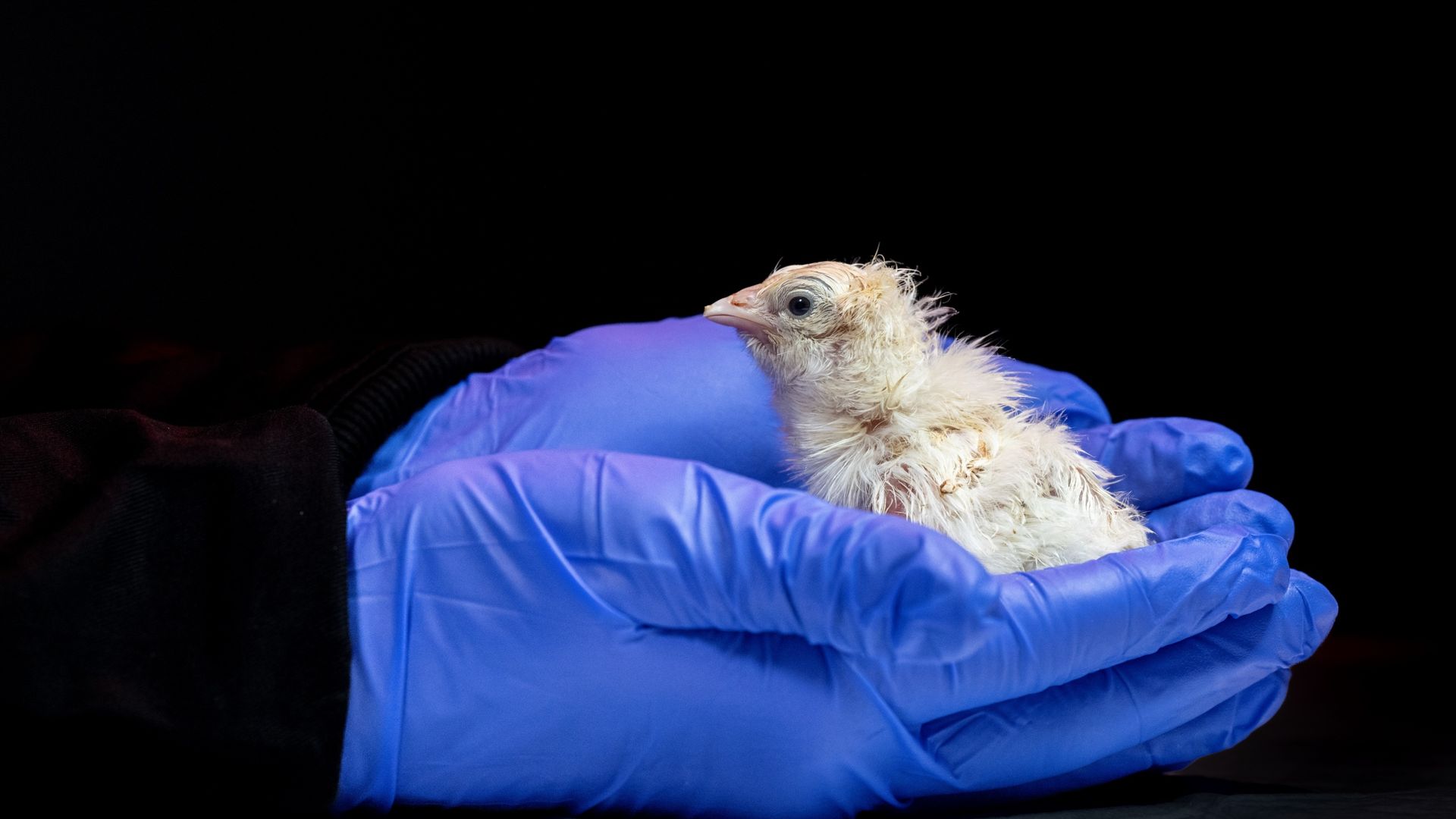
But a few days ago, a tiny, wet, shivering creature cracked its way out of an artificial environment. It opened its eyes to fluorescent lights, took its first breath of filtered air, and let out a sharp, reedy chirp. It was a chicken chick, technically. A common, everyday bird. Yet, the genetic architecture humming inside its cells carried the digital ghost of something long lost. This was the first successful hatching from an entirely artificial avian egg—a feat achieved by the de-extinction company Colossal Biosciences.
To understand why a team of world-class geneticists is throwing millions of dollars at a chicken egg, you have to understand the infuriating, beautiful, and stubborn nature of bird reproduction.
Mammals are easy. Relatively speaking, of course. If you want to clone a sheep or bring back a woolly mammoth, you take an egg cell, swap the nucleus with your target DNA, and pop it into a surrogate womb. The womb does the heavy lifting. It cushions, it feeds, it grows.
Birds, however, are an evolutionary fortress.
Consider the architecture of a bird egg. It is not just a container; it is a highly sophisticated, multi-layered life support system that must function perfectly outside the mother's body. Once the hard calcium shell forms around the yolk and the embryo inside the hen's oviduct, you cannot touch it. You cannot inject new genes into it. You cannot swap its nucleus. The moment the egg is laid, the genetic blueprint is locked behind a stone wall.
For years, this reality was a brick wall for scientists trying to save endangered avian species, let alone resurrect dead ones. If you wanted to edit the genome of a bird, you had to find a way to grow the embryo completely outside the natural shell, in a vessel that could mimic the microscopic shifts in humidity, gas exchange, and nutrient absorption that a mother bird provides just by sitting on her nest.
The scientists at Colossal spent months failing. They watched embryos wither and collapse. They adjusted formulas by fractions of a milligram. They built custom containers that looked less like nature and more like something salvaged from a science fiction movie prop department.
Then, the breakthrough happened. They perfected a multi-stage surrogate egg system. It is a delicate dance of synthetic membranes and carefully calibrated fluids that coaxes a cluster of engineered cells into becoming a living, breathing creature.
When that first chick broke through the synthetic barrier, it did not just signal a triumph of bio-engineering. It blew the doors off the bird cage.
Imagine standing on the rocky shores of Mauritius in the year 1662. The air is thick with the scent of damp earth and rotting tropical fruit. You watch a heavy, flightless bird waddle awkwardly through the underbrush. It has no fear of you because it has never known a predator. It is a dodo. Within a few decades, sailors, rats, and pigs will wipe it off the face of the earth, leaving behind nothing but a punchline for clumsiness and finality.
Dead as a dodo. It is a phrase built on the assumption of absolute endings.
But walk back into the Dallas lab. The ultimate goal of this artificial egg technology is not to mass-produce factory poultry. The chicken is merely the vessel, the biological scaffolding. By mastering the artificial egg, scientists can now take primordial germ cells—the cellular precursors to sperm and eggs—from an endangered or extinct bird, edit them using modern genetic tools, and grow them to term.
The company is already working on the blueprint for the dodo, using the genome of the Nicobar pigeon, its closest living relative, as a guide. They are doing the same for the thylacine, the Tasmanian tiger, and the woolly mammoth.
The implications stretch far beyond the glamorous headlines of prehistoric resurrections. Right now, on islands across the Pacific and in the deep recesses of the Amazon, avian malaria, habitat loss, and invasive predators are systematically erasing thousands of bird species. The pink pigeon of Mauritius is hanging on by a thread. The Hawaiian honeycreepers are vanishing so fast that scientists can barely document their songs before they fall silent.
If a species drops down to its last ten individuals, traditional conservation methods often fail. Inbreeding depression takes over; the genetic pool turns to stagnation. But with the artificial egg, conservationists could theoretically introduce genetic diversity back into a dying population, brewing hope in a plastic pod.
Naturally, this raises a cold, prickling fear in the spines of many who watch from the sidelines.
Are we playing God? It is a question that gets thrown around so often it has lost its teeth. But the anxiety behind it is real, raw, and justified. If we can simply print a new version of a species we destroyed, do we lose the moral incentive to protect the ecosystems we have left? Does the destruction of a forest matter less if we can just keep its inhabitants on a hard drive, waiting for a vacancy in an incubator?
There is a profound loneliness to these first artificial chicks. They are born without a mother to teach them how to forage, without a flock to show them how to navigate the sky. They are products of human ingenuity, raised by humans in blue latex gloves. If we eventually hatch a dodo in a lab, it will be an island of one. It will not know how to be a dodo, because there are no other dodos left to teach it. We will have recreated the biology, but we will have lost the culture of the animal.
Yet, looking at the tiny, unremarkable chicken scratching at the bottom of its plastic enclosure, it is hard not to feel a surge of fierce, irrational optimism.
We live in an era defined by what we have broken. We watch glaciers liquefy into the sea, forests turn to ash, and the index of vanished species grow longer by the year. We are accustomed to the narrative of loss. We have accepted our role as the authors of the planet's decline.
This tiny bird represents a different narrative. It is a declaration that human cleverness does not always have to be a weapon of destruction. Sometimes, it can be a needle and thread, stitching together the frayed edges of the natural world.
The work is slow, agonizingly precise, and riddled with ethical landmines. There will be more failures, more quiet tragedies in the lab before a long-dead species takes flight in the wild. The path from a synthetic chicken egg to a living dodo is steep, treacherous, and wildly expensive.
But the barrier has cracked.
Outside the laboratory window, the Texas sky stretches out, vast and indifferent. A common crow cuts across the blue, its harsh cry echoing off the concrete structures below. For the first time in human history, that sound does not feel like a fading echo of a dying world, but rather a prelude to something entirely new.