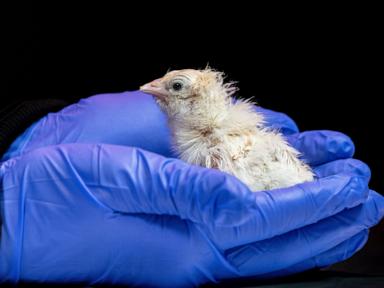
The room smells of ozone, sterile plastic, and the faint, unmistakable tang of a farmyard. It is a contradiction in scents, a clash of centuries. On one side of the glass sits a machine that costs more than a suburban home, its digital displays humming with data. On the other sits a tiny, wet, shivering mass of feathers.
A chick has just chipped its way into the world. For an alternative look, check out: this related article.
Normally, this moment is hidden beneath the warm, protective curve of a mother hen’s breast, or shrouded in the opaque calcium shell of an incubator tray. But this chick did something different. It opened its eyes inside a transparent, synthetic matrix—an artificial eggshell. Through the clear faux-shell, scientists watched every heartbeat, every twitch of embryonic muscle, and every frantic scrape of the beak before the bird finally tumbled out into the open air.
The headline moving through the wire services frames this as a neat piece of biotechnology. Colossal Biosciences hatches live chicks from artificial eggshell. It sounds clean. It sounds like a triumph of engineering, a checklist item ticked off on the road to bringing back the dodo or the passenger pigeon. Similar analysis on this trend has been shared by MIT Technology Review.
But if you stand in the laboratory, or if you have ever spent a night watching a dying species slip away, you know the truth is far messier. This isn't just about a plastic egg. It is a desperate, brilliant, and terrifying attempt to build a time machine out of polymers and genetic code.
The Great Avian Bottleneck
To understand why a team of geneticists spent years trying to reinvent the humble bird egg, you have to understand a fundamental flaw in avian biology.
Mammals are relatively easy to clone or genetically modify. You harvest an egg, swap out the nucleus, implant it back into a surrogate mother, and wait. We have been doing it since Dolly the sheep trotted into the public consciousness in 1996.
Birds, however, are a fortress.
A bird's egg is a massive, single cell surrounded by an impenetrable fortress of yolk, albumen, and hard shell. By the time a hen lays an egg, the embryo inside already consists of tens of thousands of cells. You cannot simply take a needle, poke through a calcified shell, and rewrite the DNA of a single cell. The biology locks you out.
For years, this reality stood as a brick wall for de-extinction companies. They could map the genome of the dodo using ancient DNA found in museum drawers. They could identify the exact genetic tweaks needed to turn a common pigeon into something long lost to history. But they had no way to grow the edit. They had the blueprint, but the factory doors were welded shut.
The workaround required something radical. Scientists had to learn how to cultivate bird embryos outside the egg entirely, keeping them alive in a synthetic environment where their development could be monitored, assisted, and manipulated in real time.
The artificial eggshell isn’t just a window. It is an eviction notice for extinction.
Sunlight Through Plastic
Consider the sheer fragility of a developing life. Inside a natural egg, a complex dance of gas exchange, moisture control, and antimicrobial defense happens automatically. The shell breathes, letting oxygen in and carbon dioxide out, while preventing the embryo from drying to a crisp.
Replacing that natural miracle requires an agonizingly precise piece of engineering. The synthetic shells used in these breakthroughs are crafted from specialized, biocompatible polymers. They are shaped to mimic the exact geometry of a natural egg, complete with a membrane that regulates moisture.
The first time you see a heartbeat through one of these clear shells, the feeling isn’t one of scientific detachment. It is intimacy.
You see the tiny, pulsing red dot form in the center of the yolk. You see the web of microscopic blood vessels spread outward like roots seeking water. In a natural egg, this happens in pitch darkness. Here, it happens under the glare of laboratory lights.
The process is fraught with tension. A fraction of a degree change in temperature, a microscopic tear in the synthetic membrane, or a single airborne spore can turn the experiment into a tragedy. The scientists monitoring these vessels don’t sleep much during the incubation cycle. They watch the screens, adjusting gas mixtures, checking humidity levels, waiting for the critical window when the embryo develops its lungs and prepares to transition from absorbing oxygen through blood vessels to breathing air.
Then comes the pipping.
When a chick prepares to hatch, it uses a tiny, sharp bump on its beak called an egg tooth. It hacks at the inside of the shell, rotating its body slowly to cut a circle around the cap of the egg. Watching this happen through a transparent wall is violent and beautiful. The bird is fighting for its existence against a piece of plastic designed by a team of engineers in white coats.
When the shell finally gives way, and the wet, exhausted creature spills onto the sterile tray, the silence in the lab breaks. The bird breathes. The machine worked.
The Ghosts in the Room
It is easy to get swept up in the technical wizardry of a transparent egg. But the real weight of this technology lies in what happens next.
Colossal Biosciences isn't spending millions of dollars just to hatch healthier chickens. Their stated goals are much more ambitious, and to some, deeply unsettling. They want to bring back the dodo, an emblem of human carelessness that vanished from the island of Mauritius in the 17th century. They want to resurrect the passenger pigeon, a bird that once flew in flocks so dense they darkened the skies of North America for days, before the last one, named Martha, died alone in a Cincinnati zoo in 1914.
But a bird is more than its DNA.
If we use an artificial egg to hatch a dodo, what does that bird become? It will have no parents to teach it how to forage, no flock to teach it how to behave, and no native ecosystem that resembles the one its ancestors left behind. It will be an absolute pioneer, a stranger in a century that doesn’t know how to hold it.
I think about Martha sometimes. I think about what it means to be the last of your kind, to look out through the bars of a cage and see nothing that looks like you, hears like you, or understands your language. The scientists working on de-extinction are trying to reverse that loneliness. But in doing so, they risk creating a new kind of isolation: the first of your kind, born out of a plastic womb into a world that has forgotten you exist.
The critics of this work raise valid, stinging questions. Why spend vast sums of money to resurrect the dead when the living are slipping through our fingers? Right now, across the globe, avian influenza is tearing through wild bird populations. Habitat loss is silencing forests that were vibrant just a decade ago. Shouldn't our focus be on the birds we still have, rather than the ghosts we want to chase?
The counterargument from the lab bench is one of tool-building. The technology designed to hatch a dodo might be the exact mechanism that saves a critically endangered pink pigeon or a California condor tomorrow. By learning how to manipulate avian reproduction at this level, we gain the ability to interventionally breed species whose populations have plummeted past the point of natural recovery. We build a genetic safety net.
The Weight of the Shell
The chick in the lab is dry now. Its feathers have fluffed up into a pale, yellow down. It looks entirely ordinary. It chirps, a sharp, piercing sound that bounces off the stainless-steel counters and the glass walls of its incubator.
If you didn’t know where it came from, you would never guess its origin. You wouldn't know that it spent its first three weeks of existence suspended in a synthetic matrix, watched by cameras, its development logged in spreadsheets and analyzed by machine-learning models.
That ordinariness is perhaps the most profound part of the entire experiment. The unnatural has become natural. The sci-fi future where life is manufactured and curated has slipped into the present so quietly that it almost feels mundane.
We are no longer just passive observers of the natural world, documenting its decline with somber statistics and museum exhibits. We are moving into an era of active authorship. We are stepping into the role of creators, deciding which branches of the evolutionary tree to water and which ones to let wither.
It is a terrifying amount of responsibility to place on human shoulders. We have historically been terrible stewards of the planet, clumsy giants who crush ecosystems without meaning to, or worse, with full intent. Now, we are holding the tools of resurrection.
The clear plastic shell left behind on the lab bench is empty, cracked open, its purpose served. It looks like trash. It looks like a discarded blister pack or a piece of food packaging. But it is a monument to a threshold crossed. We have found a way inside the fortress of the avian egg, and the creatures we bring back through that gateway will have to live with the consequences of our curiosity.


