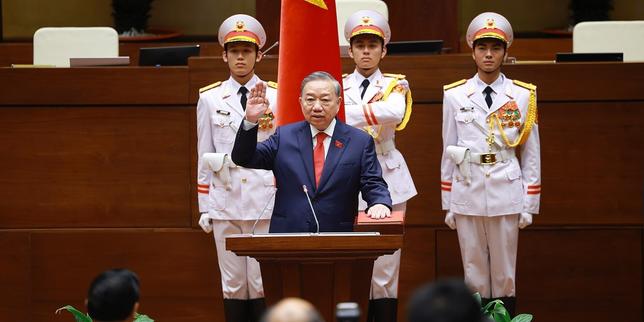
The air in Hanoi carries a weight that isn't just humidity. It is a thick, invisible pressure that clings to the yellow-walled colonial buildings and the humming swarms of motorbikes. On a humid Wednesday in the Ba Dinh District, the silence inside the National Assembly building was heavy. This was not the rowdy, debating silence of a Western parliament. It was the orchestrated, breathless quiet of a machine finally clicking into its next gear.
To Lam stood at the center of it. Meanwhile, you can read related developments here: Shadows on the Pavement of Stanmore.
For years, his name was spoken in the shaded corners of lakeside cafes with a mix of reverence and a very specific kind of chill. As the head of the Ministry of Public Security, he was the architect of the shadows. Now, he was stepping into the blinding light of the presidency. To understand why this matters, you have to look past the red flags and the gold stars. You have to look at the "Burning Furnace."
The Architect of the Purge
Imagine a man who knows every secret in a city of eight million. Not just the political secrets, but the financial ledger of every tycoon and the whispered grievances of every low-level official. That was To Lam’s reality for nearly a decade. He didn't just witness the "Blazing Furnace" anti-corruption campaign; he was the flame. To see the bigger picture, we recommend the excellent analysis by Al Jazeera.
Under the guidance of Communist Party General Secretary Nguyen Phu Trong, the campaign aimed to scrub the stains of graft from the party’s soul. It was a noble goal on paper. In practice, it became a whirlwind that leveled the political landscape. High-ranking ministers, billionaire developers, and even previous presidents were swept away.
The seats at the top were becoming musical chairs, but the music was a dirge.
When To Lam was elected president with a near-unanimous vote—472 out of 473 delegates—it wasn't just a promotion. It was the culmination of a systematic clearing of the path. To the average citizen watching the evening news, it felt like the final piece of a complex, high-stakes puzzle being slammed into place.
The Two Faces of Power
Vietnam operates on a "four pillars" system: the General Secretary, the President, the Prime Minister, and the Chairman of the National Assembly. It is a delicate architecture designed to prevent the rise of a single, unchecked strongman. It is a system built on the collective, a legacy of a history that fears the whims of the individual.
But pillars can crumble.
Over the last eighteen months, the instability has been jarring. Two presidents resigned in rapid succession—Nguyen Xuan Phuc and Vo Van Thuong. Both were casualties of the very "furnace" To Lam helped stoke. Their departures weren't just administrative changes; they were tremors that shook the confidence of foreign investors and local bureaucrats alike.
Consider the mid-level official in a provincial planning office. For decades, the system moved on "grease." Small payments, favors, and connections made the wheels of bureaucracy turn. Suddenly, the grease became a fire hazard. Officials became terrified to sign a single document, fearing that a signature today could be an indictment tomorrow. Projects stalled. Infrastructure slowed.
The furnace was cleaning the house, but it was also making it impossible to live in.
By moving into the presidency, To Lam is attempting to bridge that gap. He is moving from the role of the investigator—the man who finds the fault—to the role of the statesman, the man who represents the nation’s face to the world.
The Ghost of a Golden Steak
Politics is rarely just about policy. It is about perception. To Lam’s journey hasn't been without its own surreal, human hiccups. A few years ago, a video went viral of the minister being fed a gold-leaf-encrusted steak at a luxury London restaurant by the celebrity chef Salt Bae.
At the time, the contrast was jarring. While the "Burning Furnace" was incinerating others for their excesses, the lead investigator was seen in a moment of extreme opulence. It was a metaphor for the complexities of modern Vietnam: a country trying to maintain its austere socialist roots while hurtling toward a capitalist future at breakneck speed.
The steak didn't stop his rise. If anything, it proved his durability. In a system where one wrong move usually results in a quiet exit to a "retirement" home, To Lam showed he could weather a global PR storm and come out stronger on the other side.
He is a survivor. He is pragmatic. He knows that in the game of power, visibility is a weapon.
The Investor’s Dilemma
Beyond the ornate halls of Hanoi, the world is watching with a calculator in hand. Vietnam has become the "plus-one" for the global economy—the primary alternative for companies looking to diversify away from China. Apple, Samsung, and Intel have staked billions on the stability of the S-shaped nation.
When a president falls, a CEO in Cupertino or Seoul gets nervous. They crave predictability. They want to know that the laws today will be the laws tomorrow.
To Lam’s ascent is an attempt to project that missing stability. By consolidating power, the party is signaling that the era of "musical chairs" is over. They are saying that the furnace has done its job, and now it is time to build.
But there is a catch.
When you elevate a security chief to the highest office, the message isn't just "stability." It’s "discipline." It suggests that the future of Vietnam will be one where the rules are followed, and dissent is a luxury the state cannot afford. It is a pivot toward a more securitized form of governance, one that mirrors the path taken by neighbors in the region.
The Invisible Stakeholders
Think of a young tech entrepreneur in Ho Chi Minh City. She doesn't care about the intricacies of the Central Committee’s voting patterns. She cares about whether she can get a permit for her new startup without a year-long delay. She cares about whether the internet remains open enough for her to reach global markets.
For her, To Lam’s presidency is an enigma. Will the security-first approach crush the creative chaos that makes Vietnam’s economy so vibrant? Or will the crackdown on corruption finally create a level playing field where talent matters more than who you know?
The stakes are invisible because they are long-term. We won't know the answer today, or even next month. We will know it in three years, when we see if the "missing signatures" in the bureaucracy have returned, or if the fear has simply moved deeper into the bone.
The Bridge to 2026
To Lam’s presidency is likely a transitional one, a bridge leading to the critical 14th Party Congress in early 2026. That is when the real prizes—the General Secretary position—will be decided.
In the meantime, the President has a difficult tightrope to walk. He must be the diplomat, greeting foreign heads of state and talking about "comprehensive strategic partnerships." He must also remain the enforcer, ensuring that the party remains unified and that no new factions emerge to challenge the current order.
It is a lonely position. The presidency in Vietnam is often described as ceremonial, but in the hands of a man who controls the security apparatus, "ceremonial" is a misleading word. It is a platform. It is a shield.
The silence in the National Assembly wasn't just respect. It was the sound of a country holding its breath, waiting to see if the man who built the furnace would finally decide the fire had burned long enough.
The motorbike engines outside the hall continued their relentless, buzzing chorus. The street food vendors continued to serve bowls of steaming pho. Life in Vietnam moves fast, even when politics feels frozen in time. To Lam is now the captain of that speed, steering a ship that is trying to stay socialist in thought but capitalist in deed, all while making sure the engine doesn't overheat.
He holds the gavel now. The shadows have retreated, but they haven't disappeared. They have just moved behind the velvet curtains of the presidential palace, waiting for the next turn of the wheel.