The sound of a drone over Gaza is not a sound. It is a texture. It sits in the back of your throat, a low, metallic hum that grates against the nerves until it becomes part of the silence itself. For months, that hum has been the soundtrack to a landscape reduced to gray powder and twisted rebar. When the missile finally drops, the sound changes instantly. It becomes a physical slap of air, a blinding white flash, and then the heavy, suffocating thud of concrete pancake-stacking into the earth.
On a Tuesday like any other, that specific sound echoed through the northern Gaza Strip. The dust settled over the ruins, masking the immediate aftermath in a chalky shroud. But within hours, the shockwaves traveled far beyond the crater, rippling through military briefing rooms in Tel Aviv and the underground networks of the Gaza underground.
The Israel Defense Forces announced they had targeted and killed Ezzedine Al-Haddad. To the outside world, he was a name on a checklist, identified as the commander of Hamas’s northern Gaza brigade—one of the last standing pillars of the group’s traditional military hierarchy. To the people living beneath the drones, his death was another violent punctuation mark in a war that seems to have no syntax, only endless sentences of destruction.
But a assassination is never just a tactical success or a logistical loss. It is a human event with invisible stakes, shifting the gravity of a conflict that has already consumed tens of thousands of lives.
The Anatomy of a Target
To understand the weight of this specific strike, one must look past the sterile language of military communiqués. Generals speak of "neutralizing assets" and "degrading command structures." It sounds like a corporate restructuring. The reality on the ground is a claustrophobic game of cat and mouse played across a ruined chess board.
Imagine a man who has not seen direct sunlight in months. Let us call him a courier, a hypothetical composite of the dozens of young men who move through the shadows of Gaza. His entire existence is shrunk to the width of a concrete tunnel or the alleyways that remain walkable between mounds of debris. He carries no smartphone. He uses no electronic devices. He knows that a single digital ping is a death warrant, not just for him, but for whoever stands within ten meters of him.
This courier carries a scrap of paper, or perhaps just a memorized phrase. His destination is a shifting point in the rubble where Ezzedine Al-Haddad is supposedly directing what remains of the northern forces. For Israel, finding Al-Haddad was not a matter of simply looking down from a satellite. It required weaving together a tapestry of human intelligence, intercepted whispers, and the painstaking tracking of these human couriers.
When the strike occurred, it was the culmination of weeks of digital and physical surveillance. The target was eliminated. The IDF checked a major box. Yet, the question that lingers in the smoke is the one the military maps never answer: what fills the vacuum left behind?
The Illusion of the Final Blow
There is a recurring trap in the history of asymmetric warfare. It is the belief that a movement can be decapitated, that by removing the architects, you destroy the building.
Consider the historical pattern. Decades ago, Israel targeted the founders of Hamas, men like Sheikh Ahmed Yassin and Abdel Aziz al-Rantisi. Each time, the consensus among security analysts was that the organization had suffered a mortal blow. Each time, a new generation stepped into the breach, often more radicalized, less willing to negotiate, and deeply shaped by the violence that killed their predecessors.
The death of Al-Haddad comes at a moment when Hamas’s formal military structure in northern Gaza has already been shattered into fragments. The brigade he commanded is no longer a cohesive army marching under a single banner. It is a collection of decentralized cells, local groups of young men operating with autonomous malice and desperation.
When you kill a commander like Al-Haddad, you do not necessarily stop the fighter in the alleyway from firing a rocket-propelled grenade. In fact, you often remove the only element capable of telling that fighter to stop. The command structure becomes decentralized. It becomes fluid. It becomes a hydra.
The Human Ledger
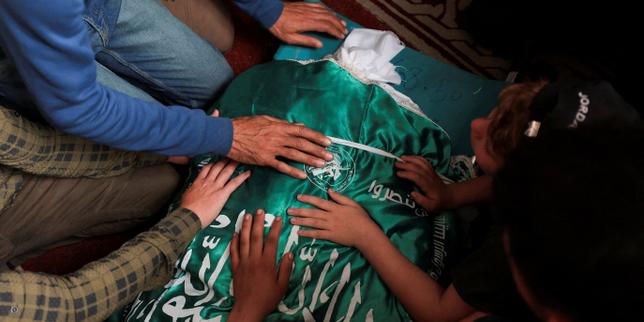
Away from the strategic calculations, the true cost of these strikes is written on the skin of the survivors. Every high-value target is embedded within a civilian matrix. In the dense concrete reality of Gaza, there is no such thing as an isolated strike.
Picture a family living three doors down from the targeted structure. They have already been displaced three times. They are sleeping on nylon mats, their possessions reduced to a few plastic bags and a dented aluminum kettle. When the shockwave hits, it does not care about military affiliation. The glass breaks. The ceiling flakes. The children scream with a familiar, practiced terror that no child should ever possess.
The tragedy of the conflict is that these two realities coexist without ever truly meeting. In Tel Aviv, the news of Al-Haddad’s death is met with a grim sense of progress, a feeling that the country is safer, that the perpetrators of the October 7 atrocities are facing justice. In Gaza, the strike is just another arbitrary falling of the sky, a reminder that nowhere is safe, that life can be extinguished in the time it takes to draw a breath.
This is the emotional core of the war, a profound mutual incomprehension. One side sees a precise surgical operation against a terrorist mastermind. The other sees a campaign of collective punishment that makes no distinction between the commander and the infant sleeping in the next room.
The Echo Chambers of Victory
But the real problem lies elsewhere. It lies in the political necessity of the spectacular strike.
For a government under immense domestic pressure to deliver total victory and bring home hostages, the elimination of a figure like Al-Haddad is currency. It is proof of concept. It justifies the ongoing cost, the economic strain, and the international isolation. The headlines are written in bold text. The victory is claimed.
Yet, the hostages remain in the dark. The borders remain closed. The war aims, described in broad, absolute terms, remain frustratingly out of reach. The strike becomes an end in itself, a tactical success masquerading as a strategic solution.
True security is never found at the bottom of a bomb crater. It is built on the messy, unsatisfying terrain of political settlements, human recognition, and the exhaustion of violence. Until that shift occurs, the killing of a commander is merely a prologue to the rise of the next.
The drones continue their low, grinding song above the ruins. The dust from the strike that killed Ezzedine Al-Haddad will eventually settle, coating the tents of the displaced and the uniforms of the soldiers. And somewhere in the quiet spaces between the rubble, a young man who watched the smoke rise is already deciding what name he will carry into the next battle.