Silence.
That is the first thing you notice when a hospital isolation ward locks down, a heavy, pressurized hush broken only by the rhythmic hiss of a negative-pressure vent pulling contaminated air away from the hallway outside. For more than thirty years, that specific brand of silence did not exist in New York for one particular reason. Measles was a memory. It was a footnote in yellowing medical textbooks, a faded childhood anecdote told by grandparents who remembered itchy red rashes and darkened bedrooms in the 1950s.
Then came the announcement from state health officials. New York had recorded its first measles death in over three decades.
On paper, the news reads like a sterile epidemiological update. A single fatality. A statistical blip in a state of nearly twenty million people. You scan the headline over your morning coffee, register a brief flicker of mild concern, and scroll down to the weather forecast. Because when a threat has been invisible for thirty-five years, our brains simply refuse to render it in high definition. We treat ancient viruses like retired boxers—old, toothless, incapable of throwing a punch that still lands.
We are wrong.
To understand what actually happened behind those sealed doors in New York, and why a single death represents a tectonic shift in our collective safety, you have to step away from the press releases and look at the biology of a ghost.
The Invisible Room
Consider a hypothetical scenario, grounded entirely in the established mechanics of viral transmission. Picture a crowded subway car on the Lexington Avenue line at 8:15 AM on a rainy Tuesday. People are pressed shoulder to shoulder, damp coats brushing against each other, breath fogging the glass. Among them is a commuter—let’s call him David—who feels slightly off. His eyes are a little watery. He has a mild cough, a low-grade fever, the exact constellation of symptoms you might blame on a sudden change in spring weather or a late night at the office.
David does not have a rash yet. That won't appear for another three or four days.
At Grand Central, David steps onto the platform and walks away. He is gone. The doors close, the train pulls out, and forty new commuters step into the exact space he just occupied.
If David had influenza, those forty people would need to be relatively close to him while he coughed to catch it. If he had COVID-19, ventilation and mask quality would heavily dictate the odds.
David has measles.
Measles does not play by the rules of modern respiratory viruses. It is an evolutionary masterpiece of contagion, arguably the most infectious human pathogen ever discovered. When David coughed on that train, he didn't just expel heavy droplets that fell harmlessly to the scuffed floor. He released microscopic viral particles suspended in aerosolized mist—particles so light they defy gravity, hanging in the stagnant air of that subway car like invisible smoke for up to two full hours after he exited the station.
Nine out of every ten unvaccinated people who breathe that air will become infected. Not nine out of ten who shake his hand. Not nine out of ten who sit next to him. Nine out of ten who simply share the room with his ghost.
That is the math we forgot. Epidemiologists measure contagiousness using a metric called the basic reproduction number, or R0—pronounced "R-naught." It tells you how many people one sick person will infect in a completely unprotected population. Seasonal flu sits around 1.3. The original strain of SARS-CoV-2 hovered near 2.5 or 3.
Measles sits between 12 and 18.
Think about what that number means in practice. One person infects fifteen. Those fifteen infect two hundred and twenty-five. Within three cycles of transmission—less than a month—a single commuter with watery eyes turns into more than three thousand active cases, radiating outward through schools, grocery stores, pediatric waiting rooms, and airport terminals.
What the Virus Actually Does
Part of our collective amnesia stems from how we talk about the disease. We call it a "childhood illness." Even the name sounds oddly gentle, almost quaint, like something out of a Victorian nursery rhyme. You get a fever, you break out in spots, you stay home from school for a week eating popsicles, and you get better.
For many people, that is indeed how the story goes. Until it isn't.
Having spent years working alongside infectious disease clinicians and watching families navigate the sharp end of preventable outbreaks, I can tell you that there is nothing quaint about severe measles. The virus enters through the respiratory tract, quietly hijacking immune cells—the very soldiers meant to destroy it—and uses them as Trojan horses to travel straight into the lymph nodes. From there, it floods the bloodstream.
By the time the telltale blotchy red rash erupts across the hairline and marches downward over the neck and torso, the virus has already been replicating unchecked inside the body for nearly two weeks.
And here is the cruelty that rarely makes the evening news: measles doesn't just attack the body; it erases the immune system's memory.
Scientists call it immune amnesia. As the measles virus replicates, it systematically destroys memory B and T cells—the specialized white blood cells that remember every cold, strep throat, pneumonia, and stomach bug you have ever fought off or been vaccinated against. Imagine spending twenty years building a massive, heavily guarded library of defense blueprints, only for an arsonist to slip inside and burn the entire building to the ground.
Even if a patient survives the acute phase of measles, they walk out of the hospital with the immune system of a newborn baby. For months, sometimes up to three years afterward, survivors remain dangerously vulnerable to secondary infections. A routine ear infection turns into bacterial meningitis. A mild case of bronchitis spirals into fatal pneumonia.
When measles kills directly, it usually does so in one of two ways. Either the virus triggers an overwhelming viral pneumonia, filling the lungs with fluid until oxygen can no longer cross into the blood, or it crosses the blood-brain barrier, causing encephalitis—an acute, violent swelling of the brain that leads to seizures, permanent deafness, intellectual disability, or coma. Roughly one to three out of every thousand children infected with measles will die from respiratory and neurologic complications, even with the best modern medical care available.
For thirty-plus years in New York, that grim arithmetic remained purely theoretical. Nobody died because the wall held.
The Architecture of a Wall
To understand why the wall finally cracked, we have to look back to 1963.
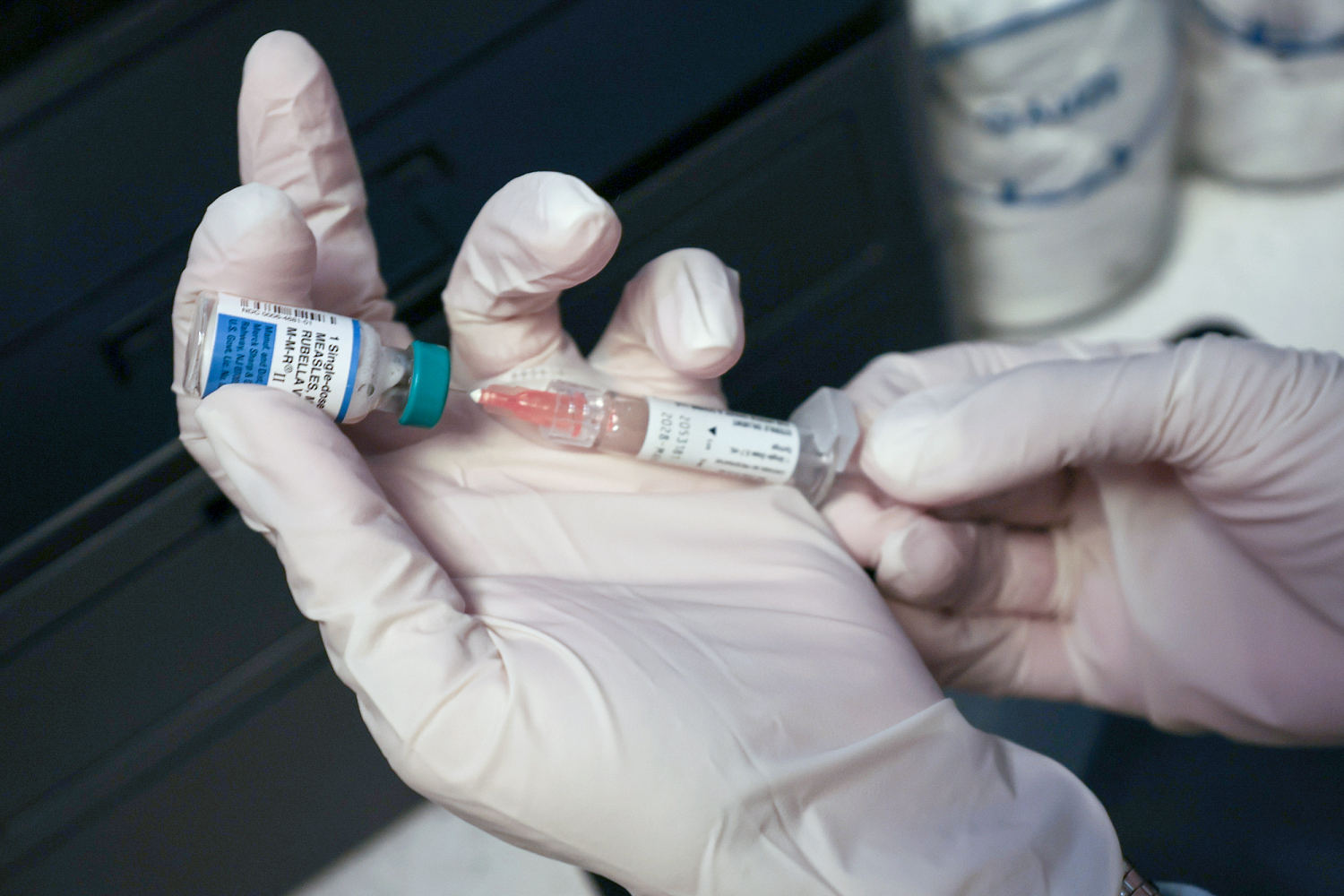
Before the first measles vaccine was licensed that year, the virus was an inescapable rite of passage in the United States. Nearly every child got it before turning fifteen. Every single year, between three and four million Americans were infected. Roughly forty-eight thousand were hospitalized. A thousand suffered permanent brain damage from encephalitis. And four hundred to five hundred Americans—mostly children—died annually.
Then came the vaccine, followed by the combined MMR shot (measles, mumps, and rubella) in 1971.
The impact was swift, decisive, and relentless. Cases plummeted by more than ninety-nine percent. By the early 1990s, after a devastating resurgence between 1989 and 1991 that claimed more than a hundred lives nationwide and prompted health officials to recommend a two-dose schedule, the virus was finally cornered. In the year 2000, the United States officially declared measles eliminated—meaning the disease was no longer continuously circulating within our borders.
Elimination, however, is not eradication. Smallpox is eradicated; it exists nowhere in nature, locked away in high-security freezers in Atlanta and Siberia. Measles is merely held at bay by an invisible shield called herd immunity.
Because measles is so aggressively contagious, that shield requires immense structural integrity. For the virus to hit dead ends instead of sparking wildfires, roughly 95 percent of a community must be immune. When vaccination rates sit at 96 or 97 percent, an infected traveler can step off an international flight at JFK Airport, walk through customs, ride a cab into Brooklyn or up to the Hudson Valley, and the outbreak will sputter out after two or three cases. The sparks land on wet wood.
Drop that rate to 92 percent, or 88 percent, or—as happened in several pockets across New York and neighboring states over the last few years—below 80 percent, and the physics of the room change entirely. Suddenly, the sparks are landing on dry kindling.
The Psychology of Safety
Why did those percentages slip? It is tempting to point a finger at a single villain—a viral social media post, a charismatic skeptic, a pandemic-era breakdown in routine pediatric checkups. The truth is quieter and far more human.
Vaccines are victims of their own perfection.
When a generation grows up never seeing a classmate in an iron lung from polio, never watching a sibling struggle to breathe through whooping cough, and never standing beside a small casket after a measles outbreak, the risk calculation in a parent's mind subtly inverts. The disease becomes an abstract ghost story, something that happened in black-and-white photographs. Meanwhile, the needle in the pediatrician's office is right there in full color—immediate, tangible, accompanied by a toddler's tears and a low-grade fever that evening.
Add to that the confusion and exhaustion of the past several years. Millions of families fell behind on routine wellness visits during healthcare disruptions. Others found themselves drowning in an endless, contradictory stream of health information online, where genuine anxieties about medical autonomy were amplified by algorithms engineered to reward outrage over nuance.
Doubt is an entirely natural human reflex. Wanting to protect your child from anything perceived as a threat—even a needle—comes from the exact same biological wiring that makes us pull our hands back from a hot stove.
But the stove is still on.
What makes measles uniquely unforgiving is that personal choices do not stay personal. If you choose not to wear a seatbelt, you endanger yourself. If a community allows its measles immunity to drop below that 95 percent threshold, it doesn't just expose the unvaccinated by choice. It strips away the only armor protecting the people who cannot be vaccinated.
Think about who occupies those vulnerable margins. Infants under twelve months old, who are too young to receive their first dose of the MMR vaccine. Children undergoing chemotherapy for leukemia, whose immune systems have been wiped clean by treatment. Pregnant women, for whom measles carries severe risks of miscarriage and premature birth. Organ transplant recipients taking daily immunosuppressants just to stay alive.
These people rely entirely on the immunity of the strangers standing next to them in the supermarket checkout line. They are the reason the wall exists.
What Happens When the Alarm Sounds
When New York health officials confirmed this death, the machinery of public health snapped into motion with a speed most citizens never witness. Disease detectives—epidemiologists trained to trace invisible footprints—began reconstructing every hour of the patient's movements during the four-day window before the rash appeared.
Every clinic waiting room. Every pharmacy aisle. Every bus route.
Teams started calling hundreds of contacts, checking immunization registries, administering emergency doses of immunoglobulin to exposed infants and immunocompromised patients who were still within the narrow seventy-two-hour window where post-exposure treatment can blunt the virus.
It is exhausting, resource-draining trench warfare against an enemy we already defeated sixty years ago. Two doses of the MMR vaccine are 97 percent effective at preventing measles altogether. Even in the rare 3 percent of vaccinated individuals who experience a breakthrough infection, the illness is almost universally mild, the viral load is dramatically lower, and the risk of fatal complications drops to near zero.
Yet here we are, watching a preventable tragedy unfold in one of the most medically advanced states in the country.
You do not need to panic when you read that New York has recorded its first measles death in over thirty years. Panic is useless; it clouds judgment and breeds fatigue. What the moment demands is clarity. If you have two documented doses of the MMR vaccine, or if you were born before 1957 when natural exposure was nearly universal, your armor is intact. You can walk onto that subway car, breathe the air, and go about your life without fear.
If you are unsure of your status, a simple blood test—an antibody titer—or an extra booster dose removes the guesswork entirely. And if you are a parent staring at a vaccination schedule with lingering questions, take those questions to a pediatrician who will sit down, look you in the eye, and walk you through the data without judgment.
Because history has a brutal habit of repeating itself the exact moment we stop believing it happened.
Somewhere in a New York hospital room right now, the negative-pressure vents are still humming, pulling air away from the corridor, keeping a three-decade-old ghost trapped inside four walls. Whether it stays trapped there, or slips out into the crowd once again, has nothing to do with the strength of the virus. It depends entirely on whether we remember why we built the wall in the first place.