The Seven-Year Drift
Ask any aerospace engineer what keeps them awake at night, and they will rarely talk about launch day. Liftoff is pure theater. Fire, sound, millions of pounds of thrust screaming against gravity, a sky torn open by pure chemical violence. That part is easy to love. The real dread lives in the aftermath.
Long after the applause fades and the cameras cut away, the hardware stays up there.
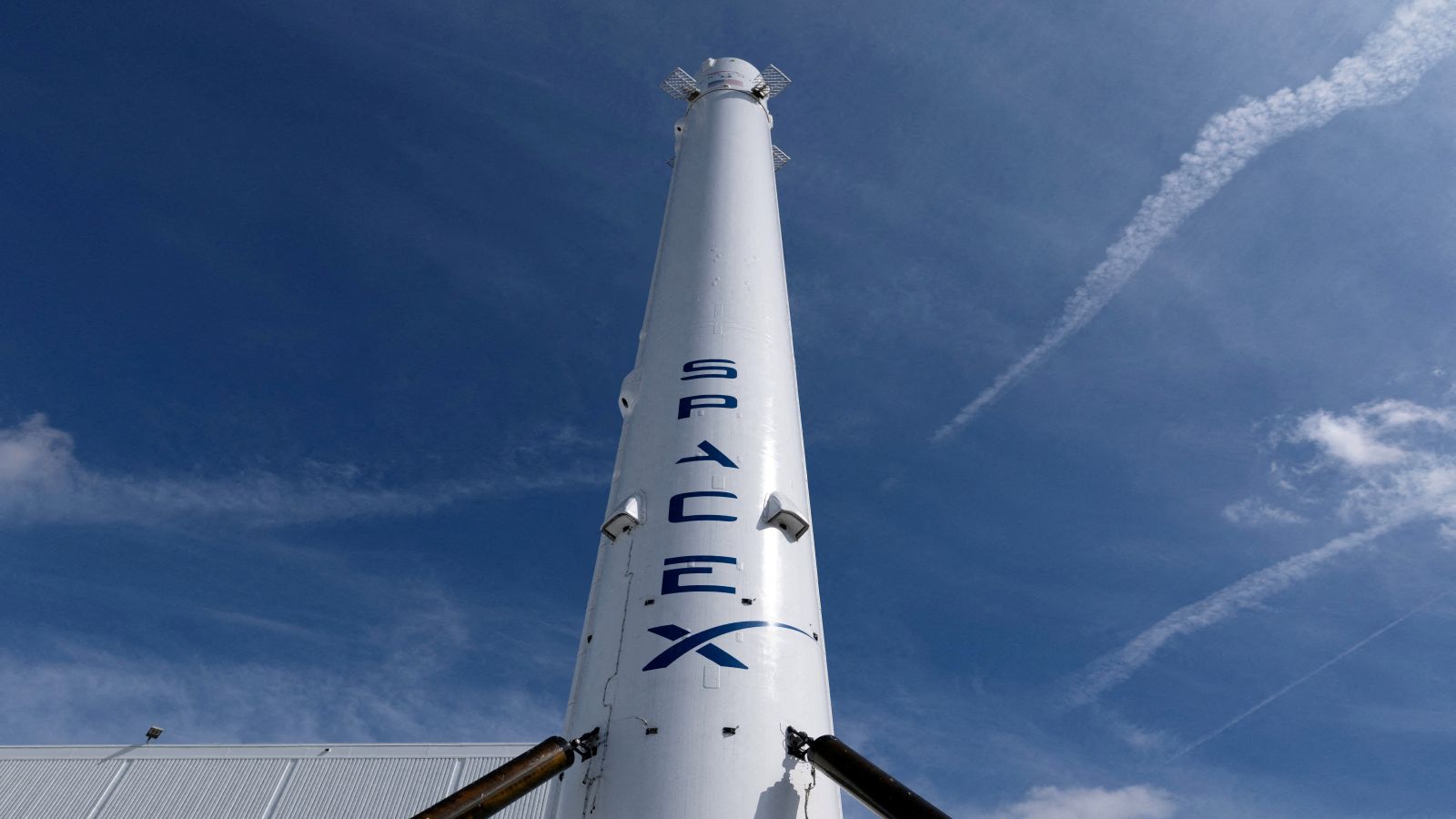
Consider the anatomy of a deep space discard. Seven years ago, a Falcon 9 upper stage hoisted a heavy climate observatory toward the Lagrange point, a gravitational sweet spot a million miles from our front door. The primary mission succeeded brilliantly. The satellite went on to monitor solar winds and geomagnetic storms, serving as an early-warning system for the electronics humming quietly in our pockets down here.
But the rocket booster that got it there had finished its job. It was empty. It was weightless. And it had no fuel left to turn around.
Without propellant to brake its momentum or alter its trajectory, the multi-ton cylinder of aluminum-lithium alloy simply surrendered to the chaotic tug-of-war between Earth and the Sun. It drifted. It looped. It tumbled silently through the black void, completely off the books of everyday civilian attention, acting as an anonymous piece of high-altitude space driftwood.
Until now.
The Mathematical Collision Course
To understand why a stray piece of space metal suddenly matters, you have to look at the invisible architecture of orbital mechanics. Space is not an empty ocean. It is a complex, shifting web of gravitational wells.
Imagine rolling a heavy steel ball across a tightly stretched rubber sheet dimpled by various weights. Every planet, moon, and asteroid pulls on everything else in a delicate, unending dance. When that SpaceX booster was abandoned back in 2015, it didn't just float in a straight line. It entered a chaotic orbit that looped far past the Moon, swinging outward before being reeled back inward by our planet's gravity.
For years, astronomers like Bill Gray, who tracks near-Earth objects with specialized software, watched the numbers shift. The math was relentless. Every loop brought the discarded stage closer to a gravitational turning point.
The physics were simple, brutal, and inevitable.
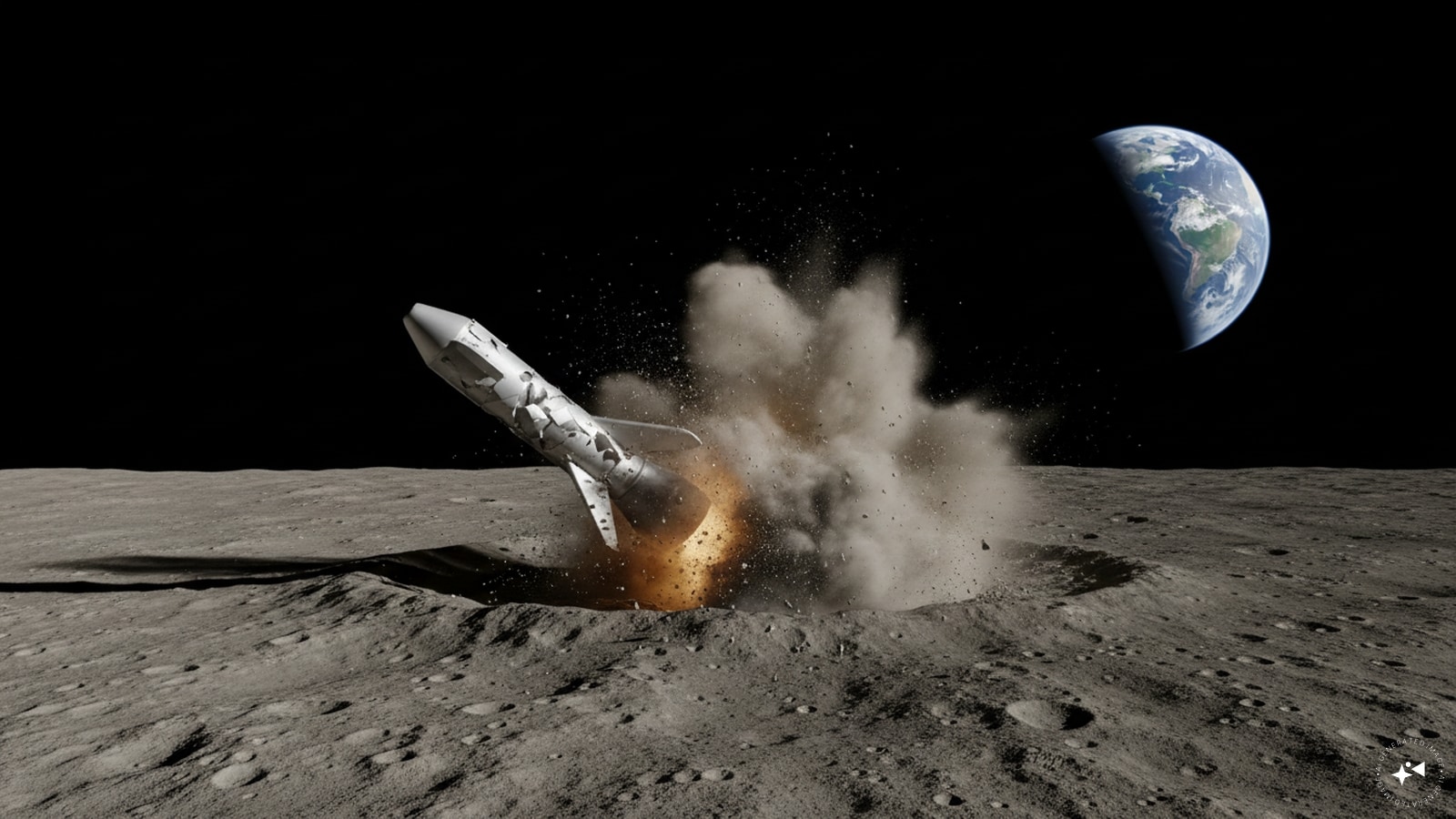
At a speed of roughly 5,400 miles per hour, the four-metric-ton chunk of metal was set to intercept the lunar surface. To put that velocity into perspective, a rifle bullet typically travels at about 1,700 miles per hour. This object was moving three times faster than standard ballistic lead, carrying the kinetic punch of an express train made of industrial-grade metal.
And because it lacked any guidance system, it was coming in blind. No steering thrusters. No retro-rockets. Just pure, unadulterated orbital decay crashing headlong into a vacuum.
The Blind Spot Above Our Heads
We tend to think of near-Earth space as a vast, empty wilderness where things can get lost forever. We treat orbit like an attic where we can toss old boxes and never worry about them again.
That mindset is a dangerous luxury.
When humanity first reached for the stars, we left a trail of breadcrumbs. Except our breadcrumbs are spent rocket bodies, shattered satellite fragments, and microscopic paint flecks traveling at seven kilometers per second. Down here on the ground, we sit under a blue sky, completely insulated from the mechanical violence playing out hundreds of miles above our heads.
I remember talking to an orbital debris specialist a few years ago who used a simple analogy to describe the problem. He asked me to picture driving a car on a highway where every driver who ever lived had simply abandoned their vehicle right where it ran out of gas. No towing. No cleanup. Just millions of dead cars rolling, rusting, and occasionally smashing into one another at highway speeds.
Now, scale that up to planetary mechanics.
The upcoming lunar impact was not a Hollywood disaster movie scenario. It wasn't going to crack the Moon in half or alter its orbit. But it served as a flashing red neon sign pointing directly at our collective blind spot. For decades, tracking debris meant watching things orbiting Earth. Once an object ventured out toward the Moon or deep space, it largely vanished from routine catalogs unless someone went looking for it with a dedicated telescope.
This particular booster was a ghost in the machine until amateur astronomers did the math.
Watching the Invisible Impact
Can you actually watch it happen? That was the question bouncing around astronomy forums and news feeds as the impact date approached.
The short answer is no, not directly with your naked eyes, and not even with a standard backyard telescope. At 5,400 mph, the collision on the lunar far side or near-term terminator line happened in a fraction of a second. There was no giant telescopic fireworks display visible to casual stargazers standing in their backyards with a pair of binoculars.
Yet, the scientific community mobilized with unprecedented intensity.
Professional and amateur observers trained high-powered instruments on the Moon, looking for the aftermath. When a multi-ton object strikes basaltic rock at hypervelocities, the physics dictate an immediate, violent release of kinetic energy. It vaporizes metal instantly, superheats surrounding dust, and carves out a fresh, jagged crater several meters wide on the lunar surface.
Orbiters currently mapping the Moon, such as NASA's Lunar Reconnaissance Orbiter, were tasked with pivoting their cameras toward the expected impact zone days later. They hunted for the fresh scar. A dark smudge of displaced regolith. A brand-new depression stamped permanently into the ancient gray dust of a world that has kept a diary of cosmic impacts for billions of years.
This crash offered an accidental science experiment. Planetary scientists rarely get to watch a controlled high-speed impact on a body without an atmosphere using modern instrumentation. By analyzing the plume of dust kicked up by the hollow metal tube, researchers could study the subsurface composition of the lunar crust and test models of hypervelocity impacts in ways that laboratory simulations on Earth can never quite replicate.
The Reckoning We Chose
There is a strange poetry to it. A piece of industrial technology built to push humanity further into the cosmos ended its journey by smashing into the most ancient, silent witness to our existence.
We built the ladder to the stars out of aluminum and steel, and now those rungs are breaking off and falling back down in wild, unpredictable arcs.
When you look up at the Moon tonight, it looks peaceful. It hangs like a silver coin in the dark, serene and untouchable. But the space surrounding it is becoming crowded. As commercial spaceflight accelerates, as private companies launch constellations of thousands of satellites, and as deep-space missions become routine, the neighborhood is getting messy.
The SpaceX booster crash wasn't a catastrophe. It was a wake-up call written in dust and kinetic energy. It forced us to look past our own atmosphere and realize that our footprint in the solar system extends far beyond the satellites we actively manage.
We are leaving tracks in the void. And sooner or later, those tracks circle back home.
The crater is there now, fresh and raw, etched into the silence of a world without wind or rain to wash it clean. It is a new monument to our ambition, sitting quietly in the dark, waiting for the next piece of the past to find its way home.