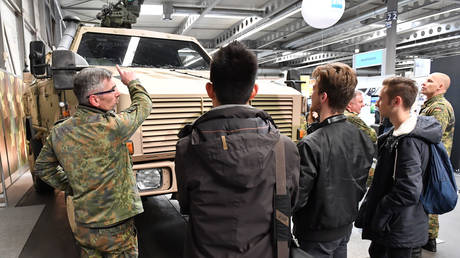
The Bundeswehr is mailing 200,000 letters to teenagers because it thinks it has a personnel problem. It doesn't. It has a reality problem.
Mainstream reporting treats this massive recruitment push as a "bold step toward readiness" or a "necessary response" to geopolitical shifts. That is a lazy consensus built on 20th-century muscle memory. Sending glossy brochures to 18-year-olds in a digital-first economy is not a strategy; it is a confession of obsolescence.
The German military is trying to buy more "human capital" at a time when the ROI on a boots-on-the-ground soldier has never been lower. If you think the strength of a modern European power is measured by the headcount of its infantry, you are reading the wrong map.
The Myth of the Meat Wall
The prevailing logic suggests that more soldiers equals more security. This is the "Meat Wall" fallacy. It assumes that if a conflict breaks out, we need a physical line of bodies to hold a geographic border.
Look at the data coming out of modern high-intensity conflict zones. Tanks are being deleted by $500 drones. Command centers are being identified by the heat signatures of personal cell phones and neutralized from another zip code. In this environment, a 200,000-person recruitment drive is just an exercise in creating 200,000 targets.
We are watching the rapid democratization of lethality. When a teenager in a basement can pilot a loitering munition that takes out a multi-million-dollar armored vehicle, the traditional military hierarchy collapses. Germany is recruiting for a version of war that is being phased out by silicon and autonomous systems.
The Skilled Labor Trap
The Bundeswehr claims it needs "technicians, pilots, and specialists." Here is the brutal truth they won't put in the recruitment letter: The people Germany actually needs for a modern defense are the exact people who will never work for a government salary.
If you are a top-tier cybersecurity expert or a robotics engineer, why would you subject yourself to the rigid, bureaucratic friction of military life?
- The Pay Gap: Private sector compensation for defense tech is 3x to 5x higher than military pay scales.
- The Culture Gap: Innovation requires a flat hierarchy and the freedom to break things. The military is a vertical hierarchy designed to prevent things from breaking.
- The Tech Gap: By the time a new piece of software is cleared for use in a government system, it is already two generations behind the commercial curve.
By casting a wide net for 200,000 "young people," the army is signaling that it prioritizes quantity over quality. It is trying to fill a bucket that has a hole in the bottom. The high-skill individuals they need are staying in the private sector, leaving the military with a surplus of generalists who require massive amounts of training just to become marginally useful in a tech-driven theater.
The Demographic Delusion
Germany is facing a demographic winter. The labor market is tighter than it has been in decades. Every industry is fighting for the same shrinking pool of Gen Z talent.
When the Bundeswehr enters this fight, it isn't just competing with other militaries; it’s competing with SAP, BMW, and every high-growth startup in Berlin. The army is trying to sell "adventure" and "service" to a generation that values flexibility and moral autonomy.
The recruitment letters are a desperate attempt to ignore the fact that the "manpower" model is dead. A nation with a shrinking population cannot afford to tie up its youth in stagnant physical roles. It must pivot to a "force multiplier" model where one human manages a fleet of autonomous systems. But you can't teach that with a mailer and a basic training camp.
The Irony of "Readiness"
The competitor articles love to use the word "readiness." They frame these 200,000 letters as a way to bolster the NATO contribution.
True readiness in 2026 isn't about how many people can do a push-up. It's about:
- Electromagnetic Spectrum Dominance: Can you hide your own signals while blinding the enemy?
- Kinetic Autonomy: How many "dumb" munitions can you turn into "smart" ones?
- Logistical AI: Can you move supplies through a contested zone without a single human driver?
None of these things require 200,000 more soldiers. They require a radical restructuring of the defense budget away from personnel and toward autonomous infrastructure. Every Euro spent on housing, feeding, and pensioning a new recruit is a Euro not spent on the hardware that will actually decide the next conflict.
The Hard Truth of "Selective Service"
There is a whispered conversation about returning to conscription or a "mandatory service" model. Proponents argue it builds social cohesion.
I have seen organizations try to force "cohesion" through mandatory participation. It fails every time. A conscripted force is an unmotivated force. It increases the administrative burden, spikes the cost of training, and lowers the overall professional standard.
If Germany wants to be a serious military power, it needs a small, elite, hyper-technical professional core. It needs 20,000 geniuses, not 200,000 warm bodies.
The Actionable Pivot
If you are one of the 200,000 people who received that letter, or if you are an investor looking at the defense sector, here is the unconventional reality:
Stop looking at the uniform. Look at the software.
The real "defense" of Germany isn't happening on a parade ground in Lower Saxony. It’s happening in the server rooms of Munich and the drone testing fields of the Baltic.
If the German government wanted to be truly "ready," it would stop sending letters and start funding high-stakes hackathons. It would offer to pay off the student loans of any engineer who spends three years building autonomous logistics software, regardless of whether they ever wear a pair of combat boots.
The "army of the future" is a network, not a battalion.
The Bundeswehr is currently a 20th-century institution trying to solve 21st-century problems with 19th-century recruitment tactics. Those 200,000 letters aren't a sign of strength. They are the paper trail of a system that refuses to admit the era of the mass army is over.
Burn the letters. Build the bots.