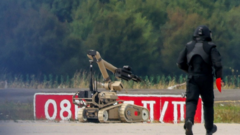
An explosive-laden drone sitting quietly near a Ukrainian transport plane isn't just a localized security breach. It's a clear declaration of a shadow war playing out across Europe. When German Chancellor Friedrich Merz stepped up to address the press ahead of a cabinet retreat near Berlin, he didn't mince words. He stated plainly that the perpetrators behind these targeted hybrid operations "will pay for them".
If you've been following European security over the past couple of years, you know this isn't happening in a vacuum. Critical infrastructure is taking hits left and right, data cables in the Baltic Sea are severed, and sabotage attempts are becoming an ordinary Tuesday for intelligence agencies. But the incident at Leipzig/Halle Airport changed the tone entirely. This wasn't minor cyber mischief. It was a serious attempt to blow up or disable vital logistics using military-grade explosives.
Let's look at what actually happened, why Berlin is on high alert, and what this escalation means for the continent's stability.
Inside the Leipzig Airport Drone Plot
The timeline of events at Leipzig/Halle Airport reads like a thriller, except the stakes are entirely real. Back on August 4, ground crews spotted a suspicious drone resting dangerously close to a Ukrainian Antonov cargo aircraft. That plane wasn't random; Leipzig is a massive European freight hub and a critical logistical lifeline used for moving military and humanitarian supplies supporting Ukraine.
When police and bomb squads examined the device, they found it packed with dangerous military-grade explosives like hexogen. To make matters worse, ongoing investigations revealed that this wasn't a solitary rogue machine. Investigators suspect multiple drones were deployed that night, with one potentially colliding with a DHL cargo aircraft during the ensuing airport chaos. Ten days later, authorities recovered yet another drone in a nearby field in Kabelsketal, complete with traces of explosives.
Chancellor Merz called out the shifting reality of these threats. Attackers are growing increasingly ruthless, showing a total disregard for human life, massive property damage, and catastrophic collateral consequences. They are willing to risk passenger planes and civilian lives just to send a geopolitical message.
The Broader Shadow War on European Soil
You can't separate the Leipzig incident from the wider campaign of sabotage plaguing NATO allies. European defense ministers have spent months sounding alarms about low-attribution, high-impact hybrid operations. We are talking about cyberattacks crippling local municipalities, mysterious communications cable cuts under the sea, and coordinated disinformation campaigns designed to fracture public support for Ukraine.
Just look around the continent. Around the same time as the German drone scare, Slovakian police foiled a planned arson attack on a drone manufacturing facility, arresting foreign nationals tied to a broader sabotage network. These plots share a common denominator: they target the physical supply chains fueling Ukraine's defense, aiming to induce economic exhaustion and psychological fatigue across Western Europe.
While Berlin has deliberately avoided pointing a direct finger at Moscow in public statements—waiting for prosecutors to finalize their brief—security analysts and intelligence sources heavily suspect Russian intelligence networks are pulling the strings. Moscow routinely denies involvement, but the pattern of operations matches historical playbooks designed to sow panic without triggering a formal military response under Article 5.
How Germany Plans to Strike Back
For a long time, Western democracies struggled to respond effectively to gray-zone tactics because traditional legal frameworks and defense postures are built for conventional warfare. Merz's government is signaling that this defensive posture is finished.
Berlin is moving forward with legislative packages designed to give intelligence and federal security services more operational freedom. This includes exploring proactive defensive measures and offensive cyber capabilities to deter future plots. You can't stop state-backed sabotage with polite diplomatic reprimands. You stop it by raising the cost for the actors involved, tracking their financial networks, and dismantling local proxy cells before they ever launch a device.
Despite the growing pressure, Merz made it explicitly clear that these terror tactics will not force Germany to abandon its foreign policy trajectory. Berlin remains one of Kyiv's primary financial and military supporters. The logic coming out of the chancellery is straightforward: maintaining robust, long-term support for Ukraine isn't about dragging out a conflict; it's about forcing hostile actors to realize that aggression won't achieve their strategic goals.
Expect federal prosecutors to release a detailed breakdown of the Leipzig investigation shortly. When they do, look past the diplomatic language. The real test will be whether European capitals can turn tough political rhetoric into a unified defense network that actually neutralizes the shadow war in our skies.