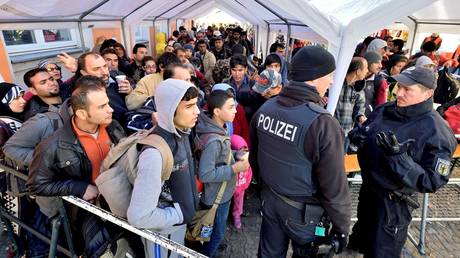
Germany's migration policy just hit a massive breaking point. If you’ve been following the headlines, you might have seen reports suggesting that German authorities are now rejecting up to 95% of asylum applications from Syrians. This isn't just a minor shift in paperwork. It’s a total overhaul of how Europe’s largest economy views one of the world's most persistent refugee crises. For years, Syrian nationals were almost guaranteed protection when they reached German soil. That era is officially over.
The shift comes at a time when the political temperature in Berlin is boiling. Voters are frustrated. Public services are stretched thin. Most importantly, the security conversation has changed. We're seeing a pivot from "welcome culture" to a "security first" mandate that focuses on individual vetting rather than group-based protection. If you're wondering how a country goes from taking in over a million people to rejecting nearly every new claim, you have to look at the legal technicalities and the political desperation behind the scenes.
The end of automatic protection for Syrians
For a long time, the Federal Office for Migration and Refugees (BAMF) operated on the assumption that being Syrian was enough to prove you were in danger. It made sense. The civil war was a chaotic mess of barrel bombs and chemical weapons. But lately, the German legal system has started to argue that while Syria is still a mess, it isn't "dangerous enough" in every single corner to justify blanket asylum.
Judges in higher administrative courts, specifically in states like North Rhine-Westphalia, have issued rulings stating that civilians in Syria no longer face a "serious individual threat" just by being there. This legal nuance is the knife that’s cutting through those 95% of claims. Instead of getting full refugee status under the Geneva Convention, many are being told they don't qualify at all. Some might get "subsidiary protection," which is a tier lower, but even that's becoming harder to snag.
It’s a brutal calculation. The German government is basically betting that they can classify parts of Syria as safe enough to return to, or at least safe enough to deny new arrivals a permanent home. I've seen this kind of policy shift before, and it usually signals a precursor to actual deportations. You can't deport people if you admit their home is a war zone. By rejecting the claims now, the state is clearing the legal path for removals later.
Political pressure and the rise of the right
Why now? Honestly, it’s about survival. The current coalition government is getting hammered in the polls. The Alternative for Germany (AfD) has been surging by weaponizing the migration issue. Every time a high-profile crime involves a migrant, the pressure on Chancellor Olaf Scholz increases. The government needs to show it has "control" over the borders, and the easiest way to show control is through high rejection rates.
But let’s be real. Rejection on paper doesn't always mean a flight back to Damascus. Germany still has massive hurdles when it comes to actual deportations. They don't have diplomatic ties with Bashar al-Assad's regime. They don't have a direct way to fly people back into a territory they officially consider a pariah state. So, we’re left with a weird limbo. Thousands of Syrians are being told they aren't welcome, yet they have nowhere to go. They end up with a "Duldung" or a tolerated stay. They can't work easily. They can't integrate. They just exist in a legal gray area that helps no one but looks good on a government spreadsheet.
What the media gets wrong about the 95 percent figure
Numbers are easy to manipulate. When the media says 95% of claims are being rejected, it often refers to a specific subset of recent "accelerated" procedures or specific court rulings. It doesn't mean every single Syrian in Germany is being kicked out tomorrow. In fact, many Syrians who have been in the country for years already have permanent residency or even citizenship.
The 95% figure mostly hits the new arrivals. It’s a deterrent. Germany is sending a loud message to anyone still thinking of making the trek through the Balkan route or across the Mediterranean. The message is simple. Don't come. You won't get papers. You won't get a life here.
It’s a complete 180 from the 2015 "Wir schaffen das" (We can do this) mantra. The infrastructure is full. Schools are overflowing. Local mayors are screaming for help because they can't find housing for anyone else. This policy shift is the state’s way of pulling the emergency brake before the whole system snaps.
The security loophole and individual vetting
Another major factor is the change in how BAMF conducts interviews. They used to do group recognitions. Now, they're digging into every single detail. They're looking for any reason to deny a claim. Did you spend time in a "safe" third country? Did you return to Syria for a funeral or a visit? If you did, your claim is dead.
Security agencies are also more involved. They're checking social media profiles and phone data. If there’s even a hint that an applicant supported a group the German state doesn't like—or even if they just don't seem "persecuted enough"—the rejection letter is in the mail. It’s a much more aggressive, suspicious approach to migration management.
Real consequences for the ground level
Think about the human side of this for a second. You have people who have spent their life savings to reach safety, only to be met with a legal wall. This creates a massive "shadow" population. When people are rejected but can't be deported, they don't just disappear. They often go underground. They work illegally. They become vulnerable to exploitation.
If Germany continues this trend of rejecting nearly everyone without a clear plan for what happens next, they're creating a ticking social time bomb. It’s one thing to have a strict border policy. It’s another to have a massive population of people with no legal rights and no way to leave. That’s not a policy. That’s a crisis.
How to navigate the changing German migration landscape
If you're following this because you're involved in the process or know someone who is, you need to understand that the old rules are dead. You can't rely on the "Syrian bonus" anymore.
- Focus on individual persecution. General war conditions aren't enough. You need proof that you, specifically, are a target.
- Document everything. Any evidence of political activism, religious persecution, or specific threats is worth its weight in gold.
- Get a lawyer early. The administrative courts are where these cases are won or lost. Going in without professional legal help is a fast track to a 95% rejection statistic.
- Look into alternative paths. For some, vocational training (Ausbildung) or work visas might eventually be more stable than the asylum path, though switching tracks is notoriously difficult in the German bureaucracy.
The German state has shifted its stance from humanitarian leader to a fortress mentality. It’s a cold, hard reality that's going to define European politics for the next decade. Don't expect the numbers to soften anytime soon. The political will just isn't there.
Check the latest rulings from the Federal Administrative Court (Bundesverwaltungsgericht) if you want to see exactly how the legal definitions of "safe" are being rewritten in real-time. Stay informed on the local state-level policies too, because a Syrian in Bavaria is facing a much tougher road than one in Berlin. The decentralization of German law means your location matters as much as your story. Stop waiting for a return to the old ways. It's not happening.


