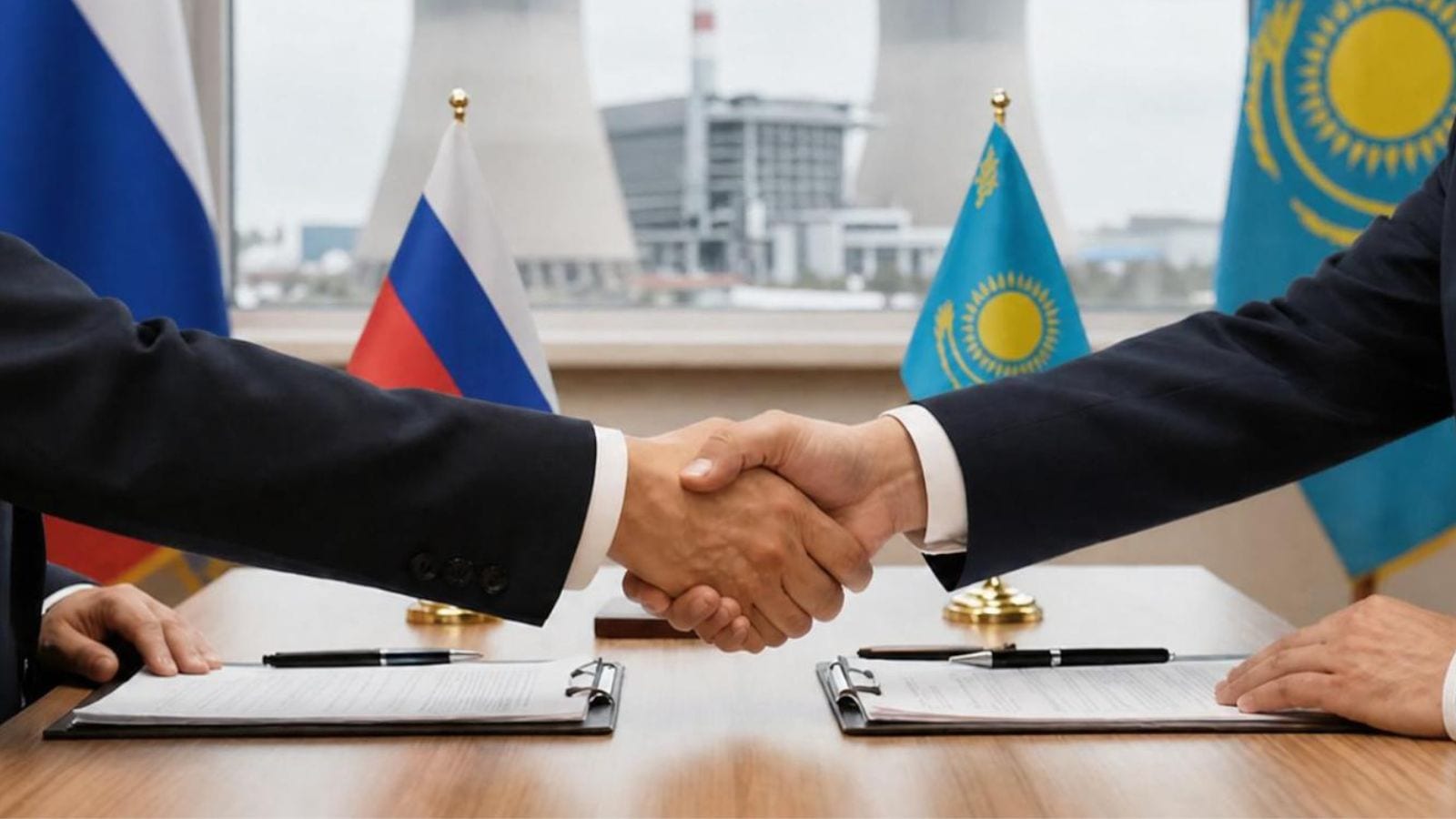
The $16.5 billion nuclear power plant agreement finalized between Russia and Kazakhstan in Astana establishes a precedent for how energy dependency, sovereign debt, and state-backed technology intersect in Central Asia. While superficial accounts treat the contract as a standard infrastructure deal, an analytical deconstruction reveals a highly calculated geopolitical and economic structure. By securing the mandate to construct Kazakhstan's first commercial nuclear facility at Lake Balkhash, Moscow is not merely exporting engineering expertise; it is locking in a multi-decade supply, regulatory, and financial dependency framework.
This transaction represents a classic execution of Russia’s energy diplomacy, utilizing state-backed financial mechanisms to outmaneuver international competitors including China National Nuclear Corporation (CNNC), France’s EDF, and South Korea’s Hydro & Nuclear Power (KHNP). To understand the true strategic implications of this deal, one must analyze the structural mechanics of the agreement across three distinct dimensions: the financial architecture of the export credit, the operational dependencies of the VVER-1200 technology, and the regional equilibrium of the Central Asian energy grid.
The Financial Architecture: Sovereign Credit as a Lock-in Mechanism
The commercial foundation of the Balkhash project relies on an asymmetric capital structure. Kazakhstan’s Ministry of Finance and its atomic energy agency have established a framework where Russia provides a state export credit covering approximately 85% of the total project cost—amounting to roughly $14 billion of the $16.5 billion valuation. The remaining $2.5 billion, which includes a dedicated $2 billion for physical security systems and localized social infrastructure, represents the baseline domestic capital injection.
This financing model functions through a specific capital-allocation mechanism:
- The Debt-to-Control Lever: By structuring the project through a dominant bilateral state loan rather than a multilateral consortium, Kazakhstan mitigates immediate capital expenditures but incurs long-term debt-servicing obligations to Moscow.
- Favorable Terms vs. Strategic Concessions: While Kazakh officials characterize the export loan as possessing highly favorable terms, the structural reality of nuclear financing dictates that low-interest sovereign loans from state-backed entities like Rosatom are invariably tied to exclusive procurement clauses.
- The Technology Exclusion Principle: Because Russia is financing 85% of the asset via export credit, the procurement of high-value components is legally and logistically restricted to Russian suppliers, preventing Kazakhstan from diversifying its technology stack mid-lifecycle.
This financial architecture effectively neutralizes the competitive advantages of Western or East Asian alternatives. Competitors like EDF or KHNP operate within market-driven or semi-regulated financial frameworks that require rigorous risk premiums, commercial insurance, and adherence to international banking covenants. Rosatom, backed directly by the Russian state treasury, treats the capital deployment as a geopolitical investment, accepting risk profiles and underwriting terms that commercial banks find unviable.
Operational Mechanics: The 60-Year VVER-1200 Lifecycle Dependency
The selection of Rosatom’s Generation III+ VVER-1200 pressurized water reactor units establishes a profound technical path dependency. The project configuration dictates the installation of two units with a combined generating capacity of 2.4 gigawatts, with the first unit scheduled to pour first concrete in 2027 and enter commercial operation by early 2034.
A nuclear power plant is not a transactional purchase; it is a 60-to-80-year industrial ecosystem. The choice of the VVER-1200 reactor design binds Kazakhstan to Russian state enterprises across the entire nuclear fuel cycle through three distinct operational bottlenecks.
1. Enriched Uranium Fuel Supply
Kazakhstan is the world’s largest producer of raw uranium, accounting for roughly 40% of global output. However, raw uranium ($U_3O_8$) cannot be directly utilized in a VVER-1200 reactor. It requires conversion and isotopic enrichment to increase the concentration of Uranium-235 to between 3% and 5%, followed by highly specialized fuel assembly fabrication. Kazakhstan lacks domestic commercial-scale enrichment facilities. Consequently, the country must export its raw uranium to Russia for enrichment and fuel fabrication, only to import the finished fuel assemblies back to the Balkhash plant. This creates a circular dependency where the world's leading uranium exporter remains reliant on an external sovereign power to process its own resources into usable fuel.
2. Proprietary Maintenance and Engineering Codes
Nuclear operations run on proprietary software, specialized metallurgy, and highly regulated engineering protocols. The VVER-1200 system operates within a closed technical loop. Safety upgrades, diagnostic software, and specialized replacement parts must be sourced directly from Rosatom subsidiaries. Attempting to integrate third-party components or software into a primary Russian reactor cooling system introduces catastrophic regulatory and operational risks, ensuring that the Kazakh nuclear regulatory body will remain tethered to Russian technical oversight for the next two generations.
3. Spent Fuel Management and Decommissioning
The back end of the nuclear lifecycle introduces significant long-term liabilities. The storage, reprocessing, and eventual disposal of spent nuclear fuel require deep geological repositories or advanced reprocessing technology. Russia's state-backed nuclear framework frequently includes provisions for the take-back or managed processing of spent fuel, a service that provides immediate political relief to host nations but reinforces the regulatory integration between the two states.
Grid Architecture: Resolving the Baseload Deficit
The strategic urgency driving Astana to accept these structural dependencies is rooted in the structural vulnerabilities of its domestic energy grid. Kazakhstan’s electricity infrastructure is currently defined by an unsustainable reliance on coal and a severe geographic misalignment between supply and demand.
[Northern Grid: Heavy Coal Generation] ---> (Deficit / Transmission Bottlenecks) ---> [Southern Grid: High Demand Center]
                                                                                               ^
                                                                                               |
                                                                                  [Proposed Balkhash NPP: 2.4 GW]
The country relies on coal-fired generation for approximately 50% of its total energy mix. The existing generating fleet is severely aged, with multiple plants operating well past their engineered lifespans, leading to high forced outage rates. Furthermore, Kazakhstan’s primary coal-fired generation assets are concentrated in the north, near the major coal basins, while significant demand growth is located in the south.
This geographical imbalance creates an acute transmission bottleneck. The southern regions of Kazakhstan suffer from structural power deficits, forcing the country to regularly import expensive balancing power from the Russian Federation to maintain grid stability.
The site selection for the new plant—near the village of Ulken on the shores of Lake Balkhash—is a precise engineering response to this grid deficit. Located in southeastern Kazakhstan, the Balkhash plant will place 2.4 gigawatts of reliable, zero-carbon baseload power directly into the southern demand cluster. Lake Balkhash provides the massive, continuous supply of cooling water required by two VVER-1200 units, solving the geographic mismatch and reducing the country’s reliance on coal.
Strategic Hedging and Multi-Vector Counterweights
A critical error in assessing this agreement is viewing it as a total capitulation of Kazakh autonomy to Moscow. Under the administration of President Kassym-Jomart Tokayev, Kazakhstan has consistently practiced a "multi-vector" foreign policy, attempting to balance the influence of Russia, China, the West, and the Middle East. The nuclear strategy reflects this delicate balancing act.
While Rosatom secured the primary mandate for the $16.5 billion Balkhash facility, Kazakhstan has concurrently approved the construction of a second nuclear power station. Crucially, Astana has selected China National Nuclear Corporation (CNNC) as the lead constructor for this secondary project.
This dual-vendor approach serves as a deliberate strategic hedge:
- Diversification of Technical Risk: By introducing Chinese reactor technology alongside Russian architecture, Kazakhstan prevents a monolithic technical monopoly over its future low-carbon energy mix.
- Geopolitical Equilibrium: Awarding the first plant to Moscow honors traditional security and historical ties, formalizing the "seven pillars of friendship" signed during the state visit. Concurrently, allocating the second project to Beijing acknowledges China’s rising economic dominance and its role as a primary consumer of Central Asian resources.
- Regulatory Leverage: Managing two competing nuclear ecosystems provides the Kazakh state with comparative benchmarks on cost, safety, and operational efficiency, allowing them to play both superpowers against one another during subsequent expansion phases.
The Operational Blueprint for Execution
For international analysts and energy executives monitoring the Central Asian infrastructure market, the finalization of the Rosatom-Kazakhstan accord delivers a clear blueprint of state-backed infrastructure competition. The success of the Russian bid did not hinge on superior commercial pricing or standard corporate financing; it succeeded because Rosatom offered an integrated, sovereign-backed package that combined financing, technology, fuel lifecycle management, and geopolitical alignment into a single transaction.
The strategic play moving forward will center on the execution timeline between 2027 and 2034. The primary variable to monitor is the speed of engineering surveys and the structural terms of the finalized export loan. If Kazakhstan can successfully manage the debt burden of the Russian export credit while accelerating the integration of the Chinese-built secondary plant, it will successfully transition from an energy-deficient state into a highly strategic, low-carbon industrial hub at the center of Eurasia. If, however, macro-economic shocks or project delays balloon the construction costs at Balkhash, the 85% debt financing framework will convert an energy infrastructure asset into a permanent mechanism of sovereign leverage for the Russian Federation.