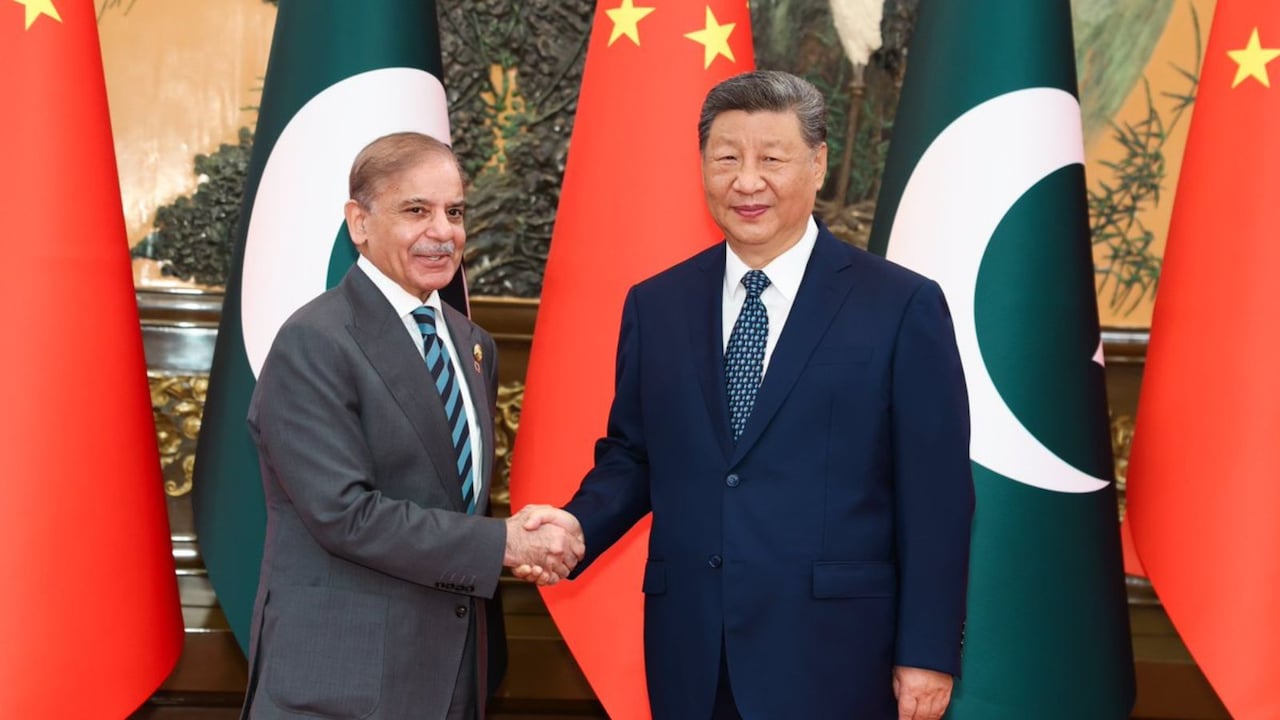
When the Ministry of External Affairs in New Delhi dismissed the newly operationalized Pakistan-China Boundary Joint Commission as mere theatrics, it did so with the cold precision of a state defending its territorial core. The joint body, which held its inaugural meeting in Islamabad featuring officials from Beijing and Pakistan, represents an attempt to codify a boundary that does not legally exist. India's response was swift and absolute, reiterating that the entire Union Territories of Jammu and Kashmir and Ladakh remain sovereign territories, while branding the underlying arrangements entirely void of legal standing. Beneath the diplomatic friction lies a deeper struggle over sovereignty, strategic transit corridors, and the shadow of a decades-old territorial handover that continues to poison regional stability.
To understand why this commission triggers such fierce opposition from New Delhi, one must look back to an agreement signed in Beijing more than six decades ago. In 1963, Pakistan and China concluded a bilateral boundary agreement that transferred approximately 5,180 square kilometers of the Shaksgam Valley in the Trans-Karakoram Tract to Chinese control. At the time, India protested vigorously, establishing a firm legal and diplomatic position that Islamabad held no sovereign rights over the territory to begin with. Because the region formed an integral part of the undivided state of Jammu and Kashmir, any transaction or cession involving a third party was constitutionally and internationally invalid. Decades later, that foundational illegality remains the bedrock of India's stance. In related updates, read about: Cross-Border Criminal Liability After Fatal Hotel Falls Why Last-Minute Dismissal Pleas Rarely Stop Trial.
The Anatomy of an Illegal Accord
The genesis of the 1963 boundary pact lies in Cold War opportunism rather than legitimate cartographic alignment. Following the 1962 Sino-Indian War, Islamabad recognized an opening to court Beijing as a counterweight to New Delhi. Ayub Khan’s military government initiated border negotiations with Chinese authorities over regions that Pakistan did not lawfully own. By ceding the Shaksgam Valley, Islamabad attempted to secure Chinese diplomatic backing on the Kashmir dispute while simultaneously altering the geopolitical contours of the northern frontier.
New Delhi's vehement protests at the time established a permanent legal doctrine: a state occupying territory through aggression or unlawful control cannot transfer sovereign rights to a third party. The international community has largely recognized the disputed nature of the region, yet Beijing and Islamabad have periodically sought to bypass this reality through bilateral administrative mechanisms. The recent activation of the Boundary Joint Commission is the latest iteration of this long-term strategy, designed to transform a contested de facto arrangement into an institutionalized reality. Al Jazeera has analyzed this important issue in great detail.
Securing the Corridor of Power
The bureaucratic maneuver of operationalizing the commission serves a vital strategic purpose for the China-Pakistan Economic Corridor, known widely as CPEC. The corridor, a flagship component of Beijing's broader transcontinental ambitions, relies heavily on physical connectivity running through Gilgit-Baltistan and across the Khunjerab Pass. Without clear, unhindered administrative cooperation between Pakistani authorities and Chinese managers in these high-altitude zones, the security architecture of the trade route remains vulnerable to legal challenges and sovereign pushback from New Delhi.
Beijing's heavy financial exposure in Pakistan, marked by billions of dollars in debt rollovers and infrastructure investments, requires a predictable security environment. The joint commission is thus designed to provide a veneer of administrative legitimacy to a transit route that cuts directly across territory claimed by India. China's long-term calculus involves securing unimpeded continental trade routes that reduce its reliance on maritime chokepoints like the Malacca Strait. The land bridge running through Gilgit-Baltistan and the Shaksgam Valley is indispensable to this grand strategy. Pakistan, having mortgaged significant portions of its sovereign economic and territorial sovereignty to service its external debt, has little room to resist Beijing's administrative integration demands. Consequently, the Boundary Joint Commission is less about local border management and more about institutionalizing a permanent corridor of power that links western China directly to the Arabian Sea.
The Legal Doctrine of Non-Acquiescence
Yet, New Delhi's rejection is not merely a reflexive diplomatic ritual. It is rooted in a hardheaded assessment of how administrative creep operates in contested border zones. When two states establish joint commissions, conduct joint surveys, and coordinate local regulations over disputed tracts, they attempt to establish prescription under international law over extended periods. India's Ministry of External Affairs understands that silence or acquiescence can be weaponized by adversaries to weaken territorial sovereignty claims at international forums.
By publicly dismissing the commission as theatrics and demanding that Pakistan immediately vacate areas under its illegal occupation, India maintains an unbroken chain of protest that neutralizes any potential arguments of quiet acceptance. This policy of non-acquiescence is essential for preserving legal title. Under international jurisprudence, consistent and explicit contestation prevents the consolidation of title by an adverse party. New Delhi's diplomatic machinery treats sovereignty as an absolute principle that cannot be diluted by bilateral convenience or administrative habituation.
High Altitude Logistics and Strategic Realities
Consider the geography of the Shaksgam Valley and the broader Trans-Karakoram tract. This terrain consists of rugged, glaciated mountains sitting at extreme elevations, where human habitation is sparse and military logistics are punishing. Yet, the strategic value of the valley transcends its inhospitable climate. It provides a direct geographic link between China's Xinjiang province and Pakistan-administered territories, acting as a critical corridor for military and commercial movement.
When Chinese and Pakistani officials sit across a table in Islamabad to discuss border management protocols for this region, they are effectively managing infrastructure that bypasses recognized international boundaries. Traffic through the mountain pass must navigate severe weather conditions and strict security protocols administered jointly by paramilitary forces from both nations. By formalizing this coordination via a joint commission, Beijing aims to insulate its commercial investments from the volatile political shifts inside Pakistan. If a domestic political crisis erupts in Islamabad or if local protests target Chinese nationals working on infrastructure projects, a formalized boundary management system provides Beijing with direct mechanisms to intervene or dictate security terms. This creeping institutionalization is precisely what New Delhi intends to block through persistent legal and diplomatic pushback.
The Cost of Sovereign Compromise
The timing of this commission's activation also reveals the anxious synchronization of foreign policies in Islamabad and Beijing. Pakistan continues to navigate a severe domestic economic crisis, relying on continuous financial lifelines from its eastern neighbor to stave off default. In exchange for debt relief and diplomatic shielding at international multilateral bodies, Islamabad routinely accommodates Beijing's strategic priorities in the northern territories. For China, asserting administrative management along the Karakoram border reinforces its broader posture along the Line of Actual Control. Beijing aims to constrain Indian strategic bandwidth by forcing New Delhi to manage pressures on multiple fronts simultaneously.
The international community often underestimates the rigidity of territorial disputes in South Asia, viewing them through the lens of temporary political posturing. However, India's foreign policy establishment views any compromise on sovereignty as an existential threat. The 1963 agreement was forged during a period when Pakistan sought to balance against India by courting Beijing, willingly trading sovereign territory for short-term diplomatic alignment. Today's revival of that logic through the Boundary Joint Commission follows the exact same playbook. Islamabad trades administrative sovereignty in the north for economic sustenance, while Beijing secures a reliable land route to warm-water ports without having to negotiate with the legitimate sovereign power.
New Delhi's response also sends a sharp signal to other regional players observing the shifting power dynamics in Central and South Asia. As Beijing expands its footprint through massive infrastructural projects and bilateral security arrangements, smaller nations often find themselves absorbed into asymmetric relationships. India's refusal to recognize the commission serves as a reminder that territorial integrity cannot be bypassed through bureaucratic sleight-of-hand. By publicly calling out the theatrics of the commission, New Delhi places the onus back on Islamabad and Beijing, reminding them that no amount of joint committee meetings can erase the foundational illegality of the 1963 transfer.
India's counter-strategy relies on maintaining legal clarity, bolstering defensive infrastructure along its own side of the border, and refusing to normalize illegal territorial realignments. While military commanders and diplomats continue talks on other sectors of the frontier, New Delhi draws a bright red line regarding any third-party collusion in Pakistan-occupied territories. The dismissal of the commission as theatrics is a calculated linguistic choice designed to strip the initiative of diplomatic weight. By framing the meetings as empty performances rather than serious legal developments, India denies Beijing and Islamabad the diplomatic normalization they seek.
The unfolding situation along the northern frontier remains a classic study in great power competition played out across disputed high-altitude terrain. As long as the structural dependencies that bind Islamabad to Beijing persist, attempts to manufacture administrative legitimacy over disputed territories will continue. Yet, as New Delhi's unequivocal response demonstrates, legal reality cannot be rewritten by bureaucratic decrees or joint commissions operating in a vacuum. The boundary between legal sovereignty and illegal occupation remains starkly defined, anchored in an uncompromising refusal to accept the permanence of conquest.


