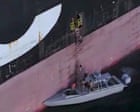
The assertion of "total control" over the Strait of Hormuz by a sovereign power rests on a fundamental misunderstanding of maritime choke points as static territory rather than kinetic environments. When Iran seizes container ships, it is not merely committing a breach of international law; it is executing a stress test on the global energy supply chain and the naval doctrine of the United States. Control in this context is a variable of three distinct pillars: maritime presence, legal jurisdiction, and the ability to project force without triggering an escalatory feedback loop that destroys the very economic value the controller seeks to protect.
The Mechanics of Asymmetric Interdiction
Iran’s strategy of seizing vessels operates within a "gray zone" of conflict—actions that fall below the threshold of open warfare but above the level of routine law enforcement. By targeting merchant vessels, Tehran exploits the vulnerability of the global "Just-in-Time" delivery model. The Strait of Hormuz, measuring roughly 21 miles wide at its narrowest point, handles approximately 20% of the world's total petroleum liquids consumption. Recently making news in related news: Russia is drawing a new red line over French nuclear bombers in Europe.
The physical geography dictates the tactical limitations. The shipping lanes consist of two-mile-wide channels for inbound and outbound traffic, separated by a two-mile-wide buffer zone. Because these lanes lie within the territorial waters of Oman and Iran, the legal framework of "Innocent Passage" under the United Nations Convention on the Law of the Sea (UNCLOS) applies. Claims of "total control" by an external power like the U.S. are structurally impossible under current international law unless a state of total war is declared, which would strip away the legal protections of neutral shipping and likely result in the immediate mining of the channel.
The Cost Function of Maritime Security
Maintaining a permanent deterrent in the Persian Gulf involves a massive allocation of naval assets. The U.S. Fifth Fleet, headquartered in Bahrain, operates as the primary counter-weight to Iranian influence. However, the cost of protection is not linear. Additional insights regarding the matter are covered by BBC News.
- The Surveillance Burden: Constant monitoring of the hundreds of small, fast-attack craft (FACs) used by the Islamic Revolutionary Guard Corps (IRGC) requires high-end signals intelligence and persistent aerial overwatch.
- Escort Logistics: Providing physical escorts for every commercial tanker is a mathematical impossibility. There are roughly 2,000 transits through the Strait per month. A standard Destroyer or Littoral Combat Ship (LCS) cannot be in multiple places at once, creating "coverage gaps" that Iran exploits through timing and proximity.
- Insurance Premiums as a Weapon: Each seizure causes an immediate spike in "War Risk" insurance premiums for Lloyd’s of London and other underwriters. Iran does not need to sink a ship to win; it only needs to make the passage economically unviable for commercial operators.
This creates a paradox where the superpower claiming control is forced to spend millions in operational costs to counter a tactic—boarding a slow-moving merchant ship—that costs the aggressor almost nothing.
Energy Flow Vulnerability and Market Sensitivity
The global oil market prices in a "geopolitical risk premium" based on the perceived stability of the Strait. If the U.S. claims total control, the market expects zero interruptions. Every time a ship is seized, that claim is devalued, leading to market volatility. The flow of crude oil through the Strait averages 20 million barrels per day (b/d).
The infrastructure for bypass is insufficient. The Habshan-Fujairah pipeline in the UAE and the Petroline in Saudi Arabia have a combined unused capacity of roughly 3.5 million b/d. This means that if the Strait were actually closed or "controlled" by an aggressive force to the point of total stoppage, over 16 million b/d would be trapped. No amount of rhetoric can mitigate the reality that the world’s spare production capacity cannot offset a total blockage of the Strait of Hormuz.
Force Projection vs Force Presence
Total control implies the ability to prevent an adversary from acting. In maritime terms, this is "Sea Command." The U.S. currently possesses "Sea Communications," meaning it can use the sea for its own purposes and those of its allies most of the time. Iran, conversely, possesses "Sea Denial" capabilities.
The Iranian Denial Toolkit
- Anti-Ship Cruise Missiles (ASCMs): Batteries hidden in the Zagros Mountains overlook the Strait, providing a permanent kinetic threat to large surface combatants.
- Smart Mines: These can be deployed rapidly from non-military vessels, making the clearing process a multi-week operation that would halt all commercial traffic.
- Submarines: The Iranian Kilo-class and Ghadir-class midget submarines are difficult to track in the shallow, noisy waters of the Gulf.
The U.S. "control" is reactive. When a seizure occurs, the U.S. responds with diplomatic pressure or an increased naval footprint, but the seizure has already happened. The initiative remains with the party willing to break international norms. Claiming "total control" ignores the tactical advantage of the "first mover" in a confined maritime space.
Strategic Realignment and the Burden of Proof
If the U.S. intends to back a claim of total control, it must shift from a posture of reaction to one of preemption. This requires a fundamental change in the Rules of Engagement (ROE). Currently, U.S. forces generally do not fire unless fired upon or unless there is a clear "hostile intent" or "hostile act." Iran’s boarding of ships often occurs under the guise of legal disputes or environmental violations, creating a "legal fog" that inhibits immediate kinetic intervention by U.S. assets.
The second limitation is the coalition of allies. Many nations whose oil passes through the Strait, such as Japan, South Korea, and China, have varying levels of appetite for military escalation. A unilateral U.S. move to exert "total control" through blockades or boarding Iranian vessels would likely fracture the International Maritime Security Construct (IMSC).
Theoretical Equilibrium in the Gulf
The current state is a Nash Equilibrium where neither side can improve its position without making the other significantly worse off.
- If the U.S. attempts to physically block all Iranian naval activity, it risks a full-scale war and the closure of the Strait.
- If Iran closes the Strait, it loses its own ability to export oil—its economic lifeline—and invites a devastating military response.
The seizures are a tool of calibrated provocation. They serve to remind the West that the cost of sanctioning Iran is high. They are not an attempt at total control by Iran, but rather a demonstration that U.S. control is an illusion.
Operational Recommendation for Maritime Stability
True stability requires a move away from the binary of "total control" toward "distributed resilience." This involves:
- Hardening Commercial Assets: Encouraging or mandating that tankers in high-risk zones carry private security or enhanced non-lethal deterrents to delay boarding until naval assets can arrive.
- Dynamic Escort Patterns: Moving away from predictable patrols toward randomized, high-visibility transits of high-value targets.
- The "Digital Strait": Implementing a transparent, real-time tracking system that immediately broadcasts boarding attempts to every global maritime hub, removing the "fog of war" that Iran uses to justify its actions after the fact.
The strategic play is to treat the Strait of Hormuz as a global utility rather than a theater of personal dominance. Any actor claiming "total control" must be prepared to sink every hostile craft within seconds of a provocation, a level of escalation that is currently politically and economically unsupportable. The goal must be the restoration of the deterrent through consistent, small-scale consequences for interdiction rather than grandiose claims of absolute dominance. Failure to calibrate this response leads to a "death by a thousand cuts" where the credibility of the U.S. Navy is eroded one seized container ship at a time.