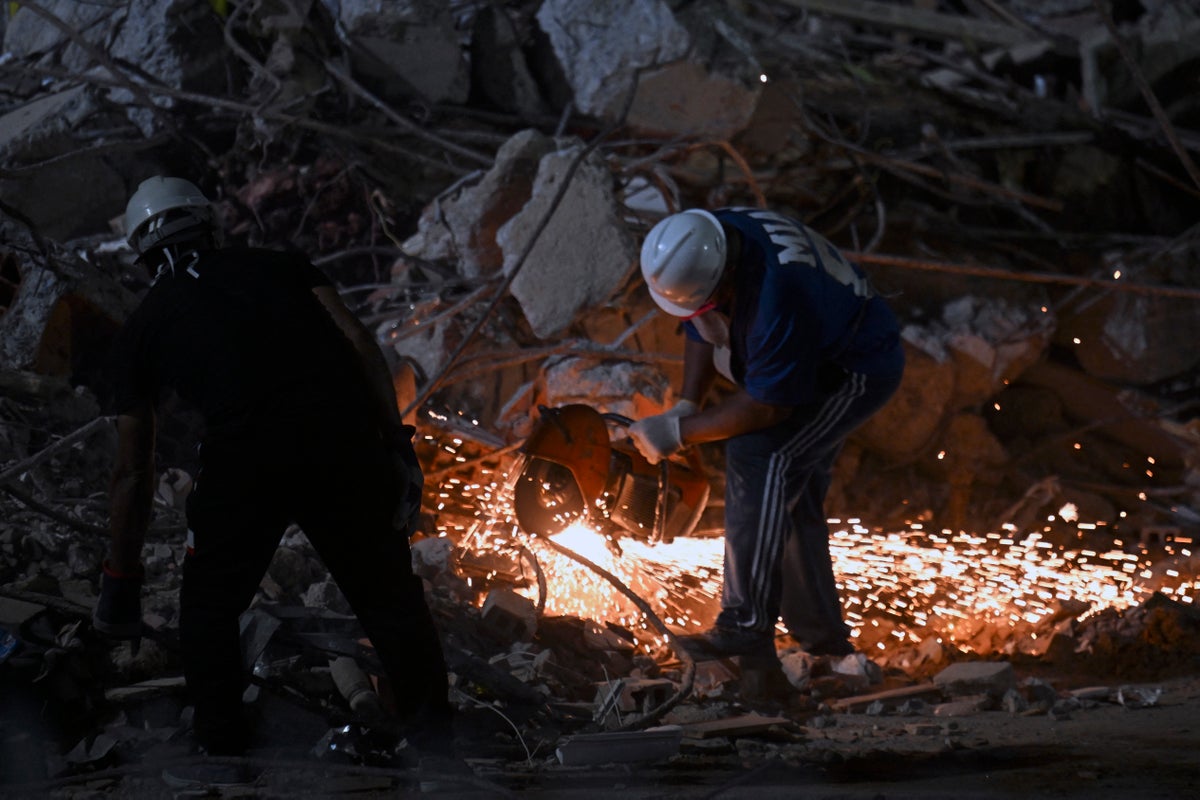
A catastrophic earthquake in Venezuela has left hundreds dead and tens of thousands missing, triggering an immediate and highly politicized international response as United States military assets arrive on the ground under the banner of humanitarian assistance. The official death toll has climbed rapidly to 589, while local rescue agencies struggle to locate more than 50,000 citizens currently unaccounted for in the debris. Beyond the immediate human tragedy lies a complex logistical and geopolitical quagmire. The arrival of foreign troops in a region historically hostile to external intervention transforms a natural disaster into a high-stakes diplomatic test.
The scale of the devastation is unprecedented for the region. Entire municipal sectors have collapsed, isolating communities from basic utilities, medical supplies, and communication networks. Also making headlines in related news: The Ceasefire Illusion Why the Cargo Ship Strike Changes Absolutely Nothing.
The Anatomy of a Structural Collapse
The high casualty figures and the staggering number of missing persons point directly to long-standing systemic vulnerabilities. Decades of economic stagnation, hyperinflation, and a lack of regulatory oversight have left Venezuela’s urban infrastructure highly susceptible to seismic shocks. Building codes, though existing on paper, were rarely enforced during the rapid, unregulated urban expansion of recent decades.
In cities built along seismic fault lines, concrete structures lacking proper steel reinforcement became immediate death traps when the ground shifted. Further information on this are covered by Reuters.
The geography of the affected areas compounds the crisis. Many of the missing are buried beneath informal hillside settlements that collapsed in massive landslides triggered by the initial tremor. These barrios, constructed from substandard materials on unstable terrain, lacked the foundational engineering required to withstand even minor seismic activity, let alone a major earthquake.
Emergency response teams face an almost impossible task. Heavy machinery cannot navigate the narrow, debris-choked corridors of these hillside communities. Rescue operations are being conducted primarily by hand or with light power tools, drastically reducing the probability of extracting survivors as the critical 72-hour window closes.
Washington Direct Intervention
The deployment of the United States military to Venezuelan soil marks a significant departure from years of diplomatic isolation and economic sanctions. While framed strictly as a humanitarian mission focused on search, rescue, and medical evacuation, the presence of American uniform personnel in Caracas carries immense geopolitical weight.
Logistical necessity forced this unusual cooperation. The Venezuelan state apparatus, depleted by years of economic mismanagement, simply lacked the heavy-lift transport aircraft, mobile field hospitals, and specialized search units required to manage a disaster of this magnitude.
- Air Bridge Operations: The US military has established a continuous supply corridor using C-17 Globemaster cargo aircraft to deliver water purification systems and temporary shelters.
- Medical Deployment: Navy hospital ships and mobile surgical teams are setting up triage centers outside the most heavily damaged urban zones.
- Search Infrastructure: Advanced sonar and thermal imaging equipment, operated by specialized military personnel, are being deployed to locate individuals trapped beneath deep structural collapses.
This intervention is fraught with tension. For years, the domestic narrative centered on resisting external pressure. Allowing foreign troops to operate freely within national borders, control key airfields, and manage domestic distribution networks represents a profound shift in the regional balance of power.
Sovereign Risks and Aid Distribution
The arrival of international aid introduces a secondary conflict over control and distribution. Historically, humanitarian crises in polarized nations suffer from the politicization of supplies, where aid is channeled to specific populations based on political alignment rather than actual need.
Local non-governmental organizations express deep concern that central authorities will attempt to centralize international donations to reassert control over a fractured population. If foreign military forces bypass local authorities to distribute aid directly to citizens, it risks undermining what remains of local governance, potentially sparking civil unrest amidst the ruin.
Conversely, if the international community hands over total control of logistics to a bureaucracy notorious for inefficiency, critical supplies will rot in warehouses while rural communities starve. Striking a balance between utilizing existing state networks and ensuring independent oversight remains the central logistical challenge of this operation.
The Missing Population Discrepancies
The figure of 50,000 missing persons requires careful scrutiny. In high-density urban environments and informal settlements, census data is notoriously unreliable, making an accurate baseline population count difficult to establish.
Communication Blackouts
The destruction of cellular towers, fiber-optic cables, and electrical grids has cut off entire provinces from the outside world. Thousands of individuals listed as missing may simply be unable to contact their families, isolated by a total collapse of the domestic digital infrastructure rather than buried beneath rubble.
Internal Displacement
As neighborhoods became uninhabitable, a mass migration began. Displaced citizens are moving on foot toward unaffected regions or crossing borders without documentation, complicating tracking efforts and inflating the official lists of the missing.
Administrative Chaos
The local agencies responsible for compiling missing persons reports are overwhelmed and understaffed. Duplicate entries, misspelled names, and a lack of centralized data management have created an inflated statistical picture that may take months to correct.
Regional Implications of the Disaster
The geopolitical ripple effects of this earthquake extend far beyond the borders of Venezuela. Neighboring countries, already hosting millions of migrants from previous economic waves, are bracing for a fresh influx of refugees fleeing the disaster zone.
Colombia and Brazil have reinforced their border posts, not to block entry, but to establish emergency medical screening and temporary refugee camps. The strain on these neighboring economies will be severe, requiring a secondary wave of international financial support to prevent a broader regional humanitarian collapse.
Furthermore, the presence of American military assets near sensitive border zones has drawn sharp criticism from global rivals. Moscow and Beijing, both possessing significant economic interests and investments within the country, are watching the American deployment closely, viewing it as a potential precursor to a permanent expansion of Western influence in South America.
The Long Road to Recovery
Rebuilding the destroyed regions will require billions of dollars in international capital, funds that will not be forthcoming without strict guarantees of transparency and political reform. The current crisis forces a reassessment of international sanctions, which have historically limited the country’s access to global financial markets.
Temporary waivers may allow for reconstruction loans, but international lenders will demand stringent oversight to prevent misappropriation. This creates an impasse where reconstruction depends on external financial intervention, but obtaining that intervention requires a level of institutional transparency that the current administrative framework is ill-equipped to provide.
The immediate focus remains on survival, but the underlying structural, economic, and political realities dictate that the aftermath of this natural disaster will reshape the region for decades. The rubble clearing is just the beginning of a long, legally complex, and deeply contested recovery process.


