The core friction in contemporary Middle Eastern strategic planning does not stem from a divergence in shared threats, but from an irreconcilable difference in exit conditions. The emerging multilateral Memorandum of Understanding (MOU) negotiated between the United States, Iran, and an eight-nation regional bloc—comprising Saudi Arabia, the UAE, Qatar, Pakistan, Turkey, Egypt, Jordan, and Bahrain—exposes a structural fracture between Washington’s transaction-driven stabilization model and Jerusalem’s zero-sum security doctrine. While the draft pact seeks to clear a maritime bottleneck and freeze nuclear enrichment, it fundamentally alters the regional balance of power by formalizing Iran's position as an un-demolished regional actor, neutralizing Israel’s long-term military containment architecture.
Understanding this friction requires moving past conventional diplomatic commentary and mapping the structural variables driving both administrations. The strategic incompatibility can be broken down into three analytical pillars: the divergent utility functions of the US and Israel, the mechanics of the maritime-nuclear trade-off, and the forced re-alignment of the Sunni normalization architecture.
The Divergent Utility Functions of Maximum Pressure
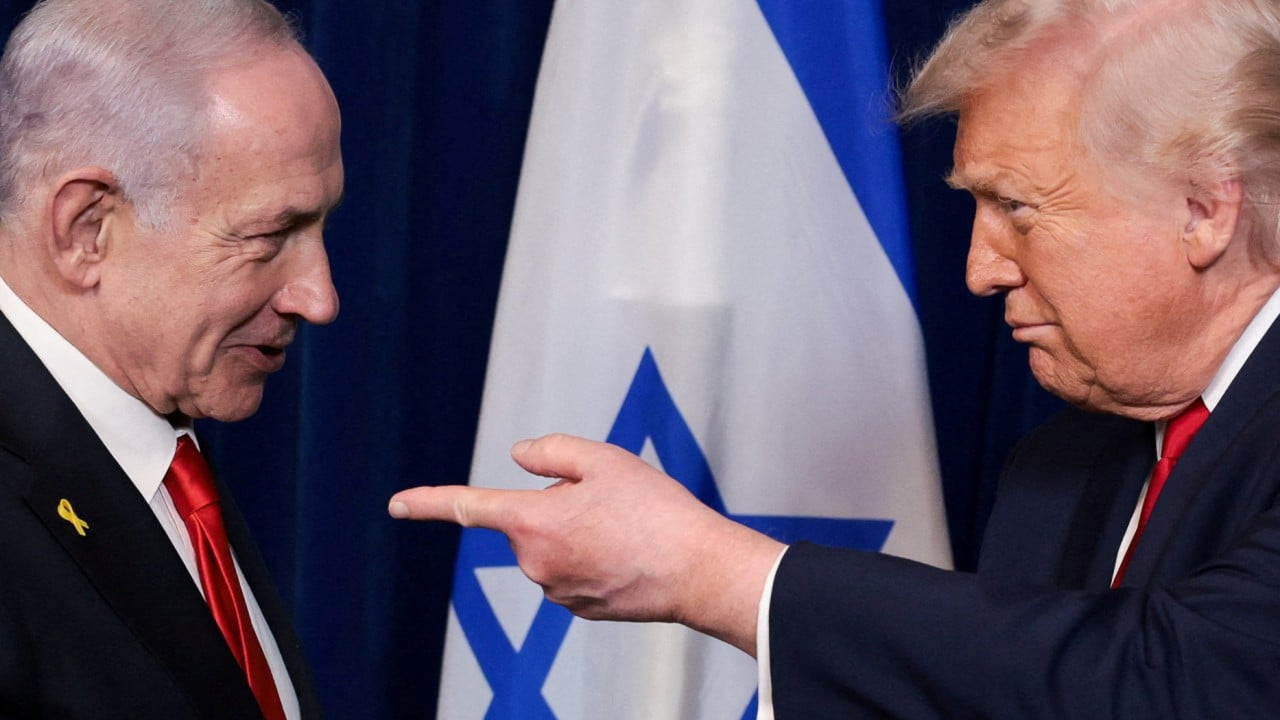
The escalation of the 2025–2026 Iran war demonstrated that the "Maximum Pressure" campaign was never a singular policy; it was a shared tactic masking fundamentally different end states. The fracture between US President Donald Trump and Israeli Prime Minister Benjamin Netanyahu is the mathematical consequence of these incompatible utility functions.
For the Trump administration, military escalation and economic sanctions serve as a kinetic prelude to leverage optimization. The US utility function prioritizes:
- The minimization of global macroeconomic shocks, specifically by reversing the 2026 Strait of Hormuz crisis and normalizing global oil flows.
- The reduction of direct US military exposure to long-term regional conflicts, favoring localized balancing.
- The extraction of explicit diplomatic concessions that can be branded as definitive, transactional victories (e.g., the physical removal of enriched uranium stockpiles).
Conversely, the Israeli utility function treats maximum pressure not as a bridge to a revised treaty, but as a mechanism for systemic degradation. Jerusalem’s strategic doctrine dictates that any diplomatic settlement leaving the clerical regime’s structural foundations intact is an existential failure. The Israeli objective requires the total dismantlement of Iran’s nuclear infrastructure, the irreversible decoupling of its regional proxy network (across Lebanon, Syria, Iraq, and Yemen), and the maintenance of absolute Israeli kinetic freedom of action.
The draft 60-day ceasefire extension and the broader peace pact introduce a permanent bottleneck for Israel. By transitioning the conflict from a kinetic theater to a multilateral diplomatic process mediated via Pakistan and Qatar, the US effectively caps the level of destruction Israel can inflict on Iranian state assets without breaking directly with Washington.
The Maritime-Nuclear Trade-Off and Iran's Sovereignty Paradox
The foundational architecture of the draft agreement rests on an economic and structural trade-off: the gradual reopening of the Strait of Hormuz and the unfreezing of restricted Iranian assets held in foreign banks, balanced against the disposal of Iran's highly enriched uranium and a formal commitment to halt nuclear weapons acquisition.
[US Economic Concessions]  --->  Unfrozen Foreign Assets + Reopened Strait of Hormuz
                                       |
                                       v
[Iranian Counter-Concessions] --->  Removal of Enriched Uranium + Frozen Nuclear Program
                                       |
                                       v
[Strategic Implication]    --->  Preservation of Iran's Sovereign Infrastructure
                                 (Direct Threat to Israel's Total-Dismantlement Goal)
This structural trade-off reveals a critical mechanism that threatens Netanyahu's long-term planning: the preservation of Iranian sovereign management over core strategic assets. Iranian state media, via the Fars News Agency, has already signaled that under the negotiated text, the Strait of Hormuz will remain under explicit Iranian administrative and military management.
This creates an immediate structural vulnerability for Israel:
- Sovereign Legitimacy Refortification: By recognizing Iran's right to manage the Strait under a internationalized framework, the pact restores Tehran’s primary economic lever. Sanctions relief and asset unfreezing provide an immediate capital injection to stabilize the domestic economy under Mojtaba Khamenei's transition, reinforcing the state's survival capacity.
- The Enrichment Irreversibility Problem: While the US demands the physical removal of highly enriched uranium from Iranian territory, the underlying technical competency, centrifuge manufacturing blueprints, and subterranean facilities (such as Fordow and Natanz) cannot be un-learned or entirely disassembled via treaty. Israel views a verified freeze as an existential pause that allows Iran to retain a breakout capability that can be reactivated at a time of its choosing.
- The Prohibition of Kinetic Intervention: A finalized US-backed peace pact creates an international legal and political umbrella over Iran. If Israel attempts to execute unilateral preventative strikes against Iranian nuclear sites during or after the implementation of this MOU, it will not merely be striking a hostile state; it will be disrupting a fragile multilateral peace framework guaranteed by Washington, Riyadh, and Islamabad.
Subverting the Abraham Accords: Forced Normalization vs. Containment
A critical, overlooked dimension of Trump’s draft pact is the reported demand made to Muslim and Arab leaders—specifically Saudi Arabia, Qatar, and Pakistan—to normalize diplomatic relations with Israel as a condition linked to the broader Iranian settlement.
On the surface, this appears to align with Netanyahu’s stated historical objective of securing a Saudi-Israeli normalization accord. However, the structural sequencing of this initiative upends the entire strategic premise of Israel's regional architecture.
The original Israeli conception of the Abraham Accords was the construction of an anti-Iran regional NATO—a hard security alliance combining Israeli kinetic capabilities, US power projection, and Gulf Arab financial-geopolitical positioning to isolate and choke the Axis of Resistance.
The draft pact flips this dynamic entirely. Instead of an alliance designed to isolate Iran, Trump is utilizing the incentive of Arab-Israeli normalization to construct a multilateral containment-by-integration matrix.
- Saudi Arabia and the UAE are shifting from active confrontation to risk mitigation. Their inclusion in the pact indicates a preference for a verified US-enforced boundary on Iranian behavior over an unpredictable, highly volatile regional war that places their domestic energy infrastructure in the line of fire.
- Qatar and Pakistan, acting as primary mediators, anchor Iran into a broader diplomatic ecosystem. Pakistan’s role as a nuclear-armed mediator provides an institutional buffer for Tehran, diluting Israel's ability to dictate terms.
Consequently, Israel finds itself isolated in its preference for continued escalation. Netanyahu’s insistence to Trump that "Israel will maintain freedom of action against threats in all arenas, including Lebanon" functions as a rhetorical defense mechanism against a closing strategic trap. While Trump has verbally reiterated support for Israel's right to self-defense, the operational reality of an active 60-day multilateral ceasefire framework makes the execution of that freedom increasingly costly.
The Strategic Play: Israel’s Hedging Options
The draft peace pact exposes the definitive limitation of Israel’s reliance on a singular ally's maximum pressure campaign. When the domestic political utility function of the United States shifts toward conflict termination and economic stabilization, Israel's total-victory doctrine loses its primary geopolitical engine.
To counter the structural constraints of the impending US-Iran MOU, Israeli strategy must pivot from attempting to veto the text to aggressively redefining the verification and kinetic enforcement parameters within the margins of the deal.
First, Israel must secure explicit, legally binding bilateral side-letters from the White House that decouple the regional ceasefire terms from the definitions of "imminent threat." Jerusalem must lock in pre-approved, non-negotiable thresholds regarding Iranian weaponization activities—such as advanced centrifuge research or missile-delivery system integration—that will trigger automatic US kinetic re-engagement, independent of the MOU's standing.
Second, Israeli intelligence must pivot its resource allocation toward uncovering structural non-compliance within the labyrinthine courier and command networks surrounding Tehran's leadership. Because internal Iranian communication vulnerabilities have slowed their institutional consensus-building, Israel can exploit these bottlenecks to expose operational violations early, systematically undermining the durability of the 60-day extension before the framework ossifies into a permanent regional reality.
The strategic divergence between Washington and Jerusalem over the future of the West Asia crisis reflects deep institutional differences in their long-term objectives. To explore these competing alignment structures further, examine Trump-Netanyahu Rift Widening Over Iran War Future?, which provides an analytical breakdown of how both leaders are pulling the conflict toward opposite geopolitical end states.